
The Milky Way and Human Health: What Space Medicine Can Teach Healthcare
The Milky Way as a Medical Frontier
How Space Research Is Advancing Human Healthcare
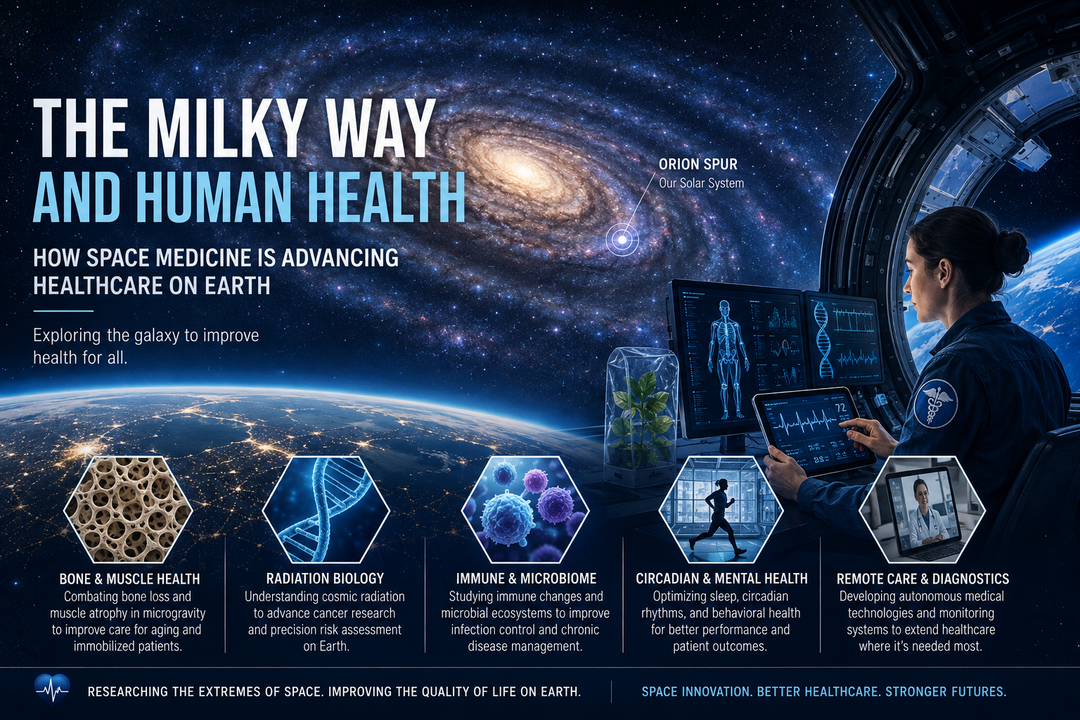
The Milky Way is more than the galaxy visible across a dark night sky. For healthcare professionals, it represents an immense natural laboratory where radiation, altered gravity, isolation, disrupted circadian rhythms, environmental confinement, and limited medical resources test the boundaries of human physiology.
Research conducted in space is helping scientists understand how the human body responds to conditions far outside Earth’s normal environment. These findings are not limited to astronaut health. They may also support advances in aging care, rehabilitation, oncology, remote diagnostics, preventive medicine, hospital-at-home programs, and care delivery in underserved communities.
Space medicine is not only about protecting astronauts. It is also about developing healthcare systems that are more predictive, portable, resilient, and accessible on Earth.
Our Place Within the Milky Way
The solar system is located within the Orion Spur, a smaller structure situated between the Sagittarius and Perseus arms of the Milky Way.
As the solar system moves through the galaxy, it takes approximately 230 to 250 million years to complete one orbit around the galactic center. Earth remains protected by several natural systems, including:
-
A breathable atmosphere
-
A stable gravitational environment
-
A planetary magnetic field
-
Relatively consistent light-and-dark cycles
-
Extensive biological and medical infrastructure
Human spaceflight reduces or removes many of these protections. This exposes the body to conditions that can accelerate physiological changes and reveal vulnerabilities that may otherwise take years to become apparent on Earth.
Spaceflight as an Accelerated Model of Human Disease
NASA categorizes the primary hazards of human spaceflight into five broad areas:
-
Space radiation
-
Altered gravity fields
-
Isolation and confinement
-
Distance from Earth
-
Closed or hostile environments
These hazards do not act independently. They interact across multiple biological systems, affecting the brain, cardiovascular system, bones, muscles, immune system, metabolism, microbiome, sleep patterns, and behavioral health.
For clinicians and biomedical researchers, this creates an unusually valuable research model. Spaceflight may reproduce certain features of aging, prolonged immobility, chronic stress, radiation exposure, sensory disruption, and environmental isolation within a compressed period.
The Space Exposome
The term space exposome describes the combined biological burden created by radiation, microgravity, confinement, altered sleep, environmental stressors, and operational demands.
Studying this combined exposure may help healthcare researchers move beyond single-variable models of disease and toward more integrated approaches to patient risk.
Precision Medicine Beyond Earth
One major development in space medicine is the expansion of multi-omic research.
The Space Omics and Medical Atlas integrates different forms of biological and clinical data, including:
-
Genomic information
-
Gene-expression patterns
-
Epigenetic changes
-
Immune-system activity
-
Metabolic markers
-
Microbiome data
-
Physiological measurements
-
Environmental exposures
This approach reflects the broader movement toward precision medicine on Earth.
Rather than treating every astronaut or patient as biologically identical, researchers can evaluate how individual differences influence:
-
Radiation sensitivity
-
Bone-density loss
-
Immune dysfunction
-
Medication response
-
Recovery time
-
Sleep disruption
-
Cardiovascular risk
The long-term objective is to develop individualized countermeasures before serious health deterioration occurs.
Bone and Muscle Loss in Microgravity
Why Gravity Matters
On Earth, bones and muscles are continuously stimulated by standing, walking, lifting, and resisting gravity.
In microgravity, the body no longer receives the same mechanical signals. As a result, astronauts may experience:
-
Reduced bone-mineral density
-
Loss of muscle mass
-
Reduced muscle strength
-
Lower endurance
-
Cardiovascular deconditioning
-
Changes in balance and coordination
These changes resemble aspects of osteoporosis, sarcopenia, prolonged bed rest, and post-hospitalization deconditioning.
Applications for Terrestrial Healthcare
Space-based musculoskeletal research may contribute to improved care for:
-
Older adults
-
Patients with limited mobility
-
Individuals recovering from surgery
-
Patients undergoing prolonged hospitalization
-
People with neuromuscular disorders
-
Patients participating in home-based rehabilitation
Potential applications include:
-
More efficient resistance-training protocols
-
Earlier biomarkers of bone deterioration
-
Personalized rehabilitation schedules
-
Improved fall-risk assessment
-
Portable strength and mobility testing
-
Pharmacologic strategies for bone preservation
Space research may also help healthcare professionals determine which combinations of exercise, nutrition, medication, and monitoring produce the strongest protective effect.
Cosmic Radiation and Human Biology
The Radiation Environment Beyond Earth
Outside Earth’s strongest protective systems, astronauts may be exposed to ionizing radiation from:
-
Galactic cosmic rays
-
Solar-particle events
-
Trapped radiation belts
-
Secondary particles generated through shielding materials
This radiation can interact with cells, DNA, blood vessels, neural tissue, and other biological structures.
NASA identifies radiation-induced cancer as a major concern for long-duration exploration missions. Researchers are also studying possible effects on:
-
Cardiovascular health
-
Central nervous system function
-
Cognitive performance
-
Immune regulation
-
Cellular aging
-
Reproductive health
-
Tissue repair
Relevance to Oncology and Radiology
Space-radiation research may support advances in:
-
Personal radiation dosimetry
-
Cancer-risk modeling
-
Radiation shielding
-
Biomarker surveillance
-
DNA-damage assessment
-
Radioprotective medications
-
Longitudinal patient monitoring
For healthcare systems, the broader lesson is that radiation exposure may require more than a single dose measurement.
A more complete clinical model could include:
-
Exposure history
-
Individual susceptibility
-
Genomic markers
-
Imaging findings
-
Blood-based biomarkers
-
Long-term health surveillance
Lessons From the NASA Twins Study
The NASA Twins Study compared astronaut Scott Kelly, who spent nearly one year aboard the International Space Station, with his identical twin, Mark Kelly, who remained on Earth.
Researchers evaluated a wide range of biological and behavioral measurements before, during, and after the mission.
Observed changes involved:
-
Gene expression
-
Immune activity
-
DNA-damage responses
-
Telomere regulation
-
Cognitive performance
-
Microbiome composition
-
Cardiovascular physiology
-
Metabolic function
Many measurements moved toward their preflight baseline after the astronaut returned to Earth. Some changes persisted longer and required continued observation.
Clinical Significance
The Twins Study demonstrated the value of longitudinal monitoring.
Instead of assessing health at only one point in time, healthcare systems may benefit from tracking changes across:
-
Baseline health
-
Active exposure
-
Early recovery
-
Long-term recovery
-
Delayed complications
This model may be relevant to radiation exposure, critical illness, surgery, chemotherapy, prolonged hospitalization, and occupational health.
Immune Function in Closed Environments
Spaceflight can alter immune regulation through the combined influence of:
-
Radiation
-
Microgravity
-
Sleep disruption
-
Psychological stress
-
Confinement
-
Altered nutrition
-
Microbial exposure
NASA monitors blood, saliva, viral activity, inflammatory markers, and microbial populations to better understand these changes.
Applications for Hospitals and Long-Term Care
This research may have implications for:
-
Hospitals
-
Nursing facilities
-
Submarines
-
Military installations
-
Remote research stations
-
Disaster-response shelters
-
Offshore medical environments
Closed environments require constant monitoring of:
-
Air quality
-
Water quality
-
Surface contamination
-
Ventilation
-
Microbial growth
-
Shared equipment
-
Human movement patterns
The clinical lesson is that environmental monitoring should be considered part of patient safety, not merely a facilities-management function.
The Microbiome as a Clinical Signal
The human microbiome may change in response to diet, stress, confinement, medication use, altered sleep, radiation, and environmental exposure.
Spaceflight research can help scientists evaluate how these factors influence:
-
Immune activity
-
Inflammation
-
Digestive health
-
Infection risk
-
Metabolic stability
-
Medication response
Future healthcare systems may combine microbiome information with environmental and clinical data to identify early signs of physiological stress.
However, microbiome findings should be interpreted carefully. Individual variation is substantial, and many proposed interventions still require stronger clinical validation.
Circadian Health and Healthcare Operations
The Challenge of Biological Time
Human physiology is regulated by internal circadian rhythms. These rhythms influence:
-
Sleep
-
Hormone secretion
-
Body temperature
-
Metabolism
-
Alertness
-
Immune activity
-
Medication response
Space missions can disrupt these systems through irregular schedules, artificial lighting, operational demands, and rapidly changing environmental cues.
Relevance to Healthcare Professionals
Circadian disruption is also common among:
-
Physicians
-
Nurses
-
Emergency personnel
-
Laboratory professionals
-
Transport teams
-
Overnight caregivers
-
Rotating-shift workers
Chronic sleep loss and circadian misalignment may contribute to:
-
Reduced attention
-
Slower decision-making
-
Metabolic dysfunction
-
Mood changes
-
Increased error risk
-
Impaired recovery
Space-Derived Countermeasures
Space-medicine strategies include:
-
Carefully timed lighting
-
Protected sleep periods
-
Fatigue monitoring
-
Structured work-rest cycles
-
Individualized sleep assessment
-
Strategic scheduling of demanding tasks
Hospitals may apply similar principles to reduce fatigue-related risk and improve workforce health.
Autonomous Diagnostics and Care at a Distance
Healthcare Without Immediate Backup
A crew traveling far from Earth cannot rely on immediate evacuation or continuous real-time communication with specialists.
Medical systems must therefore be:
-
Compact
-
Reliable
-
Durable
-
Easy to operate
-
Resource-efficient
-
Capable of supporting autonomous decisions
This requirement has driven research into portable diagnostics and remote patient-management systems.
Technologies With Earth-Based Applications
Space-derived or space-supported technologies may include:
-
Wearable biosensors
-
Portable ultrasound
-
Point-of-care laboratory testing
-
Remote cardiac monitoring
-
Environmental sensors
-
Artificial-intelligence decision support
-
Secure digital health records
-
Compact imaging systems
-
Automated early-warning systems
These tools may be especially valuable in:
-
Rural communities
-
Disaster zones
-
Military environments
-
Ambulances
-
Home-health programs
-
Long-term care facilities
-
Underserved regions
Remote Monitoring From Space to the Hospital-at-Home
Human spaceflight has relied on remote physiological monitoring since the earliest crewed missions.
Mission-control teams have monitored variables such as:
-
Heart rate
-
Respiratory activity
-
Body temperature
-
Blood pressure
-
Oxygenation
-
Sleep patterns
-
Physical activity
-
Cognitive performance
Modern healthcare systems increasingly use similar models through connected devices and virtual-care platforms.
Potential Clinical Benefits
Remote monitoring may support:
-
Earlier detection of deterioration
-
Fewer unnecessary hospital visits
-
Improved chronic-disease management
-
Better post-discharge follow-up
-
Continuous rehabilitation assessment
-
Faster escalation of care
The most effective systems should support clinicians rather than replace them.
Artificial intelligence and automation may help identify abnormal trends, but final decisions must remain grounded in clinical judgment, validated data, and appropriate oversight.
Behavioral Health, Isolation, and Team Performance
Long-duration missions expose crews to confinement, limited privacy, communication delays, interpersonal stress, and separation from family.
These conditions may influence:
-
Mood
-
Sleep
-
Cognitive performance
-
Team cohesion
-
Motivation
-
Conflict management
-
Decision-making
Space agencies study crew selection, behavioral monitoring, workload distribution, communication, and psychological support.
Applications on Earth
This research may benefit:
-
Remote healthcare teams
-
Intensive-care personnel
-
Disaster-response workers
-
Polar research crews
-
Military medical units
-
Long-term care staff
-
Clinicians working under sustained crisis conditions
Behavioral health should be understood as an operational safety issue, not only as an individual wellness concern.
Medical Supply Chains in Extreme Environments
Space missions must carefully control every medical resource carried aboard a spacecraft.
Constraints may include:
-
Limited storage
-
Weight restrictions
-
Product expiration
-
Temperature sensitivity
-
Sterility requirements
-
Packaging durability
-
Limited replacement options
-
Communication delays
These conditions make medical inventory management a critical mission function.
Lessons for Healthcare Supply Chains
Space-medicine logistics may help improve:
-
Emergency stockpiling
-
Remote-clinic inventory planning
-
Expiration tracking
-
Cold-chain monitoring
-
Sterile-storage systems
-
Predictive resupply
-
Equipment standardization
-
Medical-device maintenance
A resilient healthcare system must know what supplies are available, where they are located, whether they remain usable, and how quickly they can reach the patient.
Ethical and Clinical Boundaries
The healthcare relevance of the Milky Way does not come from astrology or unsupported claims that distant stars directly control human health.
Its medical importance comes from the real physical environments encountered beyond Earth.
These environments include:
-
Ionizing radiation
-
Altered gravity
-
Closed habitats
-
Limited clinical infrastructure
-
Delayed communication
-
Restricted supplies
-
Psychological isolation
Any clinical application derived from space research must still undergo appropriate validation, regulatory review, risk assessment, and evidence-based evaluation before widespread use.
What Healthcare Professionals Can Learn From Space Medicine
Space medicine demonstrates several principles that are increasingly important in modern healthcare.
1. Establish a Strong Baseline
Changes are easier to interpret when a patient’s normal physiology is understood before illness or exposure occurs.
2. Monitor Continuously
A trend developing over time may be more informative than a single laboratory value or isolated examination.
3. Integrate Multiple Data Sources
Genomic, clinical, environmental, behavioral, and physiological information may provide a more complete view of patient risk.
4. Detect Deterioration Early
Portable diagnostics and connected monitoring systems can help identify problems before they become emergencies.
5. Design for Limited Resources
Healthcare technologies should remain usable when staffing, power, supplies, transportation, or specialist access are constrained.
6. Treat the Environment as Part of Care
Air, water, lighting, microbial exposure, temperature, noise, and workflow can directly influence health outcomes.
7. Personalize Countermeasures
Different individuals may respond differently to the same exposure, treatment, or rehabilitation program.
The Future of Medicine Across the Milky Way
As future missions travel farther from Earth, crews will require greater medical independence.
Research priorities are likely to include:
-
Personalized radiation-risk prediction
-
Regenerative medicine
-
Compact imaging platforms
-
Autonomous clinical decision support
-
Closed-loop medication management
-
Continuous molecular monitoring
-
Portable surgical systems
-
Behavioral-health support
-
Advanced rehabilitation technologies
-
Artificial-gravity countermeasures
Many of these systems may eventually reach terrestrial healthcare before they become routine in deep space.
The same technologies designed to protect astronauts could support patients who are:
-
Geographically isolated
-
Recovering at home
-
Living with chronic disease
-
Working in hazardous environments
-
Unable to access specialists
-
Affected by disasters or infrastructure failures
Conclusion
The Milky Way may be vast, but the medical challenges it presents are deeply human.
Space medicine asks a practical question:
How can human health be protected when gravity, radiation, medical staffing, infrastructure, communication, and supply chains are fundamentally different from those of a modern hospital?
Answering that question is already contributing to research in oncology, rehabilitation, immune monitoring, behavioral health, circadian medicine, remote diagnostics, environmental safety, and connected care.
By learning how to protect a small crew far from conventional medical support, researchers may develop better ways to protect patients here on Earth.
The Milky Way is therefore not only an astronomical destination. It is a medical frontier that may help shape the future of human healthcare.
Key Takeaways
-
Spaceflight creates an accelerated model for studying physiological stress.
-
Microgravity research may benefit osteoporosis, rehabilitation, and aging care.
-
Cosmic-radiation studies may improve dosimetry and cancer-risk assessment.
-
Space-based monitoring supports the growth of remote and home-based healthcare.
-
Circadian research may help reduce fatigue-related errors among healthcare workers.
-
Closed-environment studies may improve infection control and environmental safety.
-
Space logistics may strengthen medical supply chains in remote and emergency settings.
-
Precision space medicine may support more individualized healthcare on Earth.
References
-
National Aeronautics and Space Administration. The Human Body in Space. NASA Human Research Program.
-
National Aeronautics and Space Administration. Hazards of Human Spaceflight. NASA Human Research Program.
-
National Aeronautics and Space Administration. Risk of Spaceflight-Induced Bone Changes.
-
National Aeronautics and Space Administration. Risk of Radiation-Induced Cancer From Space Radiation.
-
National Aeronautics and Space Administration. NASA Twins Study Results Published in Science.
-
NASA Science. Solar System Facts and the Solar System’s Location Within the Milky Way.
-
NASA Biological and Physical Sciences. Microgravity-Associated Bone Loss Research.
-
NASA Spinoff. Extraterrestrial Medical Diagnostics and Point-of-Care Technologies.
-
NASA Spinoff. Remote Physiological Monitoring Technologies Derived From Human Spaceflight.
-
National Aeronautics and Space Administration. Risk From Inadequate Sleep and Irregular Work Schedules.
-
Nature. Space Omics and Medical Atlas Research Supporting Precision Space Medicine.
Truway Health News & Insights
The Guidewire Is Not a Commodity: The Hidden Safety Architecture of Coronary Care
How precision engineering, clinical intelligence, and medical-device traceability are redefining exp...

Truth Social Suspends @truwayhealth Without Explanation: Truway Health Challenges Digital Censorship and Demands Accountability
October 9, 2026 | Truway Health News & Insights NEW YORK, NY — Truway Health, Inc. is formally chall...

The Stethoscope Standard: Rethinking the Value of U.S. M1 Through Medical Productive Capacity
Money ultimately derives much of its usefulness from confidence: confidence that a dollar can be exc...

Simple Steps for Seniors to Embrace Healthy and Joyful Living
For seniors seeking holistic wellness, healthy aging can feel harder than it should: the body change...

Healthcare Procurement Readiness: Building a More Resilient Clinical Supply Chain
Healthcare supply chains are often judged by a simple question: Did the product arrive? But for hosp...

Pass-Through Chambers and Material Flow in Controlled Healthcare Environments
Controlled healthcare environments depend on more than clean surfaces and filtered air. The way mate...