
Medical Supply Case-Pack Economics: How Bulk Purchasing Reduces Healthcare Procurement Costs
Understanding the Economics Behind Medical Supply Purchasing
In today's healthcare environment, controlling procurement expenses without compromising clinical quality is essential for hospitals, outpatient clinics, laboratories, long-term care facilities, and independent medical practices.
One of the most frequently overlooked opportunities for improving purchasing efficiency is case-pack economics: the relationship between product packaging quantities, per-unit acquisition costs, shipping, inventory requirements, and total operating expenses.
At Truway Health, Inc., we recognize that effective healthcare procurement involves more than finding the lowest advertised price. It requires understanding the complete cost of acquiring, receiving, storing, and using medical supplies.
Whether purchasing examination gloves, syringes, wound care products, diagnostic accessories, or other medical consumables, selecting the appropriate purchasing unit can meaningfully affect operating budgets.
1. What Are Medical Supply Case Packs?
A case pack is a standardized packaging configuration containing a specified number of individual units, boxes, or smaller packages.
Medical supplies are commonly distributed through several purchasing units:
-
EA — Each: One individual item or manufacturer-defined sales unit.
-
BX — Box: A package containing multiple individual units.
-
CS — Case: A larger package containing a fixed number of boxes or individual products.
-
PL — Pallet: A consolidated shipment containing multiple cases.
For example, medical examination gloves may be distributed as:
| Packaging | Quantity |
|---|---|
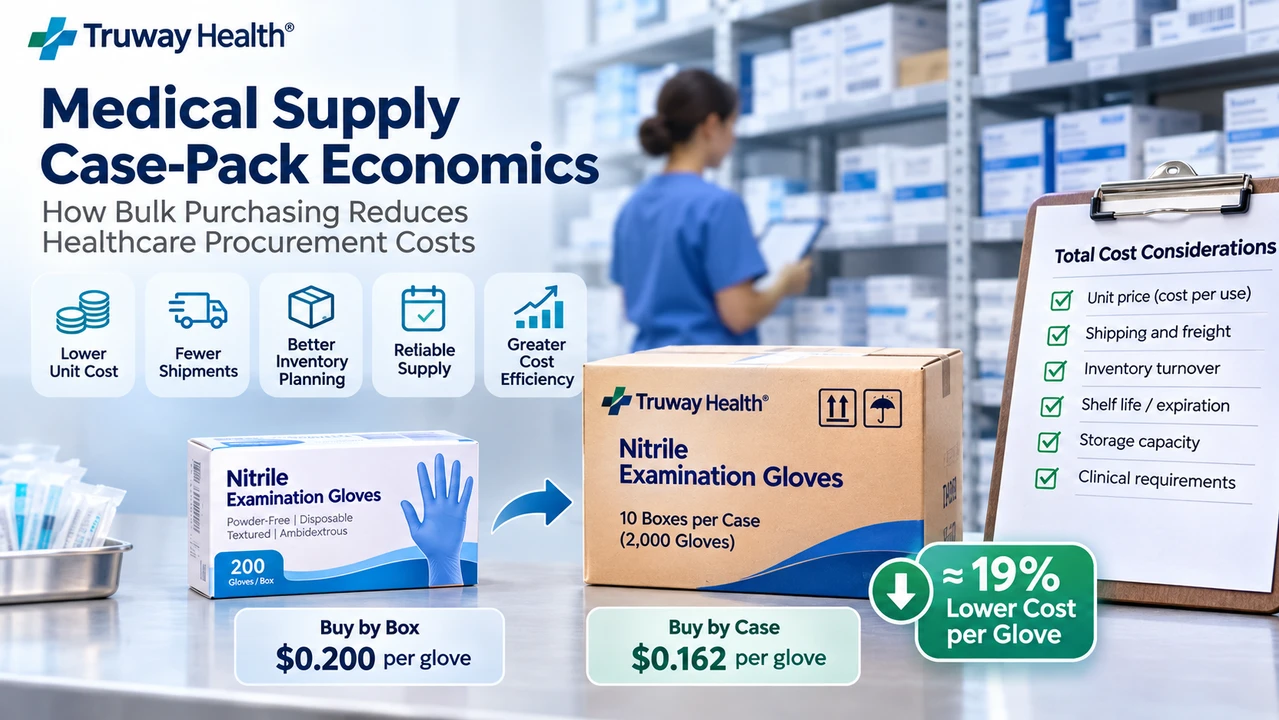
| Individual dispenser box | 200 gloves |
| Full case | 10 boxes |
| Total case quantity | 2,000 gloves |
This configuration is not universal. Some larger glove sizes contain 180 gloves per box and 1,800 gloves per case.
Understanding the precise unit of measure prevents ordering errors, inventory discrepancies, and misleading supplier price comparisons.
2. Why Cost Per Unit Matters More Than Case Price
A common procurement mistake is comparing the advertised prices of cases without accounting for the number of usable units contained within each package.
The fundamental cost-per-unit calculation is:
Unit Cost = Total Acquisition Cost ÷ Total Units Purchased
Consider the following hypothetical purchasing scenario for examination gloves.
| Cost component | 10 boxes | 1 case |
|---|---|---|
| Total gloves | 2,000 | 2,000 |
| Product cost | $380.00 | $300.00 |
| Estimated shipping | $20.00 | $24.00 |
| Total landed cost | $400.00 | $324.00 |
| Cost per glove | $0.200 | $0.162 |
Illustrative pricing only. These figures are not current Truway Health quotations.
By purchasing a full case instead of ten separately priced boxes, the facility achieves:
Total Savings = $400 − $324 = $76
Savings Percentage = ($76 ÷ $400) × 100 = 19%
For a healthcare organization consuming 100,000 examination gloves annually, a sustained $0.038 reduction in cost per glove would represent approximately $3,800 in annual savings, assuming comparable supply conditions and utilization.
The principle extends across numerous categories of medical supplies.
3. Understanding Total Landed Cost
Purchase price represents only one component of medical supply economics.
A more complete procurement analysis examines the total landed cost: the expenses required to deliver products into usable inventory.
A simplified equation is:
Total Landed Cost = Product Price + Freight + Applicable Taxes and Duties + Receiving Costs + Other Direct Acquisition Fees
Relevant expenses may include freight surcharges, insurance, customs duties for imported products, receiving labor, and handling fees.
Bulk packaging can reduce some of these expenses through shipment consolidation. However, larger cases do not automatically guarantee cheaper freight.
Package dimensions, shipment weight, carrier pricing, delivery location, and handling requirements can all influence actual transportation costs.
The correct comparison is the delivered cost per usable unit, not simply the supplier's advertised price.
4. Inventory Turnover and the Hidden Cost of Overstocking
Buying in bulk can improve acquisition pricing, but excessive inventory can create additional financial and operational burdens.
Healthcare facilities must balance volume discounts against:
-
Warehouse and storage capacity.
-
Product expiration dates.
-
Inventory financing and working capital.
-
Damage, deterioration, and obsolete stock.
-
Changes in patient demand.
-
Clinical product standardization.
-
Product recalls and manufacturer substitutions.
For example, a practice using only 300 gloves per month may require more than six months to consume a 2,000-glove case.
Although bulk purchasing might offer a lower unit price, that decision should be evaluated against storage conditions, inventory cash requirements, and anticipated demand.
The optimal order quantity is not necessarily the largest available case pack. It is the quantity that minimizes total cost while maintaining sufficient clinical availability.
5. The Mathematics of Inventory Replenishment
Procurement teams can use straightforward calculations to determine when additional medical supplies should be ordered.
Average Daily Consumption
ADC = Total Units Consumed ÷ Number of Days
If a facility uses 6,000 examination gloves over 30 days:
ADC = 6,000 ÷ 30 = 200 gloves per day
Reorder Point
A basic replenishment formula is:
Reorder Point = (Average Daily Consumption × Supplier Lead Time) + Safety Stock
Assume:
-
Average daily consumption: 200 gloves
-
Supplier lead time: 7 days
-
Safety stock: 400 gloves
Reorder Point = (200 × 7) + 400
Reorder Point = 1,800 gloves
Under these assumptions, the facility should initiate replenishment when its inventory position reaches approximately 1,800 gloves.
In practice, organizations should adjust safety-stock levels for demand variability, supplier reliability, backorders, and clinical criticality.
6. Case-Pack Economics Across Medical Supply Categories
Case-pack analysis becomes particularly valuable when applied to frequently replenished products.
| Product category | Key economic consideration |
|---|---|
| Examination gloves | Cost per glove, size distribution, consumption |
| Syringes and needles | Sterility, packaging, unit cost, shelf life |
| Wound care dressings | Cost per dressing, clinical suitability, utilization |
| Antiseptics and skin protectants | Container size, application frequency, expiration |
| Patient hygiene products | Cost per wipe, pack quantity, consumption |
| Diagnostic disposables | Device compatibility, packaging, usable units |
Importantly, products must be clinically equivalent before price comparisons are treated as meaningful.
A lower-cost supply that fails to meet the intended clinical requirements may increase waste, require substitutions, or introduce unacceptable operational risk.
7. Standardization, Traceability, and Procurement Accuracy
Healthcare procurement teams should maintain consistent product identification records across purchasing, inventory, and distribution systems.
Important identifiers may include:
SKU: Supplier-specific stock-keeping unit.
MPN: Manufacturer part number.
GTIN: Global Trade Item Number identifying a trade item or packaging configuration.
UDI: Unique Device Identifier used for applicable regulated medical devices.
Lot Number: Manufacturer-assigned production lot or batch identifier.
Expiration Date: Date through which a product is designated as suitable for use under stated conditions.
Appropriate identification supports inventory accuracy, product traceability, and recall management.
For medical devices subject to U.S. FDA Unique Device Identification requirements, device labels and packages generally require appropriate identifiers, subject to regulatory exceptions and alternatives.
Buyers should also distinguish a product's sales-unit identifier from its case or packaging-level identification.
8. Five Strategies to Improve Medical Supply Purchasing Efficiency
1. Normalize unit pricing. Convert every supplier quotation into a comparable cost per glove, syringe, dressing, package, or other appropriate unit of measure.
2. Evaluate freight before selecting packaging. Compare shipping expenses at the box, case, and consolidated-order level.
3. Measure product consumption. Use actual utilization data to determine appropriate purchasing volumes instead of relying exclusively on historical order quantities.
4. Monitor product shelf life and storage requirements. Avoid bulk-purchasing quantities that cannot reasonably be used before expiration.
5. Establish inventory reorder thresholds. Maintain appropriate safety stock while limiting unnecessary capital tied up in stored medical supplies.
These practices help purchasing teams evaluate suppliers more consistently and make informed replenishment decisions.
9. How Truway Health Supports Smarter Medical Supply Procurement
Truway Health, Inc. supplies medical equipment, clinical consumables, diagnostic products, and healthcare essentials for individual and institutional purchasing needs.
Our product catalog includes items available in individual and bulk packaging configurations, allowing healthcare purchasers to evaluate the appropriate quantities for their operations.
For example, our Medline AloeTouch ICE Powder-Free Nitrile Examination Gloves are listed in box and case configurations across multiple glove sizes.
Purchasers should review the exact product specifications, packaging quantity, shipping charges, and availability before ordering.
By comparing quantities and the full delivered cost, healthcare organizations can better align their purchasing decisions with budgetary and patient-care requirements.
Conclusion: Procurement Efficiency Begins With Better Unit Economics
Medical supply case-pack economics is fundamentally about making every purchasing dollar work more effectively.
A lower price per case does not necessarily mean a lower total cost. Effective purchasing decisions consider unit quantity, shipping, inventory turnover, storage requirements, product suitability, and operational reliability.
For healthcare organizations facing growing cost pressures, even modest improvements in recurring supply purchases can produce measurable annual financial benefits.
The objective is simple: purchase the right medical supplies, in the right quantities, at the lowest sustainable total cost—without compromising clinical requirements.
Explore Medical Supplies at Truway Health
Discover medical consumables, healthcare equipment, and professional clinical supplies at TruwayHealth.com.
Compare available packaging options, review manufacturer specifications, and identify products that fit your organization's purchasing requirements.
References and Further Reading
Disclaimer: Financial illustrations are hypothetical and provided for procurement education. Actual costs, product availability, packaging configurations, and savings depend on the selected products, suppliers, shipping terms, and operational conditions.
Truway Health News & Insights

Medical Supply Case-Pack Economics: How Bulk Purchasing Reduces Healthcare Procurement Costs
Understanding the Economics Behind Medical Supply Purchasing In today's healthcare environment, cont...

The 72-Hour Warning Window: What Biomarkers Can Tell Us About Clinical Deterioration
Introduction: Can the Human Body Signal an Emergency Before It Happens? What if healthcare professio...

Healthcare Equipment Interoperability: Understanding DICOM, HL7, and FHIR
Truway Health | Medical Technology, Digital Infrastructure & Healthcare Innovation Modern medical eq...

Medical-Grade Stainless Steel: Comparing 304 and 316 for Healthcare Equipment
Truway Health | Medical Equipment, Materials Engineering & Healthcare Procurement Not all stainless...

Winter Respiratory Season Preparedness: Essential Supplies for Caregivers and Clinics
Published October 18, 2026 | Truway Health News & Insights When respiratory illnesses rise, preparat...

What Families Should Know When a Loved One Enters Hospice Care
For families with a terminally ill loved one, the start of hospice can land like two realities at on...