
When Devices Begin to Think: The Next Era of Intelligent Medical Equipment
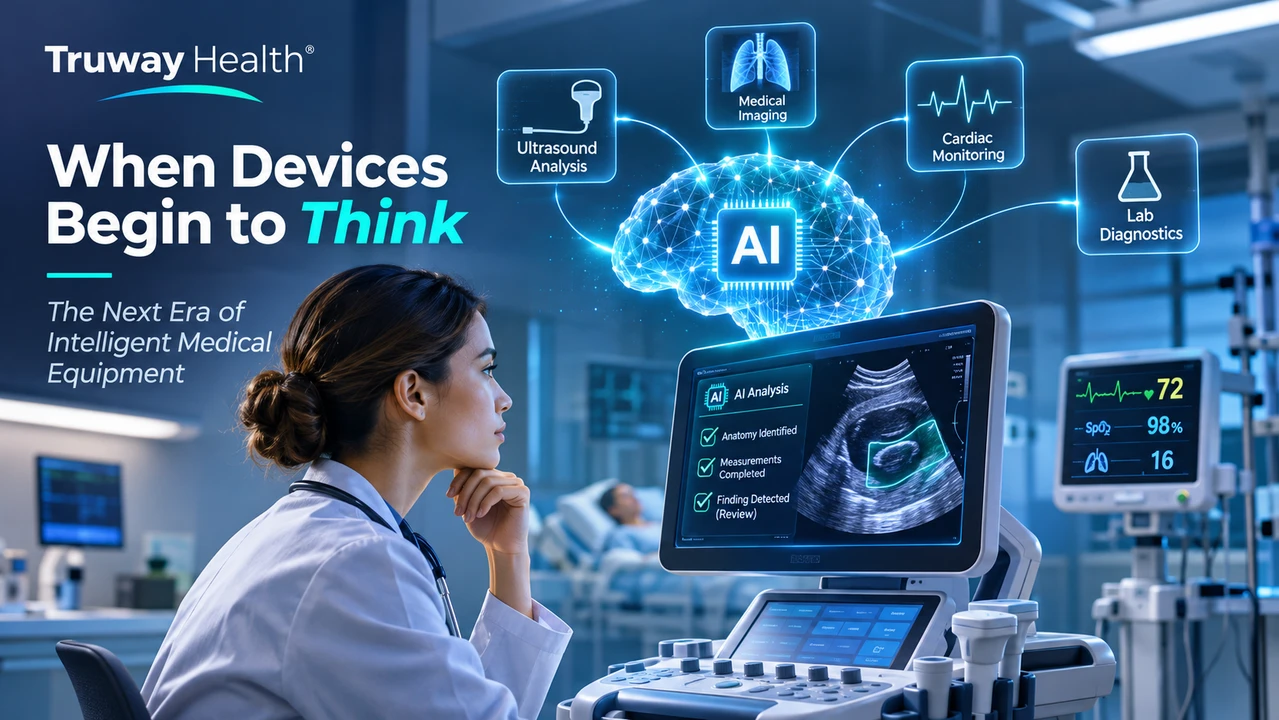
The Machine Is No Longer Just Measuring. It Is Interpreting.
For generations, medical equipment performed a relatively straightforward function: measure a physiological signal, capture an image, display a reading, or deliver a precisely controlled intervention.
A traditional ultrasound system generated images. An electrocardiograph recorded electrical activity. A laboratory analyzer quantified biological samples.
Interpretation largely remained a separate human responsibility.
Today, that distinction is beginning to change.
A new generation of medical technologies can identify patterns, estimate probabilities, recognize anatomical structures, and assist with the prioritization of clinical findings. Some systems analyze complex physiological information in seconds, helping healthcare professionals focus attention where it may be needed most.
Medical equipment is evolving from passive instrumentation toward intelligent clinical assistance.
But an important distinction remains: a machine that analyzes information is not necessarily a machine that understands medicine.
The future of intelligent healthcare depends on knowing the difference.
1. From Measurement to Machine Intelligence
The fundamental innovation is not simply the addition of artificial intelligence to existing equipment. It is the integration of computational interpretation into the medical measurement process.
Consider the difference between conventional instrumentation and an AI-enabled diagnostic system.
A conventional device might record a waveform and display the resulting measurements. An AI-enabled system may also evaluate characteristics of that waveform against patterns learned during development, generating an additional classification, estimate, or alert.
These capabilities emerge from several complementary technologies:
-
Machine learning: Algorithms trained to recognize statistical relationships within data.
-
Computer vision: Computational analysis of medical images and anatomical features.
-
Signal processing: Extraction of meaningful information from electrical, acoustic, optical, and physiological measurements.
-
Predictive analytics: Estimation of outcomes or conditions based on validated input variables.
-
Multimodal data integration: Combining information from several sources to support a more comprehensive interpretation.
Together, these technologies are changing how clinical information is acquired, processed, and presented.
Importantly, not every AI-enabled medical device continuously learns after deployment. Many operate using fixed models, with updates managed through controlled development and regulatory processes.
2. The Rise of Intelligent Diagnostic Equipment
Artificial intelligence is already influencing multiple categories of medical technology.
Ultrasound: From Images to Guided Interpretation
Ultrasound systems have traditionally depended heavily on operator technique and clinical experience.
AI-assisted capabilities can support image acquisition, anatomical identification, automated measurements, and standardized analysis.
In appropriate applications, these features may reduce certain repetitive tasks and improve consistency. However, performance still depends on imaging conditions, system validation, the intended clinical use, and operator judgment.
The opportunity is not to eliminate skilled sonographers or physicians, but to equip them with more effective analytical tools.
Cardiovascular Monitoring: Finding Patterns in Complex Signals
An electrocardiogram produces electrical information about cardiac activity.
Computational models can analyze waveform characteristics, identify certain patterns, and generate decision-support information for specifically validated applications.
Yet an algorithmic prediction is not equivalent to a confirmed diagnosis. Clinical context, additional testing, and professional evaluation remain essential.
Medical Imaging: A Second Analytical Perspective
In radiology, AI-enabled software can assist with tasks such as image reconstruction, anatomical segmentation, detection support, and examination prioritization.
These systems may help make certain workflows more efficient, but automated findings require careful interpretation.
The objective is to strengthen the diagnostic process rather than create an illusion of certainty.
3. An Important Milestone: More Than 1,600 AI-Enabled Medical Devices
The scale of this transformation is increasingly visible in regulatory records.
According to the U.S. Food and Drug Administration, more than 1,600 AI-enabled medical devices had been authorized for marketing in the United States as of September 2026.
These technologies span imaging, cardiovascular applications, neurological assessment, and other medical specialties.
The number illustrates how quickly intelligent medical technology is expanding beyond experimental development into regulated healthcare applications.
However, FDA authorization does not mean that every device has demonstrated better patient outcomes in every clinical setting.
Authorization applies to particular intended uses, supported by the applicable regulatory review.
That distinction is critical for healthcare buyers, manufacturers, and clinicians evaluating new technologies.
4. Can Medical Devices Actually Think?
The phrase intelligent medical equipment is compelling, but it deserves scientific precision.
Present-day AI-enabled medical devices do not inherently possess consciousness, clinical intuition, or independent medical understanding.
Instead, they perform computational operations that may include classification, pattern recognition, statistical inference, and decision support.
A system may recognize a potentially abnormal image pattern without understanding the patient's full medical history.
It may calculate a risk score without establishing the cause of the underlying condition.
And it may produce a highly confident result that is nevertheless incorrect.
Computational confidence should never be confused with clinical certainty.
This is one of the most important principles in responsible medical AI deployment.
The strongest systems will be those that communicate both their capabilities and their limitations clearly.
5. The Next Frontier: Multimodal Physiological Intelligence
One particularly promising research direction involves combining several categories of biological information into a coordinated analytical framework.
Imagine a monitoring environment in which cardiovascular signals, respiratory activity, movement, temperature, and other measurements are evaluated together.
Instead of considering each reading in isolation, computational models could examine patterns across several physiological systems and over time.
This creates opportunities to investigate important scientific questions.
Can interactions between different physiological signals provide earlier indications of deterioration?
Can longitudinal monitoring distinguish normal biological variation from clinically meaningful change?
Can computational models identify useful patterns without producing excessive false alerts?
These questions are scientifically significant, but their answers require carefully designed studies and independent validation.
A digital representation of human physiology should not be mistaken for a complete or fully accurate simulation of the human body.
The biological complexity of disease, recovery, and individual variation remains far greater than any current computational model can fully represent.
6. The Hidden Challenges of Intelligent Equipment
As medical devices become increasingly software-dependent, several challenges deserve attention.
Algorithmic bias: A model developed using limited or unrepresentative data may perform differently across patient populations.
Data quality: Inaccurate measurements, poor image quality, or incomplete records can compromise computational outputs.
Model drift: Changes in patient populations, equipment, clinical workflows, or incoming data can affect performance over time.
Cybersecurity: Connected devices require appropriate safeguards, vulnerability management, and secure software maintenance.
Human factors: Poorly designed alerts or opaque outputs may encourage inappropriate reliance on automation.
Lifecycle management: Software changes must be evaluated and controlled to maintain safety and effectiveness.
The FDA's August 2025 final guidance on predetermined change control plans addresses how manufacturers can prospectively plan certain AI-related device modifications. Its February 2026 cybersecurity guidance also emphasizes risk management for connected medical technologies.
These considerations make one principle increasingly important: intelligent equipment must be evaluated throughout its useful life, not merely at the point of purchase.
7. What Healthcare Buyers Should Demand
Purchasing intelligent medical equipment requires more than comparing specifications, display resolution, processor speeds, or advertised AI features.
Healthcare organizations should establish whether the technology is appropriate for its proposed clinical application.
Key procurement considerations include:
-
Regulatory status: Is the device authorized for the specific intended use?
-
Clinical evidence: Has the AI function been adequately validated, including in relevant patient populations?
-
Transparency: Can users understand what the output represents and when it may be unreliable?
-
System compatibility: Can the equipment integrate with existing clinical infrastructure?
-
Cybersecurity: Are secure updates, vulnerability management, and manufacturer support available?
-
Lifecycle economics: What are the costs of licensing, maintenance, calibration, software support, and eventual replacement?
These factors help distinguish useful medical innovation from marketing language.
The real value of intelligent equipment should be assessed through measurable performance, operational reliability, and clinically meaningful benefit.
8. The Truway Health Perspective: Intelligence Must Serve Clinical Purpose
At Truway Health, the evolution of medical equipment presents an important opportunity to connect technological innovation with practical healthcare needs.
Equipment selection should not be driven by novelty alone.
A sophisticated system must still satisfy fundamental requirements for measurement reliability, usability, safety, documentation, and long-term operational support.
Artificial intelligence adds another layer of responsibility.
Healthcare organizations must evaluate not only whether equipment can generate information, but whether that information can be used appropriately and reliably.
The next generation of medical technology should support stronger clinical workflows, more transparent decision-making, and better-informed equipment procurement.
Innovation is most valuable when scientific capability, clinical responsibility, and operational reliability advance together.
9. Looking Ahead: The Intelligent Clinical Environment
The future of medical equipment may be defined less by individual devices and more by how well those devices function as parts of a coordinated clinical system.
Diagnostic imaging, patient monitoring, laboratory information, and electronic health records may increasingly contribute to integrated analytical workflows.
Such systems could help clinicians identify relevant changes, interpret trends, and prioritize follow-up.
But the transition will require more than computational capability.
It will require high-quality data, validated performance, interoperability, meaningful human oversight, and a durable commitment to patient safety.
The central question is no longer simply whether a medical device can incorporate artificial intelligence.
It is whether that intelligence can provide dependable clinical value.
Conclusion: The Future Is Not Just Smarter Equipment
Medical devices are entering an era in which measurements and computational interpretation can increasingly occur within the same technological environment.
This represents an important change in the history of healthcare instrumentation.
Yet the most advanced medical device is not necessarily the one with the most algorithms.
It is the one that performs its intended function reliably, communicates its limitations, integrates effectively into clinical practice, and supports better-informed decisions.
When devices begin to think, healthcare must become even more deliberate about how that intelligence is used.
The future belongs not simply to intelligent machines, but to intelligent healthcare systems built around human judgment, scientific validation, and patient safety.
Explore Medical Technology With Truway Health
Truway Health, Inc. continues to examine developments in medical equipment, healthcare technology, clinical research, and supply-chain innovation.
Visit TruwayHealth.com to explore medical products, industry insights, and emerging developments in healthcare technology.
Disclaimer: This article is intended for general educational and industry information. It does not constitute medical advice or imply that any particular product offered by Truway Health includes AI capabilities or has FDA authorization.
References
-
U.S. FDA — Predetermined Change Control Plans for AI-Enabled Device Software (August 2025)
-
World Health Organization — Ethics and Governance of AI for Health
Truway Health News & Insights

Beyond the Lead Apron: Modern Shielding Strategies in Digital Dental Radiography
The Evolution of Radiation Protection For decades, the lead apron became one of the most recognizabl...
Digital Dentistry's Quiet Revolution: How Intraoral Sensors Are Transforming Imaging
The Smallest Devices Are Often Behind the Biggest Changes Not every revolution in healthcare arrives...
When Devices Begin to Think: The Next Era of Intelligent Medical Equipment
The Machine Is No Longer Just Measuring. It Is Interpreting. For generations, medical equipment perf...

Medical Supply Case-Pack Economics: How Bulk Purchasing Reduces Healthcare Procurement Costs
Understanding the Economics Behind Medical Supply Purchasing In today's healthcare environment, cont...

The 72-Hour Warning Window: What Biomarkers Can Tell Us About Clinical Deterioration
Introduction: Can the Human Body Signal an Emergency Before It Happens? What if healthcare professio...
Healthcare Equipment Interoperability: Understanding DICOM, HL7, and FHIR
Truway Health | Medical Technology, Digital Infrastructure & Healthcare Innovation Modern medical eq...