
Healthcare's Last Mile: Why Medical Delivery Reliability Matters More Than Ever
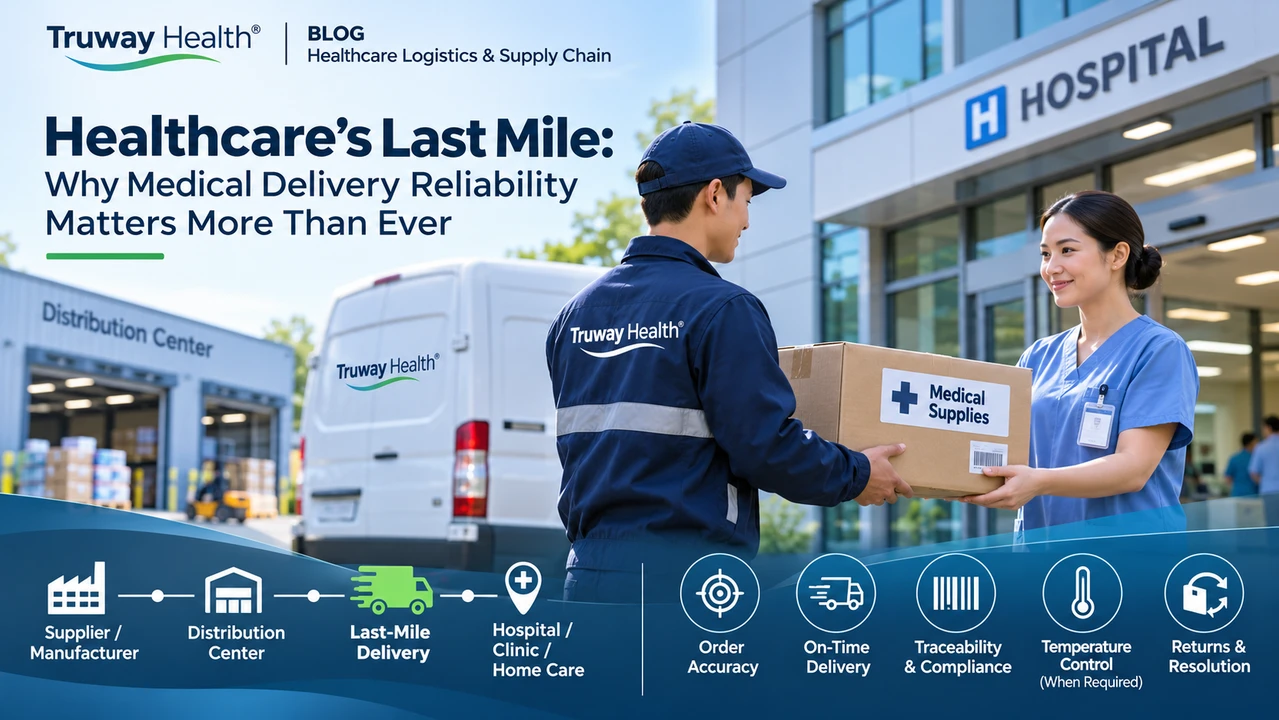
Healthcare Doesn't Stop at the Warehouse
In modern healthcare, a medical product's value is not determined solely by its design, manufacturing quality, or clinical purpose. Its value also depends on whether it reaches the right destination, in the correct condition, at the moment it is needed.
A shipment of examination gloves delayed at a distribution hub, a catheter delivered in the wrong size, or a diagnostic component arriving after a scheduled procedure can disrupt an otherwise carefully coordinated healthcare operation.
These challenges reveal one of the most important elements of healthcare infrastructure: the last mile of medical distribution.
The last mile represents the final stage of a product's journey from a distribution center, supplier, or fulfillment facility to its intended recipient. In healthcare, that destination may be a hospital, outpatient clinic, nursing facility, laboratory, or patient's home.
Unlike conventional consumer shipping, healthcare delivery can involve specialized product specifications, strict handling requirements, limited inventory reserves, and time-sensitive clinical needs.
As healthcare services become increasingly decentralized, the ability to deliver medical supplies accurately and consistently is becoming a fundamental measure of supply chain performance.
1. The Last Mile Is a Critical Link in Patient Care
Healthcare professionals depend on continuous access to essential supplies to perform routine and complex procedures.
A functioning supply chain must support more than product availability. It must also maintain consistency between inventory, purchase orders, fulfillment operations, transportation, and final delivery.
Consider three common situations:
-
Hospital supply continuity: A facility requires examination gloves, wound care products, and sterile supplies to maintain day-to-day operations.
-
Home healthcare: A patient depends on recurring deliveries of approved medical equipment and consumables to support care outside a hospital.
-
Clinical diagnostics: A practice needs replacement probes, sensors, or instrument accessories to maintain its scheduled services.
In each scenario, an inaccurate or delayed shipment can create operational complications.
The consequences may include staff time spent resolving shortages, emergency replacement purchases, postponed appointments, unnecessary transportation costs, and disruptions to established care routines.
Healthcare delivery reliability is therefore more than a transportation metric. It is an essential component of operational preparedness.
2. Delivery Speed Is Important, but Accuracy Is Essential
Rapid shipping can be valuable, particularly when facilities are replenishing critical supplies. However, speed alone is insufficient.
A medical shipment arriving ahead of schedule provides little benefit if the product is incorrect, damaged, incomplete, or incompatible with the recipient's requirements.
An effective medical fulfillment strategy should prioritize five elements:
Product accuracy: The delivered product must match the requested specifications, including size, material, model, configuration, and applicable product identifiers.
Quantity verification: Shipping records should accurately reflect the number of units, packages, cases, or individual components delivered.
Packaging integrity: Products must be protected against damage, contamination, and inappropriate handling throughout the distribution process.
Delivery visibility: Customers should have access to meaningful shipment status information, tracking updates, and documentation of delivery exceptions.
Receiving accountability: Deliveries should be checked against purchase orders and packing records to identify discrepancies before products enter active inventory.
Together, these principles support a more dependable distribution model.
The objective is not simply to deliver faster. It is to deliver correctly, consistently, and with documented accountability.
3. Why Third-Party Logistics Matters in Healthcare
Third-party logistics, commonly known as 3PL, enables businesses to coordinate warehousing, inventory management, order fulfillment, and transportation through specialized logistics providers.
For medical distributors, an appropriately qualified 3PL partner can help support geographical coverage, operational flexibility, and efficient order processing.
A modern healthcare distribution model may include:
-
Regional warehouse coordination and distributed inventory.
-
Automated order transmission and inventory synchronization.
-
Barcode scanning and SKU-level fulfillment controls.
-
Carrier selection based on destination and service requirements.
-
Package tracking, shipment exception management, and proof of delivery.
-
Return authorization, product inspection, and inventory reconciliation.
However, healthcare products are not interchangeable with ordinary merchandise.
Certain categories may require additional procedures governing storage, transportation, sterility, traceability, or regulatory compliance. Not every general-purpose fulfillment provider is equipped to handle every healthcare product category.
The effectiveness of a healthcare 3PL arrangement depends on matching the provider's capabilities to the actual products being distributed.
4. Inventory Intelligence Begins Before an Order Ships
One of the most important ways to improve last-mile delivery is to address problems before the final shipment is created.
Inventory discrepancies, inaccurate product listings, discontinued SKUs, and incomplete supplier information can produce fulfillment failures that transportation speed cannot resolve.
A more intelligent inventory system uses product-level data to support:
-
Accurate stock availability and reorder planning.
-
Matching between supplier SKUs and customer-facing catalog identifiers.
-
Expiration-date and lot tracking where applicable.
-
Identification of low-stock and discontinued products.
-
Coordination between purchasing systems and fulfillment partners.
-
Early detection of backorders and shipment exceptions.
For example, when a healthcare facility orders multiple cases of examination gloves, the system should distinguish between individual units, boxes, and master cases.
That distinction may appear simple, but incorrect units of measure can generate significant ordering and delivery discrepancies.
Likewise, a substitution between catheter sizes should never occur without verifying clinical suitability and obtaining appropriate customer authorization.
Precision inventory management is the foundation of dependable medical delivery.
5. Traceability and Regulatory Accountability
Medical distribution also requires attention to product identity and the documentation associated with regulated products.
The U.S. Food and Drug Administration's Unique Device Identification (UDI) system helps identify many medical devices throughout manufacturing, distribution, and use. Applicable device labels and packages carry identifiers that can support device identification and traceability.
For certain prescription drugs, the Drug Supply Chain Security Act (DSCSA) establishes additional requirements for authorized trading partners, product verification, and electronic tracing.
These requirements are product-specific. They should not be assumed to apply identically to every medical supply.
Healthcare logistics providers must also account for handling conditions. Temperature-sensitive products, including certain vaccines and biological materials, require procedures based on manufacturer instructions and applicable regulatory guidance.
The Centers for Disease Control and Prevention emphasizes appropriate storage, temperature monitoring, and timely responses to temperature excursions for vaccines.
Effective traceability systems can help organizations investigate damaged shipments, manage product recalls, identify affected inventory, and document custody throughout the distribution process.
The result is a supply chain designed not only for efficiency, but also for transparency and accountability.
6. Reverse Logistics: What Happens When a Delivery Goes Wrong?
Last-mile reliability also depends on how a distributor responds when an order cannot be completed successfully.
Incorrect shipments, damaged products, delivery refusals, and manufacturer recalls require defined resolution procedures.
Reverse logistics addresses the controlled movement of products back through the distribution network for inspection, authorized return, replacement, disposal, or other appropriate disposition.
In healthcare, these activities deserve particular attention.
For example, a returned sterile medical device may not be eligible for resale, even if the external packaging appears undamaged. Decisions must be based on the product's condition, manufacturer requirements, applicable regulations, and documented quality procedures.
A dependable resolution process includes:
-
Recording the shipment discrepancy or reported defect.
-
Verifying the original order, product identity, and delivery documentation.
-
Determining the appropriate return, replacement, refund, or corrective action.
-
Segregating products that may be compromised.
-
Documenting the resolution and identifying opportunities to prevent recurrence.
A strong reverse logistics program is not merely a way to recover inventory value. It is a means of protecting product integrity and customer confidence.
7. Measuring Medical Delivery Performance
Healthcare organizations can improve last-mile performance by monitoring objective indicators rather than relying exclusively on shipping estimates.
Important performance measures include:
| Performance Indicator | What It Measures |
|---|---|
| On-Time Delivery Rate | Percentage of shipments delivered within the agreed delivery window |
| Order Accuracy Rate | Percentage of orders fulfilled with the correct products and quantities |
| Perfect Order Rate | Percentage of orders arriving on time, complete, undamaged, and correctly documented |
| Inventory Fill Rate | Percentage of requested demand satisfied from available inventory |
| Shipment Exception Rate | Frequency of delays, damage, delivery failures, and other exceptions |
| Resolution Time | Time required to investigate and resolve reported fulfillment problems |
Together, these indicators provide a more complete picture of distribution quality.
A carrier's tracking system may report that a shipment was delivered, but that status alone does not establish that the order was complete or suitable for its intended use.
Healthcare supply chain performance should ultimately be measured by successful fulfillment of the customer's documented requirements.
8. The Future of Healthcare's Last Mile
The next generation of medical logistics will increasingly connect procurement, warehouse management, delivery tracking, and customer service through interoperable digital systems.
Several developments may influence this transition.
Predictive inventory management can use historical consumption patterns, seasonal demand, and supplier lead times to help organizations anticipate replenishment needs.
Automated fulfillment controls can reduce manual data entry and identify mismatches before products leave the warehouse.
Distributed inventory networks can position frequently requested products closer to demand centers, potentially reducing transportation distance and replenishment time.
Connected tracking systems can improve shipment visibility and exception reporting across multiple carriers and fulfillment partners.
Digital traceability records can strengthen documentation for products requiring lot, serial, or custody information.
These technologies are tools rather than guarantees. Their value depends on reliable data, appropriate implementation, operational oversight, and effective quality controls.
As healthcare delivery expands across hospitals, specialty practices, outpatient facilities, and residential settings, medical supply chains must become increasingly responsive to diverse delivery requirements.
9. The Truway Health Perspective: Reliability as a Healthcare Standard
At Truway Health, Inc., we recognize that medical distribution involves more than the movement of physical goods.
It requires thoughtful coordination among manufacturers, suppliers, logistics providers, healthcare facilities, and the individuals who depend on timely access to medical products.
Our perspective emphasizes product accuracy, responsible sourcing, clear communication, and accountable fulfillment practices.
Building resilient healthcare supply chains requires attention to every stage of the purchasing and delivery process, from identifying the correct product to resolving unexpected shipment discrepancies.
The industry's long-term opportunity lies in developing distribution models that are more transparent, adaptable, and responsive to real-world healthcare needs.
Reliable medical delivery is not simply a competitive advantage. It is an essential element of a dependable healthcare supply system.
Conclusion: The Final Mile Defines the Experience
Healthcare supply chains are often evaluated by manufacturing capacity, purchasing efficiency, and warehouse inventory.
Yet the true success of those systems becomes visible at the point of delivery.
A medical supply order fulfills its purpose only when the correct product reaches the intended recipient in suitable condition, with the documentation and timing necessary to support its use.
As healthcare becomes more distributed and technology-driven, the organizations that prioritize accuracy, visibility, quality, and accountability will be better positioned to meet evolving customer requirements.
The future of medical logistics will not be measured by how quickly a package leaves the warehouse, but by how dependably it arrives where it is needed.
Explore Medical Supply Solutions with Truway Health
Discover a growing selection of medical supplies, healthcare products, and equipment through Truway Health.
Whether sourcing routine clinical consumables, evaluating product specifications, or planning institutional purchasing requirements, informed procurement begins with clear product information and dependable supplier communication.
Visit TruwayHealth.com to explore our medical supply catalog and connect with our team about your purchasing needs.
References and Further Reading
-
U.S. Food and Drug Administration — Unique Device Identification (UDI) Basics
-
U.S. Food and Drug Administration — Enhanced Drug Distribution Security Under the DSCSA
-
Centers for Disease Control and Prevention — Vaccine Storage and Handling
Truway Health News & Insights

Healthcare's Last Mile: Why Medical Delivery Reliability Matters More Than Ever
Healthcare Doesn't Stop at the Warehouse In modern healthcare, a medical product's value is not dete...

Beyond the Lead Apron: Modern Shielding Strategies in Digital Dental Radiography
The Evolution of Radiation Protection For decades, the lead apron became one of the most recognizabl...

Digital Dentistry's Quiet Revolution: How Intraoral Sensors Are Transforming Imaging
The Smallest Devices Are Often Behind the Biggest Changes Not every revolution in healthcare arrives...

When Devices Begin to Think: The Next Era of Intelligent Medical Equipment
The Machine Is No Longer Just Measuring. It Is Interpreting. For generations, medical equipment perf...

Medical Supply Case-Pack Economics: How Bulk Purchasing Reduces Healthcare Procurement Costs
Understanding the Economics Behind Medical Supply Purchasing In today's healthcare environment, cont...

The 72-Hour Warning Window: What Biomarkers Can Tell Us About Clinical Deterioration
Introduction: Can the Human Body Signal an Emergency Before It Happens? What if healthcare professio...