
Truway Health Announces Release of the LUMEN‑HAB Protocol: A Multiphase Operational Study Advancing Human Habitation Beyond Earth
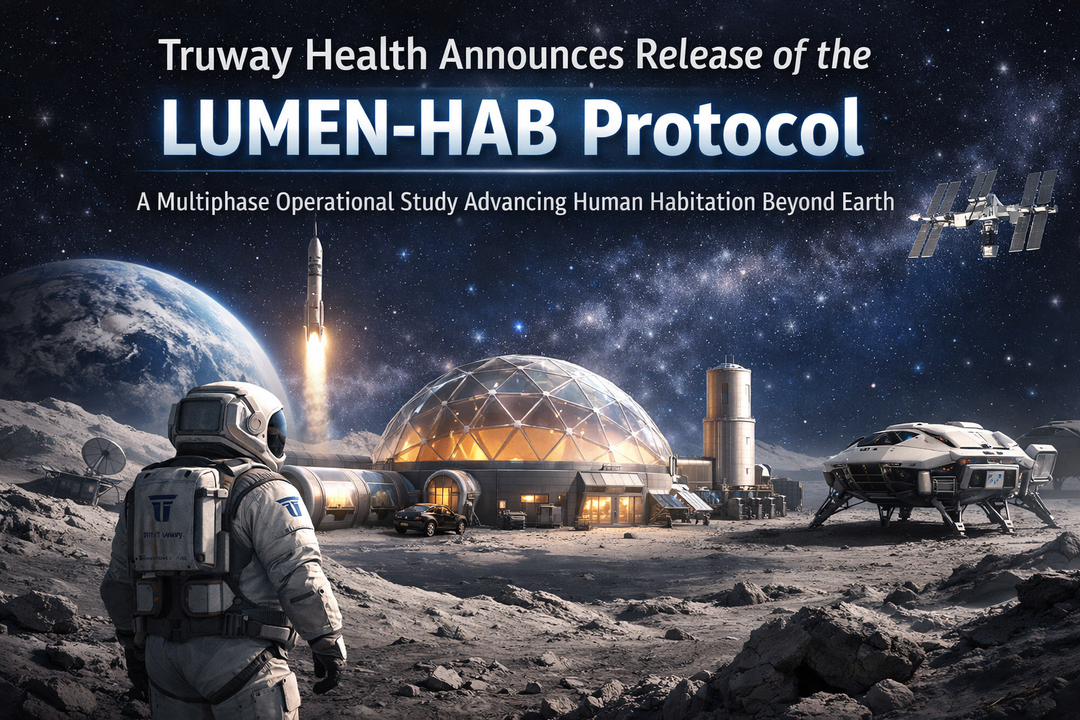
April 11, 2026 — Manhattan, NY
Truway Health, Inc. has formally released THI‑LUNAR‑GATEWAY‑MARS‑HAB‑001 (LUMEN‑HAB), a landmark multiphase operational protocol designed to evaluate the environmental, logistical, and systems‑level requirements for sustained human habitation on the lunar surface, within the Lunar Gateway transit architecture, and across Mars‑analog environments. The protocol is now publicly accessible through ClinicalTrials.gov.
LUMEN‑HAB represents a new class of operational research: a validator‑grade, telemetry‑driven, multi‑environment assessment that integrates habitat resilience testing, environmental control and life‑support system (ECLSS) continuity, radiation‑exposure modeling, EVA logistics, and long‑duration behavioral stability. The study’s central focus is the identification, extraction, processing, and utilization of lunar and Martian water‑ice resources to support life‑support functions, radiation shielding, and in‑situ propellant production.
“Human habitation beyond Earth demands more than engineering ambition — it requires a validated operational architecture capable of withstanding environmental volatility, resource constraints, and mission‑critical system failures,” said Gavin Solomon, President & CEO of Truway Health and Responsible Party for the study. “LUMEN‑HAB provides a structured, evidence‑driven framework for understanding how lunar and Martian environments can support sustained human presence.”
Although LUMEN‑HAB does not involve human subjects or biomedical interventions, the protocol adheres to federal registration standards and employs a rigorous methodology consistent with high‑fidelity operational research. The study incorporates acoustic telemetry arrays, neural‑state modeling, reactor‑interface signaling, and validator‑grade blockchain governance rails to ensure transparency, reproducibility, and operational integrity.
Key Objectives of LUMEN‑HAB
-
Evaluate habitat system resilience across lunar, Gateway, and Mars‑analog environments
-
Assess water‑ice extraction, processing, and conversion efficiency
-
Model radiation exposure and shielding performance
-
Analyze EVA logistics, dust mitigation, and mobility constraints
-
Measure life‑support continuity under stress conditions
-
Characterize behavioral stability during long‑duration isolation
-
Validate operational continuity across transit‑to‑surface mission phases
The findings from LUMEN‑HAB are expected to inform future mission architectures for lunar permanence, Gateway‑supported logistics, and accelerated readiness for Martian surface habitation. The protocol also establishes a foundation for coalition‑grade governance frameworks, enabling transparent, multi‑agency collaboration in the emerging domain of interplanetary habitation research.
The full protocol record is available under Unique Protocol ID: THI‑LUNAR‑GATEWAY‑MARS‑HAB‑001.
Truway Health News & Insights

Healthcare's Last Mile: Why Medical Delivery Reliability Matters More Than Ever
Healthcare Doesn't Stop at the Warehouse In modern healthcare, a medical product's value is not dete...

Beyond the Lead Apron: Modern Shielding Strategies in Digital Dental Radiography
The Evolution of Radiation Protection For decades, the lead apron became one of the most recognizabl...

Digital Dentistry's Quiet Revolution: How Intraoral Sensors Are Transforming Imaging
The Smallest Devices Are Often Behind the Biggest Changes Not every revolution in healthcare arrives...

When Devices Begin to Think: The Next Era of Intelligent Medical Equipment
The Machine Is No Longer Just Measuring. It Is Interpreting. For generations, medical equipment perf...

Medical Supply Case-Pack Economics: How Bulk Purchasing Reduces Healthcare Procurement Costs
Understanding the Economics Behind Medical Supply Purchasing In today's healthcare environment, cont...

The 72-Hour Warning Window: What Biomarkers Can Tell Us About Clinical Deterioration
Introduction: Can the Human Body Signal an Emergency Before It Happens? What if healthcare professio...