
Internet of Medical Things (IoMT): What Healthcare Leaders Need to Know
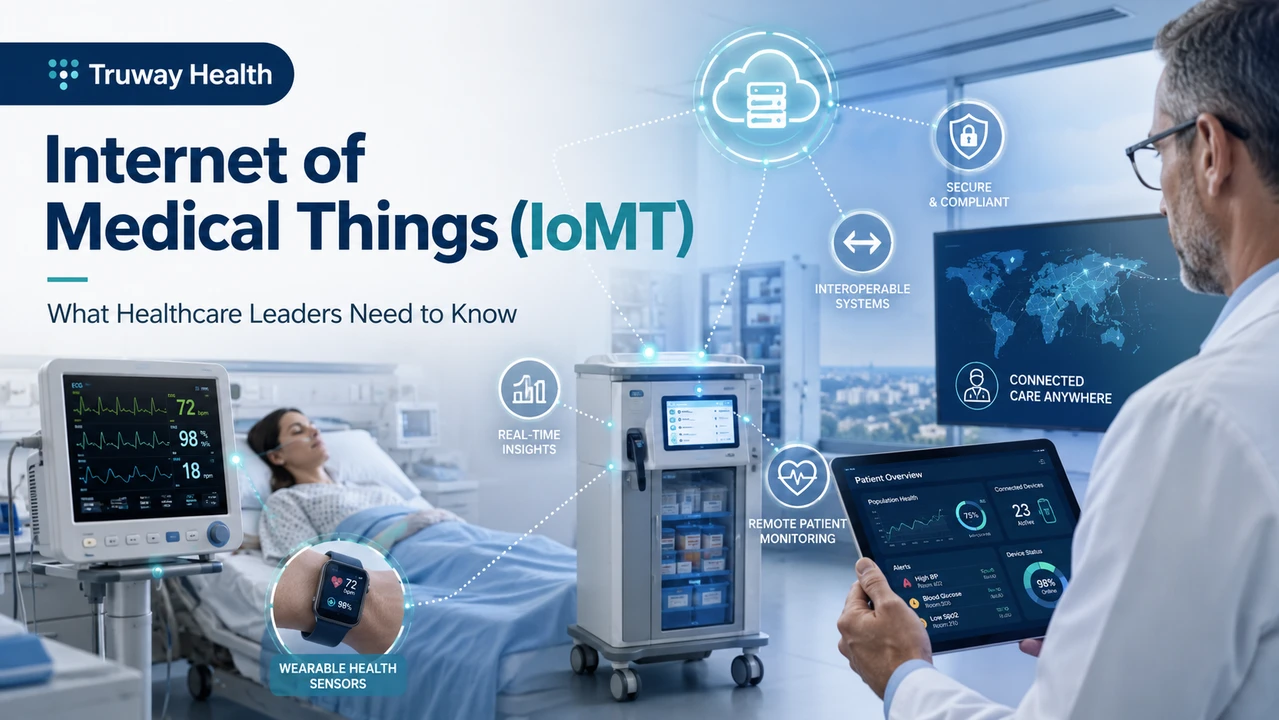
Healthcare is becoming increasingly connected. Patient monitors communicate with clinical systems, medication cabinets track inventory electronically, wearable devices transmit physiological measurements, and diagnostic equipment can exchange data across hospital networks.
Together, these technologies form the Internet of Medical Things (IoMT)—an ecosystem of connected medical devices, software platforms, sensors, networks, and healthcare information systems designed to collect, transmit, analyze, and act on medical data.
For healthcare leaders, IoMT represents much more than another technology trend. It is becoming part of the infrastructure supporting clinical care, asset management, remote monitoring, hospital operations, and medical-device procurement.
The opportunity is significant, but connectivity also introduces new responsibilities involving cybersecurity, interoperability, device lifecycle management, data protection, procurement, and patient safety.
What Is the Internet of Medical Things?
The Internet of Medical Things is a healthcare-specific extension of the broader Internet of Things.
IoMT includes medical devices and healthcare technologies capable of communicating electronically with another device, application, platform, or network.
Examples can include:
- Network-connected bedside patient monitors
- Capnography and pulse-oximetry systems
- Infusion pumps
- Smart medication cabinets
- RFID inventory systems
- Connected diagnostic imaging equipment
- Remote patient monitoring devices
- Wearable ECG and physiological monitors
- Continuous glucose monitoring systems
- Smart laboratory instruments
- Connected sterilization and environmental-monitoring equipment
- Telehealth devices
- Mobile clinical workstations
- Home-health monitoring technologies
The defining feature is connectivity.
Instead of functioning as isolated pieces of equipment, IoMT devices can become components of a larger digital healthcare environment.
Why IoMT Matters to Healthcare Leaders
Modern hospitals can contain large numbers of connected devices. HHS's 405(d) healthcare cybersecurity program has cited estimates of approximately 10–15 network-connected medical devices per hospital bed, illustrating how quickly the connected-device environment can expand.
For executives and healthcare administrators, this creates an important strategic shift.
Medical equipment procurement can no longer be evaluated solely on questions such as:
Does the device perform its clinical function?
Healthcare organizations increasingly also need to ask:
How will this device communicate with our infrastructure, how will it be secured, and how will it be supported throughout its lifecycle?
1. IoMT Can Create More Connected Clinical Workflows
One of the greatest advantages of IoMT is the ability to move information more efficiently between medical devices and healthcare systems.
A connected patient-monitoring environment, for example, may allow measurements to move from bedside equipment into clinical information systems without requiring repeated manual transcription.
Depending on the device and integration architecture, connected environments may help support:
- Faster availability of clinical measurements
- Reduced manual data entry
- Centralized monitoring
- Automated alerts
- Longitudinal patient-data collection
- Remote clinical observation
- Equipment utilization analysis
- Improved inventory visibility
The ultimate objective should not simply be to connect more equipment.
It should be to create useful, secure and clinically meaningful connectivity.
2. Remote Patient Monitoring Is Expanding the Connected-Care Environment
IoMT extends beyond the walls of hospitals.
Remote patient monitoring technologies can collect physiological information from patients at home or in other nontraditional care environments and transmit that information to healthcare systems.
Connected technologies may monitor parameters such as:
- Heart rate
- Blood pressure
- Oxygen saturation
- Glucose
- Respiratory parameters
- Weight
- Temperature
- Cardiac activity
- Activity and mobility
This allows healthcare delivery models to increasingly incorporate home health, telemedicine and distributed care.
NIST continues to examine cybersecurity and privacy considerations associated with connected home-health technologies. In December 2025, NIST published additional guidance addressing cybersecurity and privacy risks involving smart technologies used in home healthcare environments.
3. Connectivity Also Creates Cybersecurity Risk
Every network-connected device can potentially expand an organization's technology attack surface.
Medical devices can present particularly complicated cybersecurity challenges because equipment may remain in clinical service for many years while operating alongside rapidly changing software, networking and cybersecurity environments.
Potential concerns can include:
- Unsupported software
- Outdated operating systems
- Unpatched vulnerabilities
- Weak authentication
- Improper device configuration
- Insecure network protocols
- Excessive network permissions
- Third-party software vulnerabilities
- Poorly controlled remote access
- Inadequate encryption
- Limited device inventories
- Lack of visibility into software components
Cybersecurity therefore needs to become part of medical equipment management, rather than remaining solely an information-technology issue.
NIST has emphasized that privacy, device integrity and cyber resilience should be incorporated into internet-connected medical-device design and manufacturing.
FDA Medical-Device Cybersecurity Requirements Are Evolving
Healthcare organizations should also recognize that medical-device cybersecurity has become an increasingly important regulatory consideration.
On February 3, 2026, the U.S. Food and Drug Administration issued updated final guidance titled Cybersecurity in Medical Devices: Quality Management System Considerations and Content of Premarket Submissions. The guidance addresses FDA recommendations regarding cybersecurity and Section 524B of the Federal Food, Drug, and Cosmetic Act for cyber devices.
FDA's approach emphasizes cybersecurity across the total product lifecycle, rather than treating security as something addressed only before a product reaches the market. FDA materials also address considerations involving software updates, security patches and software bills of materials, commonly called SBOMs.
For healthcare procurement teams, that creates an important implication:
Cybersecurity due diligence should begin before a connected device is purchased.
4. Healthcare Organizations Need to Know What Is Connected
You cannot effectively secure equipment you do not know exists.
Healthcare organizations should develop accurate inventories of network-connected medical technologies.
An IoMT inventory should ideally identify information such as:
- Manufacturer
- Model
- Serial number
- Physical location
- Department
- Device owner
- Network connection
- Software or firmware version
- Operating system
- IP or network identifiers
- Support status
- Patch status
- End-of-support date
- Cybersecurity documentation
- Maintenance history
This inventory can become the foundation for both cybersecurity and medical-equipment lifecycle management.
5. Network Segmentation Can Reduce Exposure
Healthcare organizations should avoid treating every connected device as though it belongs on the same unrestricted network.
Appropriate network architecture may separate medical-device environments according to factors including device function, security characteristics, clinical risk and communication requirements.
Segmentation can help limit unnecessary communication between devices and reduce the potential consequences of a compromised endpoint.
NIST's healthcare cybersecurity work has specifically examined connected medical technologies such as wireless infusion pumps and provides risk-management approaches addressing device assets, vulnerabilities and protective controls.
6. Interoperability Should Be Evaluated Before Purchase
A technically advanced medical device may still create operational problems if it does not communicate effectively with an organization's existing technology infrastructure.
Before purchasing connected equipment, healthcare organizations should evaluate compatibility with relevant systems, potentially including:
- Electronic health records
- Patient-monitoring systems
- Hospital networks
- Laboratory information systems
- Picture archiving and communication systems
- Pharmacy systems
- Asset-management platforms
- Identity and access-management systems
- Clinical data repositories
Healthcare buyers should request technical integration documentation early in the procurement process rather than discovering interoperability limitations after delivery.
7. Procurement Teams Are Becoming Part of the Cybersecurity Process
IoMT changes the role of healthcare procurement.
A connected medical-device purchase is simultaneously a:
Clinical decision + equipment decision + IT decision + cybersecurity decision + lifecycle-management decision.
That means clinical engineering, biomedical engineering, information technology, cybersecurity, procurement and clinical users may all need representation during major connected-device evaluations.
Questions Healthcare Buyers Should Ask
Before purchasing an IoMT device, consider asking the manufacturer or supplier:
- What network connectivity does the device require?
- What data does the device collect, store or transmit?
- Is transmitted data encrypted?
- How are users authenticated?
- How are software and firmware updates delivered?
- How quickly are cybersecurity vulnerabilities addressed?
- What happens when the device reaches end-of-support?
- Is a software bill of materials available when applicable?
- What third-party software components are used?
- Does the device support network segmentation?
- What ports, protocols and external connections are required?
- Is remote access available, and how is it secured?
- How are security events logged?
- What interoperability standards does the device support?
- What cybersecurity documentation is provided to the customer?
These questions should increasingly become routine elements of connected medical-equipment procurement.
8. IoMT Requires Lifecycle Management
Purchasing the device is only the beginning.
A connected medical device may remain operational for years.
Healthcare organizations therefore need processes covering:
Procurement → Installation → Configuration → Monitoring → Maintenance → Updating → Incident Response → Replacement → Secure Decommissioning
Lifecycle planning becomes particularly important when manufacturers discontinue support for operating systems, software, communications protocols or older hardware.
A clinical device that still performs its original medical function may eventually become unsuitable for network use if its cybersecurity architecture can no longer be adequately maintained.
9. IoMT Can Improve Medical-Equipment Management
Connectivity can also help healthcare organizations understand how equipment itself is being used.
Depending on the system, connected asset-management platforms may provide visibility into:
- Equipment location
- Utilization
- Maintenance schedules
- Device availability
- Inventory levels
- Service history
- Environmental conditions
- Equipment downtime
This can help healthcare organizations make more informed purchasing and replacement decisions.
Rather than simply asking, “How many devices do we own?”, organizations can increasingly ask, “Where are our devices, how often are they used, and which assets actually need replacement?”
10. The Future Is a Connected Healthcare Infrastructure
IoMT should not be viewed as a collection of individual smart devices.
Its greater significance comes from the creation of a connected healthcare infrastructure where medical equipment, clinical information systems, logistics platforms, analytics systems and healthcare professionals can exchange information more efficiently.
Future healthcare environments are likely to rely increasingly on combinations of:
- IoMT
- Artificial intelligence
- Remote patient monitoring
- Cloud computing
- Edge computing
- RFID
- Real-time location systems
- Predictive maintenance
- Automated inventory management
- Clinical decision-support technologies
However, greater connectivity must be accompanied by equally strong governance.
A Practical IoMT Strategy for Healthcare Leaders
Healthcare organizations developing an IoMT strategy should focus on five priorities:
1. Inventory
Know every connected medical device operating within the organization.
2. Secure
Apply cybersecurity controls appropriate to the device, network and clinical risk.
3. Integrate
Evaluate interoperability before purchasing equipment.
4. Manage
Maintain devices throughout their complete operational lifecycle.
5. Govern
Create clear responsibility across clinical engineering, IT, cybersecurity, procurement, compliance and clinical operations.
Final Takeaway
The Internet of Medical Things is changing healthcare from an environment of isolated medical equipment into an ecosystem of connected clinical technology.
That transition can improve monitoring, information exchange, equipment visibility, remote care and operational efficiency.
But connectivity creates responsibility.
Healthcare leaders should treat cybersecurity, interoperability, lifecycle support and data governance as fundamental components of medical-device procurement and management—not as technical details to address after installation.
The most successful healthcare organizations will not necessarily be those with the largest number of connected devices.
They will be the organizations that connect technology strategically, securely and purposefully.
About Truway Health
Truway Health provides healthcare organizations, laboratories, government customers and medical professionals with access to medical equipment, healthcare technologies and procurement solutions designed for modern healthcare environments.
As healthcare infrastructure becomes increasingly connected, Truway Health supports buyers in evaluating equipment across technical specifications, procurement requirements, logistics, lifecycle considerations and operational needs.
Explore medical equipment and healthcare technology solutions at TruwayHealth.com.
Truway Health News & Insights

The Guidewire Is Not a Commodity: The Hidden Safety Architecture of Coronary Care
How precision engineering, clinical intelligence, and medical-device traceability are redefining exp...

Truth Social Suspends @truwayhealth Without Explanation: Truway Health Challenges Digital Censorship and Demands Accountability
October 9, 2026 | Truway Health News & Insights NEW YORK, NY — Truway Health, Inc. is formally chall...

The Stethoscope Standard: Rethinking the Value of U.S. M1 Through Medical Productive Capacity
Money ultimately derives much of its usefulness from confidence: confidence that a dollar can be exc...

Simple Steps for Seniors to Embrace Healthy and Joyful Living
For seniors seeking holistic wellness, healthy aging can feel harder than it should: the body change...

Healthcare Procurement Readiness: Building a More Resilient Clinical Supply Chain
Healthcare supply chains are often judged by a simple question: Did the product arrive? But for hosp...

Pass-Through Chambers and Material Flow in Controlled Healthcare Environments
Controlled healthcare environments depend on more than clean surfaces and filtered air. The way mate...