
Choosing Surgical Loupes: 2.5× vs. 3.5× Magnification
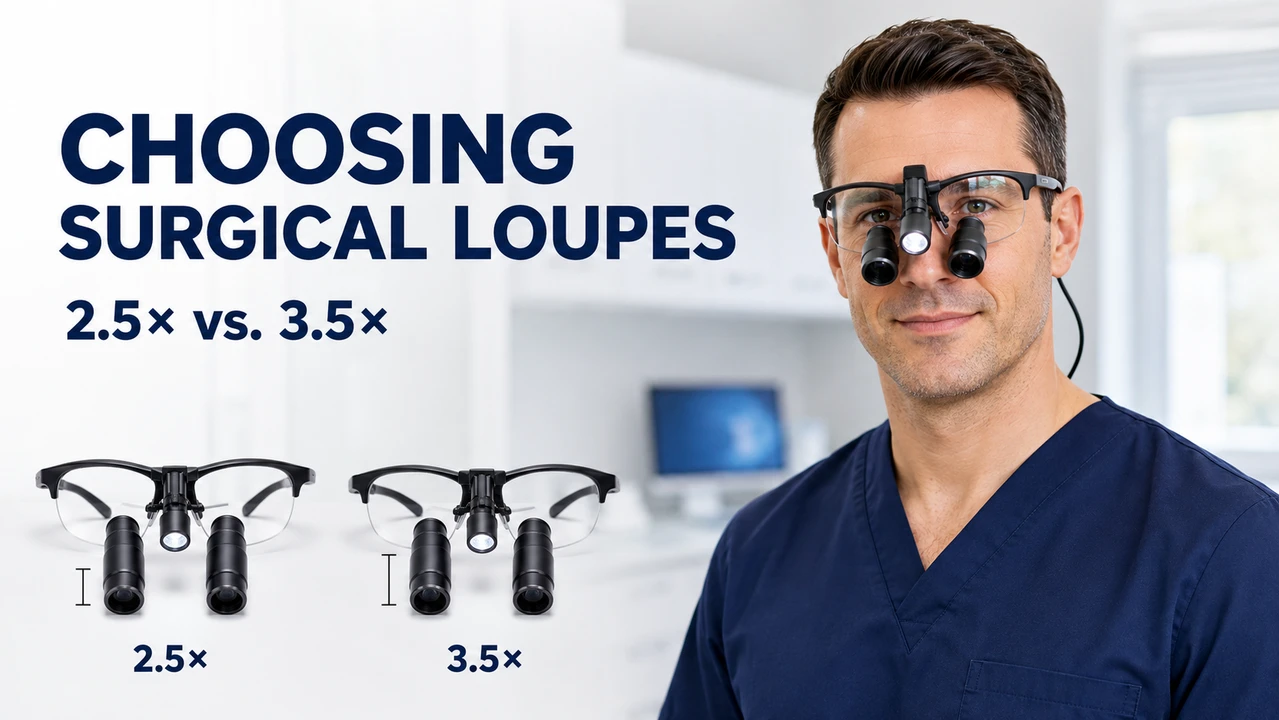
Surgical loupes provide a magnified view of the working area, helping healthcare professionals see fine anatomical details while maintaining a more comfortable working posture. Two of the most common magnification options are 2.5× and 3.5×, but the right choice depends on the procedure, experience level, working distance, and desired field of view.
The Quick Answer
Choose 2.5× surgical loupes if you want a wider field of view, greater depth of field, easier adaptation, and an all-purpose option for routine clinical work.
Choose 3.5× surgical loupes if your work requires closer visualization of fine structures and you are comfortable operating within a smaller, more precise viewing area.
2.5× vs. 3.5× Surgical Loupes
| Feature | 2.5× Loupes | 3.5× Loupes |
|---|---|---|
| Magnification | Moderate | Higher |
| Field of view | Wider | Narrower |
| Depth of field | Greater | Shallower |
| Learning curve | Easier | More demanding |
| Head-position tolerance | More flexible | Requires steadier positioning |
| Detail visibility | Suitable for routine work | Better for fine structures |
| Typical use | General dentistry, hygiene, examinations and routine procedures | Endodontics, microsurgery, vascular work and detail-intensive procedures |
Benefits of 2.5× Surgical Loupes
For many first-time users, 2.5× magnification provides the best balance between improved visibility and freedom of movement. The wider viewing area makes it easier to remain oriented while moving between instruments, the patient, and the surrounding workspace.
A greater depth of field also allows the user to move slightly forward or backward without immediately losing focus. This flexibility can be valuable during longer procedures or in environments where the clinician frequently changes position.
Common applications include:
- General dentistry and dental hygiene
- Oral examinations
- Suturing and wound care
- Routine surgical procedures
- Veterinary care
- Medical and dental education
- Procedures requiring a broad view of the treatment area
The lower learning curve makes 2.5× loupes a practical starting point for clinicians who have not previously used magnification.
Benefits of 3.5× Surgical Loupes
The primary advantage of 3.5× loupes is increased visualization of smaller structures. This can help during procedures where fine margins, narrow canals, small vessels, delicate tissue, or subtle surface details must be identified.
The tradeoff is a smaller field of view and a shallower depth of field. Users must maintain a more consistent working distance and head position to keep the operative area in focus. Some clinicians may require an adaptation period before using 3.5× magnification comfortably throughout a full procedure.
Common applications include:
- Endodontic procedures
- Periodontal procedures
- Implant-related work
- Fine suturing
- Vascular procedures
- Microsurgical techniques
- Laboratory and technical inspection
- Other detail-intensive clinical tasks
Clinicians who already use 2.5× loupes and want greater detail may find 3.5× magnification to be a natural upgrade.
Working Distance Matters
Magnification alone does not determine whether surgical loupes will be comfortable. The working distance—the space between the user’s eyes and the treatment area—must correspond with the clinician’s height, posture, and preferred operating position.
If the working distance is too short, the user may lean forward and place unnecessary strain on the neck and back. If it is too long, maintaining a clear image may become difficult.
Before ordering, consider:
- Your height
- Whether you normally sit or stand
- The height of the patient or operating surface
- Your natural working posture
- The distance from your eyes to the treatment area
Properly fitted loupes should allow you to see the working area clearly without repeatedly bending your neck or rounding your shoulders.
Field of View and Depth of Field
The field of view is the width of the area visible through the loupes. Lower magnification generally provides a wider field, while higher magnification concentrates attention on a smaller area.
The depth of field is the range in which the subject remains sharply focused. A greater depth of field permits more movement without losing focus. A shallower depth of field requires more consistent positioning.
These differences explain why 2.5× loupes may feel easier for new users, while 3.5× loupes reward precise posture and controlled movement.
Should You Add an LED Headlight?
An LED headlight can improve illumination by directing light along the user’s line of sight. This helps reduce shadows that may occur when overhead lighting is obstructed by the clinician’s head or hands.
When comparing headlights, consider:
- Light output and brightness settings
- Battery operating time
- Battery weight
- Charging time
- Beam uniformity
- Color temperature
- Mounting compatibility
- Replacement battery availability
A 3W LED headlight may be appropriate for routine work and extended wear. A 5W system may provide stronger illumination for deeper or more demanding working areas, although actual brightness and runtime vary by model.
Which Magnification Should You Choose?
Select 2.5× loupes when:
- You are purchasing your first pair of loupes.
- You need an adaptable, general-purpose option.
- You want a wider viewing area.
- You frequently reposition during procedures.
- You prioritize a more forgiving depth of field.
Select 3.5× loupes when:
- Your procedures involve fine anatomical details.
- You already have experience using magnification.
- You can maintain a consistent working position.
- You are comfortable with a narrower viewing area.
- Greater detail is more important than maximum viewing width.
Final Considerations
The best surgical loupes are not necessarily the pair with the highest magnification. The right choice is the one that supports the intended procedure, maintains a usable field of view, matches the clinician’s working distance, and remains comfortable during extended wear.
Truway Health offers 2.5× and 3.5× surgical-loupe configurations with LED headlight options for dental, medical, surgical, veterinary, educational, and technical applications. Contact Truway Health for assistance selecting the appropriate magnification, working distance, frame configuration, and illumination system for your needs.
Product specifications and suitability vary by model and intended application. Users should review the manufacturer’s instructions and applicable institutional requirements before clinical use.
Truway Health News & Insights

Healthcare Equipment Interoperability: Understanding DICOM, HL7, and FHIR
Truway Health | Medical Technology, Digital Infrastructure & Healthcare Innovation Modern medical eq...
Medical-Grade Stainless Steel: Comparing 304 and 316 for Healthcare Equipment
Truway Health | Medical Equipment, Materials Engineering & Healthcare Procurement Not all stainless...

Winter Respiratory Season Preparedness: Essential Supplies for Caregivers and Clinics
Published October 18, 2026 | Truway Health News & Insights When respiratory illnesses rise, preparat...

What Families Should Know When a Loved One Enters Hospice Care
For families with a terminally ill loved one, the start of hospice can land like two realities at on...

Moving from RN to Family Nurse Practitioner What You Need to Know
Experienced registered nurses often reach a point where strong bedside skills still leave a lingerin...

The Guidewire Is Not a Commodity: The Hidden Safety Architecture of Coronary Care
How precision engineering, clinical intelligence, and medical-device traceability are redefining exp...