null

Truway Health Announces ClinicalTrials.gov Registration of 50-Year Prospective Study Examining “Clinical Time” and Temporal Dynamics in Patient Health
Truway Health Announces ClinicalTrials.gov Registration of 50-Year Prospective Study Examining “Clinical Time” and Temporal Dynamics in Patient Health

PRESS RELEASE

Truway Health Announces ClinicalTrials.gov Registration of 50-Year Prospective Study Examining “Clinical Time” and Temporal Dynamics in Patient Health

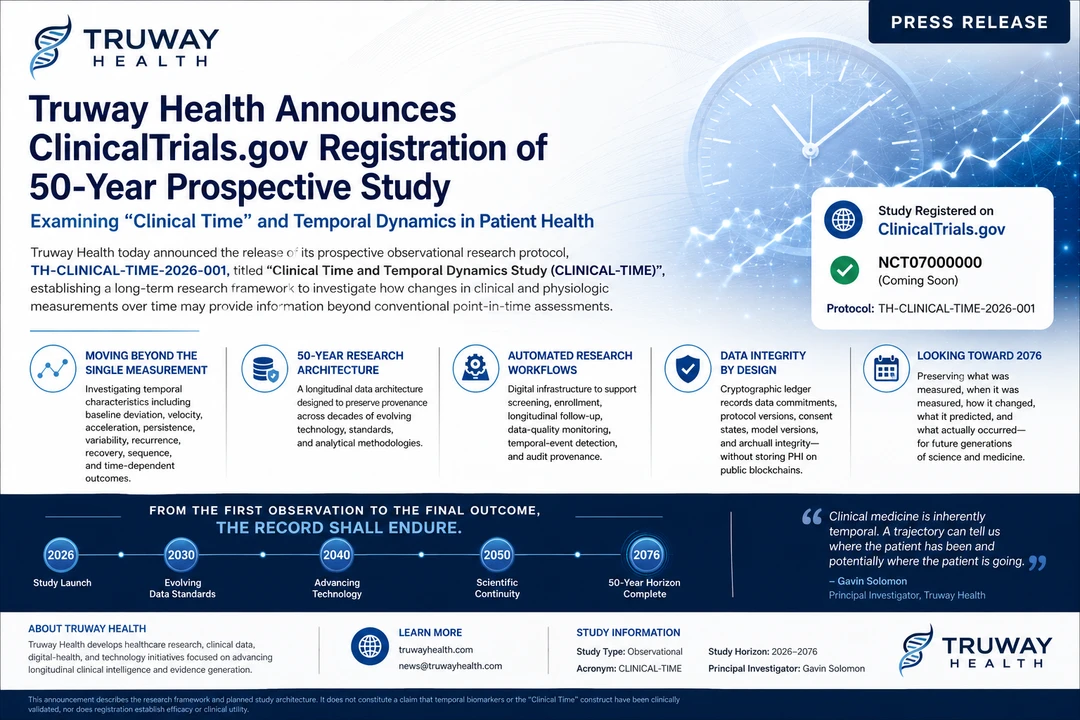
NEW YORK — September 1, 2026 — Truway Health today announced the release of its prospective observational research protocol, TH-CLINICAL-TIME-2026-001, titled “Clinical Time and Temporal Dynamics Study (CLINICAL-TIME)”, establishing a long-term research framework to investigate how changes in clinical and physiologic measurements over time may provide information beyond conventional point-in-time assessments.

The study is designed around a central research question: Can the temporal behavior of a patient's clinical state—rather than a single measurement alone—provide additional information about clinically meaningful outcomes?

The prospective study is planned around a 2026–2076 study horizon, with individual participant follow-up conducted according to the approved protocol, informed consent, and applicable requirements.

Moving Beyond the Single Measurement

Traditional clinical datasets frequently represent patient state as isolated observations. The CLINICAL-TIME framework instead examines the trajectory connecting those observations.

Researchers will investigate temporal characteristics including:

  • Individualized baseline deviation
  • Rate of change (velocity)
  • Acceleration and deceleration
  • Persistence of abnormalities
  • Physiologic variability
  • Recurrence of clinical states or events
  • Temporal sequence
  • Recovery kinetics
  • Time-dependent clinical outcomes
  • Potential clinical lead time

These measurements may be derived from longitudinal clinical, physiologic, laboratory, imaging-derived, patient-reported, remote-monitoring, and digital-health data when available and permitted by the study protocol.

A 50-Year Research Architecture

The study's long-term horizon is intended to support investigation of clinical trajectories across changing technologies, healthcare environments, data standards, and analytical methodologies.

Truway Health is developing the accompanying research infrastructure around a versioned longitudinal data architecture designed to preserve provenance across decades.

The architecture is intended to distinguish:

Observation → Temporal Feature → Prediction → Outcome

while maintaining the provenance of each analytical layer.

A cryptographic ledger architecture may additionally be used to record data commitments, protocol versions, consent-version references, workflow events, model versions, and archival integrity records without placing protected health information on a public blockchain.

Research Automation and Digital Infrastructure

The CLINICAL-TIME research framework is designed to support automated research workflows for appropriate protocol-defined activities, including:

  • screening workflow generation;
  • eligibility review;
  • enrollment workflow management;
  • longitudinal follow-up;
  • data-quality monitoring;
  • temporal-event detection;
  • model-version tracking;
  • archival verification; and
  • research audit provenance.

Automation is intended to generate and route research workflow tasks, not independently diagnose patients, prescribe treatment, or replace qualified clinical or investigator judgment.

Scientific Objective

The primary research objective is to evaluate whether longitudinal temporal clinical features improve prediction of prespecified clinically meaningful outcomes compared with conventional point-in-time measurements.

Predictive performance may be assessed using prespecified measures of discrimination, calibration, and time-to-event performance, consistent with the final approved statistical analysis plan.

The study also provides a framework for examining whether individualized temporal phenotypes can remain stable, reproducible, and scientifically useful across extended periods of observation.

Data Integrity Across Generations of Technology

A defining feature of the research architecture is its emphasis on temporal provenance.

Clinical data standards, medical devices, electronic health-record systems, analytical models, and computational infrastructure are expected to evolve substantially during a 50-year research horizon.

Accordingly, the framework uses versioned schemas and analytical models so that historical observations retain their original provenance rather than being silently rewritten during future migrations.

Annual or periodic archival commitments may provide an additional cryptographic record of the integrity of longitudinal research datasets.

Statement from Truway Health

“Clinical medicine is inherently temporal. A single measurement tells us where a patient is; a trajectory can tell us where the patient has been and potentially where the patient is going. CLINICAL-TIME is designed to rigorously investigate that distinction.”

Gavin Solomon, Principal Investigator, Truway Health

Observational Research Framework

TH-CLINICAL-TIME-2026-001 is structured as a prospective observational cohort study. The study does not assign an experimental therapeutic intervention. Participants will be observed according to the approved research protocol, with longitudinal information evaluated to characterize temporal clinical dynamics and their relationship to prespecified outcomes.

The study's long-term architecture is intended to support scientific continuity while maintaining appropriate separation between clinical data, research analytics, identity management, and cryptographic provenance.

Looking Toward 2076

Truway Health views the CLINICAL-TIME study as a research infrastructure as much as an individual study protocol: a framework for asking whether time itself can become a measurable dimension of clinical research.

From the first observation to the final longitudinal outcome, the objective is to preserve not only what was measured, but when it was measured, how it changed, what analytical model interpreted it, and what subsequently occurred.

“Through the heavens fall, the record shall endure.”


About Truway Health

Truway Health develops healthcare research, clinical data, digital-health, and technology initiatives focused on advancing longitudinal clinical intelligence, research infrastructure, and evidence generation.

Study Information

Protocol: TH-CLINICAL-TIME-2026-001
Brief Title: Clinical Time and Temporal Dynamics Study
Acronym: CLINICAL-TIME
Study Type: Observational
Study Horizon: 2026–2076
Principal Investigator: Gavin Solomon
Organization: Truway Health, Inc.

Media & Research Inquiries:
Truway Health
News & Insights
truwayhealth.com

This announcement describes the research framework and planned study architecture. It does not constitute a claim that temporal biomarkers or the “Clinical Time” construct have been clinically validated, nor does registration establish efficacy or clinical utility.

Sep 1st 2026 Truway Health

Truway Health News & Insights

TRUWAY HEALTH INSTAGRAM