
Healthcare Procurement Readiness: Building a More Resilient Clinical Supply Chain
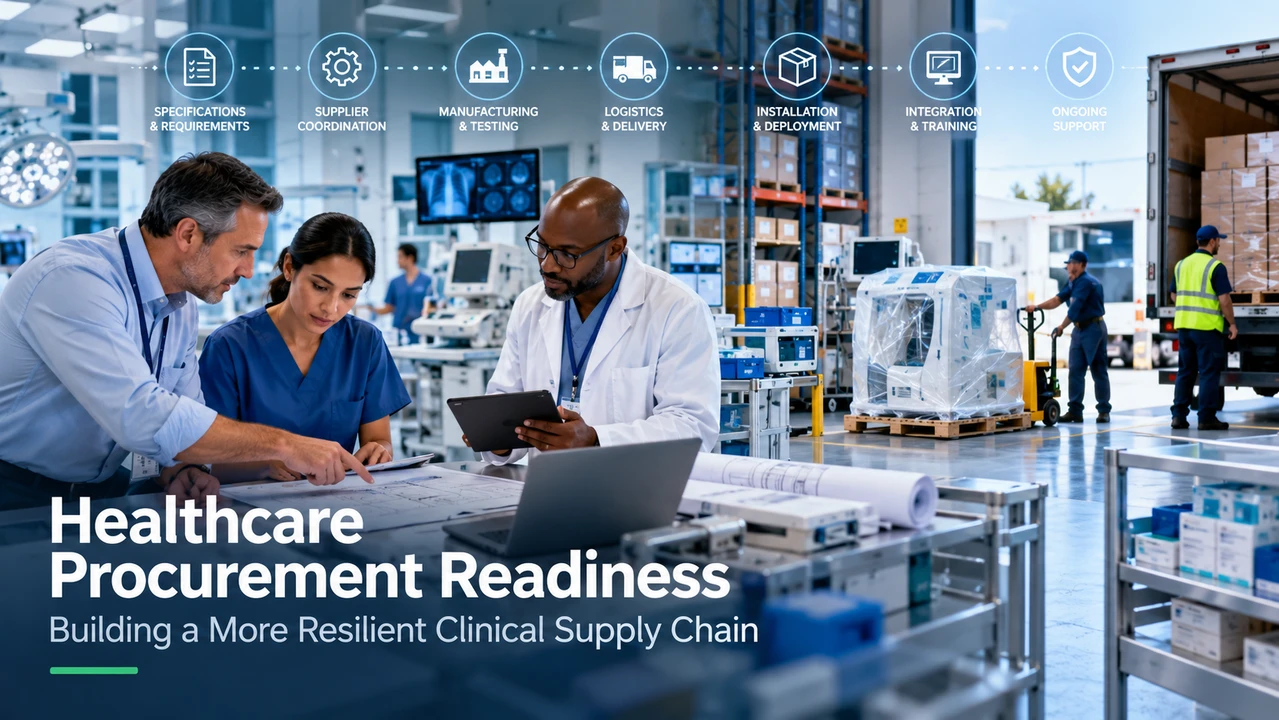
Healthcare supply chains are often judged by a simple question: Did the product arrive?
But for hospitals, ambulatory centers, laboratories, government healthcare facilities, and clinical research organizations, successful procurement involves far more than delivery. A medical product must arrive in the correct configuration, with appropriate documentation, within the required timeline, and in a condition that allows it to move directly into the organization’s operational workflow.
That makes procurement readiness an increasingly important part of healthcare infrastructure.
Procurement Is an Operational Process, Not Just a Purchase
Medical procurement can involve equipment, sterile supplies, diagnostic systems, storage products, surgical instruments, patient-monitoring technologies, and specialized infrastructure.
Each category presents different requirements.
Before a purchase order is issued, buyers may need to evaluate:
-
Technical specifications
-
Product compatibility
-
Regulatory documentation
-
Electrical and environmental requirements
-
Packaging and transportation conditions
-
Installation requirements
-
Training expectations
-
Warranty coverage
-
Lead time
-
Replacement-part availability
-
Data or software integration requirements
A product that satisfies a catalog description but cannot integrate into the clinical environment may still create significant downstream delays.
Procurement therefore works best when clinical, technical, logistical, and administrative requirements are considered together.
The Importance of Salient Characteristics
For complex medical equipment, procurement teams frequently rely on salient characteristics to define the minimum capabilities necessary for a successful acquisition.
These characteristics may include physical dimensions, performance thresholds, imaging capabilities, storage capacity, connectivity, materials, sterilization compatibility, power requirements, or environmental tolerances.
Clear specifications can help both buyers and suppliers.
For buyers, they create a structured framework for evaluating alternatives.
For suppliers, they clarify which capabilities are essential and which features may allow flexibility.
This becomes especially important when an organization is evaluating an equivalent product rather than a single manufacturer or model.
The strongest procurement specifications typically focus on measurable functionality rather than brand names alone.
Lead Time Should Be Treated as a Clinical Variable
Lead time is sometimes treated purely as a logistics metric.
In healthcare, however, it can directly influence operational capacity.
Long procurement cycles may affect:
-
Procedure scheduling
-
Department openings
-
Equipment replacement
-
Research timelines
-
Emergency preparedness
-
Sterile-processing capacity
-
Inventory reserves
-
Construction or renovation schedules
For customized equipment, cleanroom systems, diagnostic platforms, or products requiring international manufacturing, lead time may include far more than production.
A realistic timeline can involve engineering review, configuration approval, manufacturing, factory testing, export documentation, freight transportation, customs processing, final-mile delivery, installation, validation, and user training.
Healthcare organizations should therefore evaluate total deployment time, not simply factory production time.
Documentation Is Part of the Product
Modern healthcare procurement generates an expanding documentation package.
Depending on the product, facilities may require materials such as:
-
Instructions for use
-
Operator manuals
-
Safety documentation
-
Technical data sheets
-
Certificates of conformity
-
Electrical specifications
-
Installation requirements
-
Serial-number records
-
Maintenance documentation
-
Warranty terms
-
Shipping records
-
Regulatory information
For sophisticated equipment, documentation may continue throughout the product lifecycle.
Preventive-maintenance logs, service records, software updates, calibration records, and component replacements may all become part of the equipment's operational history.
Treating documentation as part of the deliverable helps healthcare organizations maintain stronger asset controls.
Interoperability Is Becoming a Procurement Requirement
Healthcare devices increasingly operate within connected environments.
Ultrasound systems, patient monitors, laboratory equipment, imaging systems, medication-management technologies, and other devices may need to exchange information with existing infrastructure.
Procurement teams may therefore need to evaluate capabilities such as:
-
DICOM
-
HL7
-
Network connectivity
-
USB or removable-media export
-
PACS compatibility
-
Electronic health record integration
-
Cybersecurity controls
-
Software-update procedures
-
User-access management
-
Data export formats
A device may perform exceptionally well as a standalone product while creating operational friction if its information cannot move efficiently through the healthcare environment.
Interoperability should therefore be considered early in the procurement process.
Installation Planning Starts Before Delivery
Large or specialized healthcare systems often require site preparation before they arrive.
Examples can include medical refrigerators, imaging systems, cleanroom infrastructure, laboratory equipment, sterile-storage systems, and specialty diagnostic platforms.
Facilities may need to review:
-
Door and hallway dimensions
-
Floor loading
-
Electrical service
-
Ventilation
-
Drainage
-
Network access
-
Ceiling clearance
-
Environmental requirements
-
Equipment anchoring
-
Delivery pathways
-
Infection-control procedures
These considerations are especially important when equipment must pass through restricted corridors, elevators, loading docks, sterile areas, or active clinical departments.
A successful installation frequently begins with a site-readiness assessment completed weeks or months before delivery.
Inventory Resilience Requires More Than Extra Stock
Healthcare organizations learned during recent supply disruptions that simply holding additional inventory does not eliminate supply-chain risk.
Resilience also depends on understanding alternative sources, component compatibility, shelf life, transportation risk, regulatory requirements, and supplier capacity.
A mature procurement strategy may evaluate multiple levels of redundancy:
Supplier redundancy: Are qualified alternative suppliers available?
Product redundancy: Is there a clinically acceptable equivalent?
Logistics redundancy: Can the product arrive through more than one transportation route?
Inventory redundancy: Is sufficient reserve stock available?
Technical redundancy: Can another system temporarily perform the same function?
These questions transform inventory planning from a purchasing exercise into a continuity-of-operations strategy.
Supplier Communication Matters
Healthcare procurement often involves multiple participants: clinicians, purchasing departments, biomedical engineering teams, facilities staff, freight carriers, manufacturers, distributors, installers, and regulators.
Clear communication helps prevent misunderstandings as requirements move across those groups.
Important milestones may include:
-
Technical requirements confirmed
-
Configuration approved
-
Commercial terms accepted
-
Manufacturing initiated
-
Production completed
-
Quality inspection completed
-
Shipping documents issued
-
Equipment dispatched
-
Delivery confirmed
-
Installation completed
-
Training completed
-
Final acceptance documented
Maintaining a documented chain of communication can make complex acquisitions significantly easier to manage.
Procurement Readiness Is Part of Patient-Care Readiness
The healthcare supply chain ultimately exists to support clinical operations.
When equipment, supplies, infrastructure, and documentation arrive at the right place and at the right time, clinicians can focus on patient care rather than resolving procurement problems.
Healthcare organizations can strengthen procurement readiness by asking several simple questions before every major acquisition:
What exactly do we need?
What must the product integrate with?
What documentation must accompany it?
What needs to be prepared before delivery?
How long will deployment realistically take?
What happens if the primary supplier or product becomes unavailable?
Organizations that answer these questions early can reduce surprises later.
Building Better Healthcare Supply Systems
Healthcare procurement is evolving from transactional purchasing toward integrated supply-chain management.
Equipment specifications, logistics, technology integration, documentation, facility preparation, and supplier coordination increasingly operate as parts of the same system.
For healthcare organizations, improving that system can mean fewer delays, stronger asset visibility, more predictable deployment, and greater operational resilience.
At Truway Health, we continue to examine how healthcare technology, medical supply logistics, clinical infrastructure, and procurement strategy can work together to support more efficient healthcare delivery.
Because in modern healthcare, getting the right product is only the beginning.
The larger objective is ensuring that the product is ready to perform when the healthcare system needs it.
Truway Health News & Insights

Healthcare Equipment Interoperability: Understanding DICOM, HL7, and FHIR
Truway Health | Medical Technology, Digital Infrastructure & Healthcare Innovation Modern medical eq...

Medical-Grade Stainless Steel: Comparing 304 and 316 for Healthcare Equipment
Truway Health | Medical Equipment, Materials Engineering & Healthcare Procurement Not all stainless...

Winter Respiratory Season Preparedness: Essential Supplies for Caregivers and Clinics
Published October 18, 2026 | Truway Health News & Insights When respiratory illnesses rise, preparat...

What Families Should Know When a Loved One Enters Hospice Care
For families with a terminally ill loved one, the start of hospice can land like two realities at on...

Moving from RN to Family Nurse Practitioner What You Need to Know
Experienced registered nurses often reach a point where strong bedside skills still leave a lingerin...

The Guidewire Is Not a Commodity: The Hidden Safety Architecture of Coronary Care
How precision engineering, clinical intelligence, and medical-device traceability are redefining exp...