
The Connected Hospital: Linking Devices, Inventory and Clinical Data
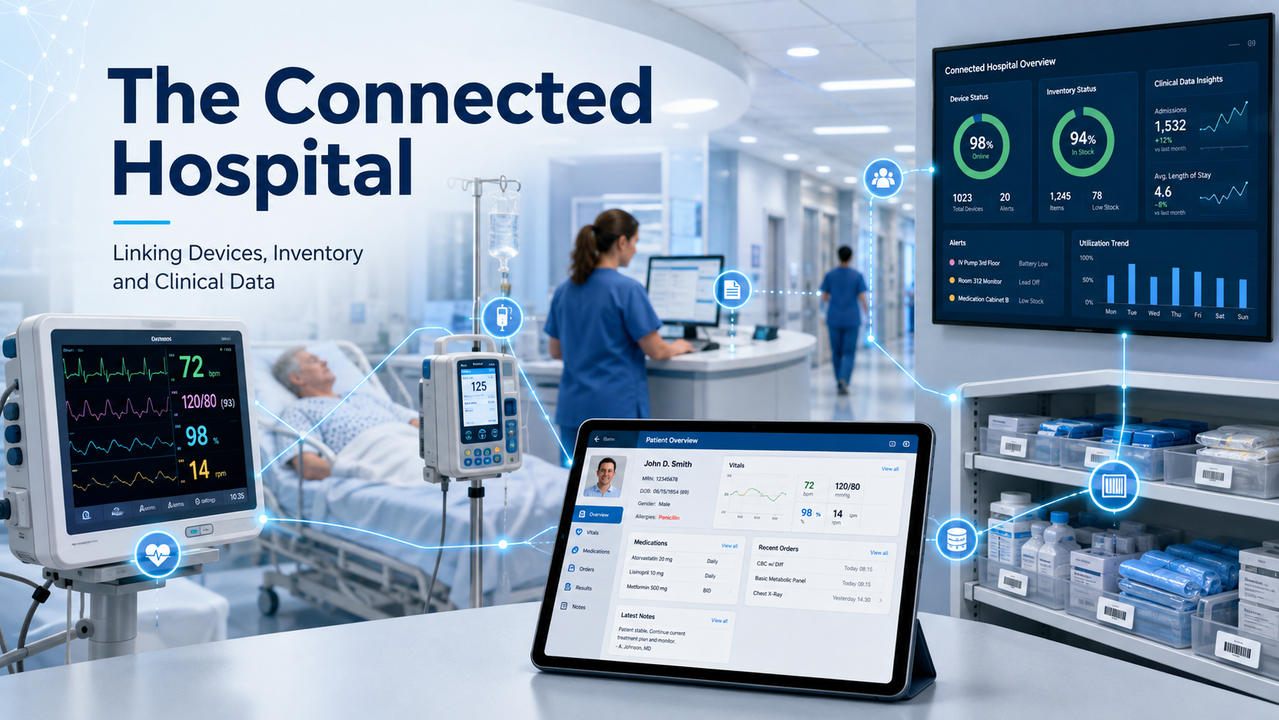
Hospitals are rapidly evolving from collections of independent departments, devices and supply rooms into interconnected clinical environments where equipment, inventory systems and patient data increasingly work together.
This transformation is creating what can be described as the connected hospital: a healthcare environment where medical devices, supply-chain systems, environmental controls and clinical information platforms exchange data to improve visibility, coordination and decision-making.
For hospitals, the opportunity goes far beyond simply connecting equipment to a network. The real value comes from building a digital ecosystem in which clinicians, biomedical teams, procurement departments and administrators can better understand what equipment is available, where it is located, how it is performing and how it relates to patient care.
What Is a Connected Hospital?
A connected hospital integrates traditionally separate systems into a more coordinated infrastructure.
These systems may include:
- Patient monitors
- Infusion pumps
- Ventilators and respiratory equipment
- Capnography systems
- Diagnostic analyzers
- Imaging equipment
- Sterile storage systems
- Environmental monitoring sensors
- Medication-management systems
- Medical supply inventory platforms
- Real-time location systems
- Electronic health records
- Biomedical equipment management systems
- Procurement and supply-chain software
Each technology generates information.
A patient monitor may generate heart rate, oxygen saturation and respiratory data. A sterile storage cabinet may monitor temperature or humidity. An inventory platform may track the remaining quantity of wound-care products. A laboratory analyzer may generate diagnostic results.
The connected hospital seeks to make those separate streams of information more useful by linking them within a coordinated clinical and operational environment.
Medical Devices Are Becoming Data Sources
Historically, hospitals purchased many medical devices primarily for their individual clinical function.
A pulse oximeter measured oxygen saturation. A capnography monitor measured end-tidal carbon dioxide. A hematology analyzer processed blood samples. An infusion pump delivered medication.
Those functions remain essential, but modern devices increasingly have another role:
They produce operational and clinical data.
When properly integrated, these devices can contribute information to hospital systems that support documentation, surveillance, workflow improvement and clinical decision-making.
For example, a multiparameter monitoring system may continuously collect:
- SpO₂
- Pulse rate
- Respiratory rate
- ECG information
- Blood pressure
- EtCO₂
- Temperature
Instead of remaining isolated on the monitor itself, selected measurements may be transmitted into centralized monitoring systems or incorporated into the patient's electronic medical record.
This reduces the need for repeated manual transcription while giving care teams a more complete longitudinal view of patient physiology.
Connecting Patient Monitoring With Clinical Records
One of the most important areas of hospital connectivity involves communication between bedside monitoring equipment and electronic health record systems.
When compatible systems exchange information correctly, clinicians may spend less time manually documenting repetitive measurements.
This can be particularly valuable in areas involving continuous or high-frequency monitoring, including:
- Intensive care
- Emergency departments
- Surgical recovery
- Procedural sedation
- Respiratory care
- Cardiac monitoring
- Step-down units
Consider capnography.
An EtCO₂ monitor generates respiratory measurements continuously. In a disconnected environment, clinicians may periodically record values manually.
In a connected environment, validated monitoring data can potentially become part of a broader patient information system, allowing clinicians to examine physiological changes alongside medication administration, procedures and other clinical events.
The result is not merely more data.
The objective is better clinical context.
Inventory Is Becoming Part of the Clinical Network
The connected hospital does not stop at patient monitoring.
Medical supplies are increasingly becoming part of the same information environment.
Hospitals manage thousands of products, including:
- Wound dressings
- Catheters
- Syringes
- Examination gloves
- Diagnostic consumables
- Surgical supplies
- Sterile instruments
- Respiratory accessories
- Laboratory reagents
- Personal protective equipment
Traditional inventory systems may tell administrators how many products were ordered or stored.
More advanced systems can provide much greater visibility.
Hospitals may track:
- Quantity on hand
- Storage location
- Lot number
- Expiration date
- Manufacturer
- Usage rate
- Reorder thresholds
- Department-level consumption
- Recall information
- Supply interruptions
When inventory data is connected with clinical operations, hospitals can begin moving from reactive purchasing toward more predictive supply management.
From Supply Room to Smart Supply Room
Medical storage is also becoming increasingly intelligent.
Traditional supply rooms depend heavily on manual inspection and periodic inventory counts.
A connected supply environment can potentially incorporate technologies such as:
- RFID
- Barcode scanning
- Environmental sensors
- Automated dispensing systems
- Real-time inventory tracking
- Temperature monitoring
- Humidity monitoring
- Access controls
- Automated reorder notifications
For sterile supplies, environmental monitoring may be particularly important.
Facilities may need to maintain appropriate storage conditions while protecting products from contamination, excessive moisture or inappropriate handling.
Connected storage systems can help facilities maintain greater visibility into environmental conditions and access patterns.
The result is a shift from passive storage toward actively monitored inventory environments.
Real-Time Location Systems and Equipment Visibility
Hospitals frequently own hundreds or thousands of mobile devices.
Examples include:
- Wheelchairs
- Infusion pumps
- Portable monitors
- Defibrillators
- Ultrasound systems
- Patient transport equipment
- Respiratory devices
- Mobile diagnostic systems
Locating this equipment can consume significant staff time.
Real-time location systems, commonly called RTLS, can help facilities determine where equipment is located within the hospital.
Depending on the system, RTLS technologies may use:
- RFID
- Bluetooth Low Energy
- Wi-Fi
- Ultra-wideband
- Infrared
- Ultrasound positioning
The operational benefits can be significant.
Instead of purchasing additional equipment simply because existing units cannot be located quickly, hospitals may be able to improve utilization of assets they already own.
Connecting Biomedical Engineering With Device Performance
Connectivity can also improve equipment maintenance.
Hospital biomedical engineering departments are responsible for maintaining large fleets of clinical equipment.
Traditionally, maintenance may depend on scheduled inspections or reports from clinical departments.
Connected devices can potentially provide additional information such as:
- Usage hours
- Error codes
- Battery health
- Calibration status
- Service alerts
- Software versions
- Device availability
- Maintenance history
This creates the foundation for more sophisticated equipment-management strategies.
Rather than maintaining equipment exclusively according to fixed schedules, hospitals may increasingly incorporate actual equipment utilization and performance data into maintenance planning.
Over time, this can support predictive maintenance approaches.
Predictive Maintenance in Healthcare
Predictive maintenance attempts to identify equipment problems before they cause operational disruption.
For example, data showing abnormal battery degradation, repeated fault codes or unusual operating patterns could help biomedical teams prioritize inspection.
Potential benefits include:
- Reduced equipment downtime
- Better maintenance scheduling
- Improved asset utilization
- Longer equipment life
- Fewer unexpected failures
- More efficient allocation of biomedical staff
Healthcare facilities must still follow manufacturer recommendations, regulatory requirements and established preventive maintenance procedures.
Connectivity does not replace those responsibilities.
It provides another layer of information that may help organizations manage equipment more effectively.
The Role of Interoperability
A connected hospital can only function when systems can communicate.
This is where interoperability becomes critical.
Hospitals frequently operate technologies from dozens or even hundreds of manufacturers.
A single healthcare system might use different vendors for:
- Patient monitoring
- Laboratory equipment
- Imaging
- Electronic medical records
- Pharmacy systems
- Inventory management
- Sterile processing
- Environmental monitoring
If every device operates only within a proprietary ecosystem, meaningful integration becomes difficult.
Healthcare organizations therefore increasingly evaluate interoperability during procurement.
Important questions may include:
- Can the device export data?
- Which communication protocols are supported?
- Can the device integrate with the hospital's EHR?
- Is an API available?
- Does the device support recognized healthcare data standards?
- Can data be transmitted securely?
- Can devices be remotely managed?
- What cybersecurity controls are available?
- Does integration require proprietary middleware?
These questions can be just as important as traditional specifications such as dimensions, power requirements or clinical performance.
HL7 and FHIR
Two important concepts in healthcare interoperability are HL7 and FHIR.
HL7 standards have long helped healthcare systems exchange clinical and administrative information.
FHIR—Fast Healthcare Interoperability Resources—provides a newer framework designed to make healthcare information easier to exchange between applications.
These technologies can help different healthcare platforms communicate more consistently.
For connected hospitals, standardized data exchange is important because the goal is not merely connecting devices.
The goal is enabling different systems to understand and use the information being exchanged.
Cybersecurity Becomes a Clinical Concern
Connectivity introduces significant benefits, but it also creates risk.
Every network-connected medical device potentially becomes part of the hospital's cybersecurity environment.
Hospitals must therefore evaluate cybersecurity throughout the equipment lifecycle.
Important considerations include:
- User authentication
- Network segmentation
- Encryption
- Software updates
- Patch management
- Access controls
- Vendor support
- Vulnerability disclosure
- Remote-access policies
- Device retirement procedures
A connected device that cannot be securely maintained may eventually become a liability.
For procurement teams, cybersecurity review should therefore begin before purchase rather than after installation.
Connected Hospitals and Supply-Chain Resilience
Connectivity can also improve supply-chain resilience.
Hospitals often experience shortages because purchasing teams do not receive enough advance warning about changing consumption.
Connected inventory systems can provide a clearer picture of actual utilization.
For example, hospitals may monitor the consumption rate of:
- Examination gloves
- Wound dressings
- Respiratory supplies
- IV supplies
- Diagnostic consumables
- Sterile products
If demand suddenly increases, inventory systems can identify the trend before supplies reach critically low levels.
Hospitals may then have more time to:
- Increase orders
- Identify substitute products
- Contact alternate suppliers
- Reallocate stock between facilities
- Adjust par levels
- Evaluate equivalent products
This illustrates why supply-chain data increasingly belongs within the broader connected hospital ecosystem.
Artificial Intelligence and the Connected Hospital
Once hospital systems generate large amounts of structured data, artificial intelligence becomes increasingly relevant.
AI may potentially help organizations identify patterns across:
- Patient monitoring data
- Equipment utilization
- Supply consumption
- Maintenance records
- Staffing
- Environmental conditions
- Procurement history
For example, an analytics platform might identify that a particular department repeatedly experiences shortages of specific products during predictable periods.
Another system might identify medical equipment that is consistently underutilized.
Clinical algorithms may analyze physiological measurements to identify patterns that warrant additional attention.
The value of AI therefore depends heavily on the quality of the underlying information.
A hospital cannot become meaningfully intelligent unless its systems are first sufficiently connected.
The Digital Thread From Manufacturer to Patient
One of the most compelling long-term concepts in healthcare technology is creating a continuous digital thread around medical products and equipment.
Consider a medical device.
Its information lifecycle might include:
Manufacturer → Distributor → Hospital Receiving → Biomedical Engineering → Clinical Department → Patient Use → Maintenance → Retirement
A connected hospital could potentially maintain structured information throughout this entire lifecycle.
Important data might include:
- Manufacturer
- Model
- Serial number
- UDI
- Purchase order
- Receiving date
- Department assignment
- Maintenance history
- Software revision
- Utilization
- Recall status
- Final disposition
The same concept applies to consumable medical products through lot and expiration tracking.
Greater traceability may strengthen both operational efficiency and patient safety.
Procurement Is Changing
Healthcare procurement traditionally focuses on:
- Price
- Product specifications
- Delivery
- Warranty
- Regulatory status
- Supplier reliability
Those factors remain essential.
But the connected hospital adds another category:
Digital compatibility.
Future medical equipment evaluations may increasingly ask whether the product fits into the hospital's broader technology ecosystem.
Procurement teams should therefore consider:
- Clinical performance
- Regulatory status
- Interoperability
- Cybersecurity
- Connectivity
- Data ownership
- Integration requirements
- Maintenance infrastructure
- Software lifecycle
- Total cost of ownership
This broader evaluation helps prevent hospitals from purchasing technically capable devices that later become isolated digital islands.
Building the Connected Hospital Incrementally
Hospitals do not need to replace every system simultaneously.
Connectivity can be introduced gradually.
A practical strategy may begin with high-value areas such as:
- Patient monitoring
- Medical equipment tracking
- Sterile storage monitoring
- High-value inventory
- Biomedical asset management
- Laboratory diagnostics
Healthcare organizations can then expand connectivity as systems mature.
The objective should not be connecting everything simply because connectivity is possible.
Instead, organizations should identify areas where integration produces measurable clinical or operational value.
Questions Hospitals Should Ask Before Purchasing Connected Medical Equipment
Healthcare buyers evaluating connected devices should consider asking suppliers:
What data does the equipment generate?
Can the data be exported?
Which communication standards are supported?
Can the system integrate with our existing infrastructure?
How are software updates handled?
What cybersecurity controls are built into the product?
Who owns the device-generated data?
What happens if the manufacturer stops supporting the software?
Does the equipment require recurring software licensing?
Can the device operate safely if network connectivity is unavailable?
These questions help institutions evaluate not only the equipment itself but its entire digital lifecycle.
The Future Hospital Is an Information Network
The defining feature of the next generation of hospitals may not be any single medical device.
It may be the ability to coordinate thousands of devices, products and information streams into one increasingly intelligent healthcare environment.
Patient monitors will communicate with clinical information systems.
Inventory platforms will help anticipate shortages.
Biomedical systems will track equipment utilization and maintenance.
Smart storage environments will monitor supplies and environmental conditions.
Diagnostic systems will increasingly integrate results directly into clinical workflows.
Behind all of these technologies will be a growing emphasis on interoperability, cybersecurity and structured healthcare data.
That is the foundation of the connected hospital.
Truway Health and the Connected Healthcare Environment
At Truway Health, we believe medical technology procurement increasingly requires looking beyond the individual product.
Healthcare organizations must evaluate how equipment fits within clinical workflows, supply chains, facility infrastructure and broader digital environments.
From patient monitoring and respiratory equipment to diagnostic systems, wound-care products, sterile storage technologies and hospital infrastructure, the future of healthcare procurement will increasingly involve products designed to operate within a connected ecosystem.
The hospitals that successfully integrate clinical technology, inventory intelligence and operational data will be better positioned to improve equipment utilization, strengthen supply-chain visibility and support more efficient patient care.
The connected hospital is not simply about adding more technology. It is about making healthcare technology work together.
Truway Health News & Insights
Healthcare Equipment Interoperability: Understanding DICOM, HL7, and FHIR
Truway Health | Medical Technology, Digital Infrastructure & Healthcare Innovation Modern medical eq...

Medical-Grade Stainless Steel: Comparing 304 and 316 for Healthcare Equipment
Truway Health | Medical Equipment, Materials Engineering & Healthcare Procurement Not all stainless...

Winter Respiratory Season Preparedness: Essential Supplies for Caregivers and Clinics
Published October 18, 2026 | Truway Health News & Insights When respiratory illnesses rise, preparat...

What Families Should Know When a Loved One Enters Hospice Care
For families with a terminally ill loved one, the start of hospice can land like two realities at on...

Moving from RN to Family Nurse Practitioner What You Need to Know
Experienced registered nurses often reach a point where strong bedside skills still leave a lingerin...

The Guidewire Is Not a Commodity: The Hidden Safety Architecture of Coronary Care
How precision engineering, clinical intelligence, and medical-device traceability are redefining exp...