
From Airports to Regenerative Medicine: What Today's Biomedical Intelligence Sweep Reveals About the Future of Human Health
By Gavin Solomon
President & CEO, Truway Health, Inc.
Every day, thousands of new scientific observations, clinical reports, and biomedical discoveries are added to the global body of medical knowledge. At Truway Health, our research surveillance initiatives continuously monitor emerging literature to identify signals that may influence healthcare delivery, diagnostics, therapeutics, logistics, and patient outcomes.
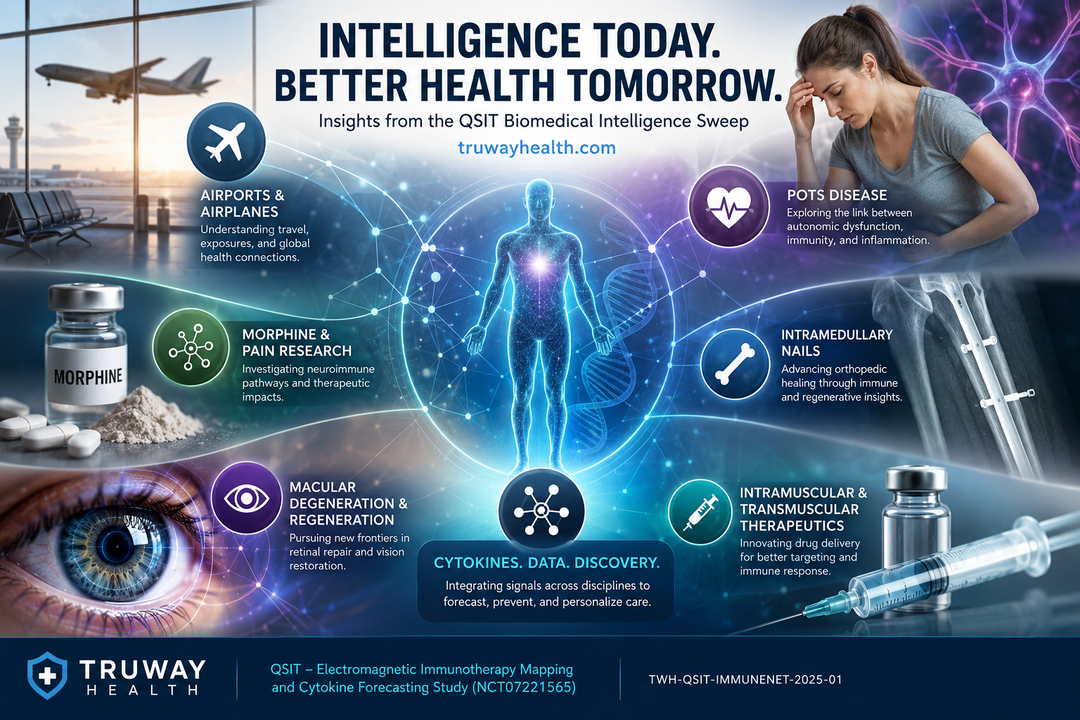
As part of the Electromagnetic Immunotherapy Mapping and Cytokine Forecasting Study (QSIT) (NCT07221565), our June 1, 2026 intelligence sweep reviewed scientific alerts and keyword monitoring activities spanning transportation medicine, autonomic disorders, regenerative medicine, ophthalmology, orthopedic recovery, injectable therapeutics, and immunologic signaling.
Why Airports and Aviation Matter to Healthcare
Modern airports and commercial aviation systems are more than transportation networks. They represent dynamic environments where infectious disease surveillance, environmental exposures, circadian rhythm disruption, cardiovascular stress, and public health monitoring intersect.
Research in aviation medicine continues to improve our understanding of how altitude, cabin pressure, travel-related stressors, and global mobility influence human physiology and healthcare preparedness.
As healthcare becomes increasingly mobile and interconnected, transportation hubs may serve as valuable sources of epidemiologic and population-health intelligence.
POTS Disease and the Growing Interest in Autonomic Health
One of the areas receiving increased attention across the medical literature is Postural Orthostatic Tachycardia Syndrome (POTS) and related dysautonomia conditions.
Researchers continue to investigate the relationship between autonomic nervous system dysfunction, inflammation, immune activation, viral illnesses, and cytokine signaling. These investigations are particularly relevant to future forecasting models seeking to understand how inflammatory pathways influence cardiovascular regulation, fatigue, cognition, and quality of life.
The growing body of evidence suggests that immune and neurologic systems may be more interconnected than previously understood.
Morphine, Pain Management, and Neuroimmune Communication
Pain management remains one of medicine's most important challenges.
Scientific investigations involving morphine and other opioid therapies continue to evaluate not only analgesic effectiveness but also downstream effects on immune function, inflammatory pathways, and neuroimmune communication.
Understanding how therapeutic agents influence cytokine expression may help researchers develop more precise and personalized treatment strategies in the future.
Orthopedic Recovery and Intramedullary Nail Research
Orthopedic trauma literature continues to highlight the role of inflammation, immune-cell recruitment, and tissue remodeling during fracture healing.
Intramedullary nail fixation procedures remain a cornerstone of modern orthopedic recovery, while researchers investigate the biologic mechanisms responsible for bone regeneration and long-term structural repair.
These studies provide valuable insights into how immune responses influence healing outcomes and may contribute to future regenerative medicine innovations.
Macular Degeneration and the Promise of Regenerative Medicine
Among the most exciting areas of modern biomedical research is the effort to restore vision through regenerative approaches.
Investigators continue to explore stem-cell therapies, retinal repair technologies, tissue engineering, and cellular regeneration strategies for age-related macular degeneration and other retinal disorders. Recent studies suggest regenerative medicine may eventually provide new opportunities for restoring damaged ocular tissues and improving visual function.
Although significant scientific and regulatory work remains ahead, the pace of innovation in ophthalmic regeneration continues to accelerate.
Intramuscular and Transmuscular Therapeutics
Drug-delivery science continues to evolve beyond traditional pharmaceutical approaches.
Researchers are actively studying intramuscular and transmuscular administration pathways for biologics, vaccines, regenerative therapeutics, and advanced delivery systems. These approaches may improve targeting, optimize immune responses, and enhance therapeutic effectiveness across multiple disease states.
Future innovations in this area may support personalized medicine initiatives and more efficient therapeutic deployment strategies.
The Bigger Picture: Connecting Signals Across Healthcare
What makes modern biomedical intelligence so powerful is not any single study—it is the ability to identify relationships across seemingly unrelated disciplines.
Aviation medicine, autonomic disorders, regenerative ophthalmology, orthopedic healing, injectable therapeutics, and cytokine biology may appear disconnected on the surface. Yet each contributes valuable information to a broader understanding of how the human body responds to injury, stress, disease, treatment, and recovery.
At Truway Health, the QSIT program continues to evaluate these interconnected signals through ongoing literature surveillance, biomarker mapping, and predictive analytics initiatives.
The future of healthcare will belong to organizations capable of transforming scientific information into actionable intelligence—and today's research signals may become tomorrow's medical breakthroughs.
Research Program: TWH-QSIT-IMMUNENET-2025-01
ClinicalTrials.gov Identifier: NCT07221565
Sponsor: Truway Health, Inc.
Keywords: POTS, Aviation Medicine, Airports, Airplanes, Morphine, Cytokines, Macular Degeneration, Regenerative Medicine, Intramuscular Injection, Orthopedic Recovery, Biomarkers, Precision Medicine, QSIT
Truway Health News & Insights

When Fall Feels Heavy: Seasonal Changes and Emotional Well-Being
Autumn arrives with golden leaves, cooler mornings, and invitations to get cozy. But you do not have...
The $20 Accessory That Can Sideline a $20,000 Device
The equipment has arrived. The team has cleared space, scheduled training, and prepared to put the n...

Can Your Sterile Storage Workflow Survive a Busy Monday?
It is 7:10 a.m. The first procedures are approaching, an add-on case has changed the schedule, and t...
Truway Health Surgical Instrument Kits & Trays: The Details Behind a Well-Configured Set
A surgical instrument kit is more than a collection of instruments. Its value lies in the details: t...
Introducing NeuroVista: Truway Health’s Research Platform for Imaging and Connected Medical Data
Understanding medical data requires more than a clear image or a single measurement. Researchers als...

Clinical Technology Outlook 2026–2030: From Isolated Measurements to Continuous, Connected Care
Clinical technology is entering a new phase. For decades, healthcare has largely been organized arou...