
TruWay Health Announces Registration of New Research Protocol for Federated Learning in Point-of-Care Cardiac Ultrasound
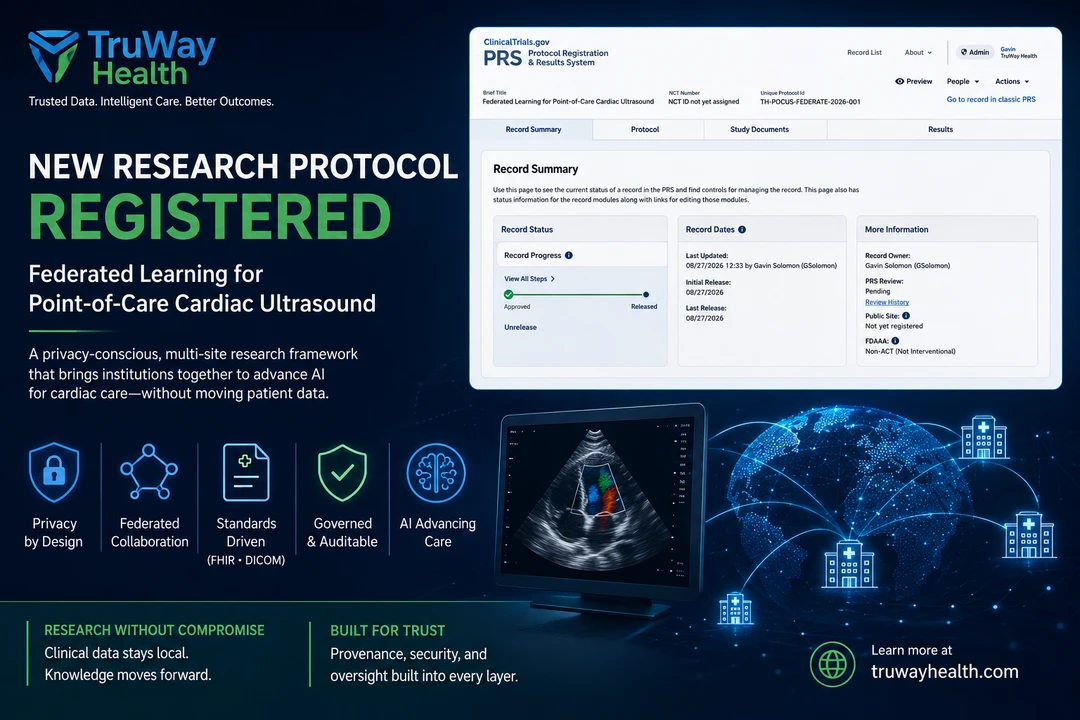
Protocol establishes a privacy-conscious framework for multi-site research integrating point-of-care cardiac ultrasound, federated learning, healthcare interoperability, and auditable research infrastructure
August 27, 2026 — TruWay Health today announced the registration of its research protocol, “Federated Learning for Point-of-Care Cardiac Ultrasound,” under unique protocol identifier TH-POCUS-FEDERATE-2026-001 in the ClinicalTrials.gov Protocol Registration and Results System (PRS).
The protocol addresses the development and evaluation of a federated-learning framework for point-of-care cardiac ultrasound research. The proposed approach is designed to enable participating research sites to collaborate on machine-learning development while maintaining underlying clinical and imaging data within their authorized environments.
The current PRS record identifies the protocol as Non-Interventional (Non-ACT). The record has been released in the PRS, with PRS review pending, and an NCT number has not yet been assigned.
Building a new model for collaborative cardiac ultrasound research
Point-of-care cardiac ultrasound has the potential to provide rapid, accessible cardiac imaging across diverse clinical environments. Developing reliable AI systems for this setting, however, requires research across varied patient populations, ultrasound devices, acquisition techniques, clinical workflows, and institutional environments.
The TH-POCUS-FEDERATE-2026-001 protocol is designed around federated learning, a research approach in which participating sites can train models using locally governed datasets while contributing controlled model information to a collaborative learning process.
Rather than requiring centralized collection of the underlying ultrasound datasets, the framework is intended to preserve institutional data boundaries while enabling systematic evaluation of model performance across participating environments.
“The next generation of healthcare AI will require more than increasingly capable models. It will require infrastructure that makes collaboration possible while respecting privacy, provenance, clinical governance, and institutional responsibility,” said Gavin Solomon of TruWay Health. “TH-POCUS-FEDERATE-2026-001 represents our effort to establish that foundation for point-of-care cardiac ultrasound research.”
Interoperability from the clinical record to the research model
The proposed architecture incorporates established healthcare interoperability standards, including FHIR and DICOM, to support the movement of authorized clinical and imaging information through controlled research workflows.
The framework contemplates a separation between clinical data and distributed research infrastructure. Protected health information, patient identifiers, and raw ultrasound imaging are intended to remain within appropriately governed clinical or research environments rather than being placed on a public blockchain.
Cryptographic commitments and distributed-ledger mechanisms may instead be used for selected provenance, authorization, attestation, governance, and treasury functions where appropriate.
This separation is intended to provide verifiable research infrastructure without treating a public blockchain as a repository for clinical information.
Federated learning with governance at the center
The protocol's architecture is designed to establish explicit controls around participating sites, model versions, training rounds, validation, provenance, and research outputs.
A representative research lifecycle may include:
- authorized site participation;
- participant screening and enrollment;
- consent and research-data governance;
- controlled ultrasound and clinical-data ingestion;
- local model training;
- authenticated federated updates;
- secure aggregation;
- independent model validation;
- model provenance and versioning;
- governed deployment decisions; and
- continuous audit and safety monitoring.
The architecture is designed so that the federated-learning system does not itself become the final authority over clinical decisions.
Human oversight remains fundamental
TruWay Health's framework places clinical and human governance above automated decision-making.
Where automated medical coding or other AI-derived outputs are used within the research workflow, those outputs are intended to be treated as candidates for appropriate review and validation rather than as autonomous clinical determinations.
Likewise, model performance, safety signals, validation results, and deployment decisions remain subject to applicable research governance and clinical oversight.
“Automation can make a research system faster, but speed cannot substitute for evidence,” said Solomon. “Our objective is to build an architecture in which computational systems are accountable to the research protocol rather than the protocol being redesigned around the limitations of the technology.”
Security and distributed infrastructure
The proposed technical architecture incorporates controlled identity, cryptographic signing, role-based authorization, audit trails, smart-wallet infrastructure, automated workflow controls, and governed treasury rails.
Where blockchain infrastructure is employed, its role is limited to appropriate trust and coordination functions. The design principle is straightforward: clinical information belongs within appropriately governed healthcare systems; cryptographic infrastructure can provide evidence about authorized events without becoming the clinical record itself.
Production deployment of cryptographic custody, smart contracts, automated payment mechanisms, and federated-learning infrastructure would remain subject to appropriate security review, independent testing, governance controls, and applicable regulatory requirements.
Research infrastructure, not a clinical-care claim
The registration of TH-POCUS-FEDERATE-2026-001 does not constitute a claim that an AI system developed under the protocol is clinically validated, independently diagnostic, or authorized for routine patient care.
The protocol is intended to provide a structured research framework through which federated learning and point-of-care cardiac ultrasound can be studied under appropriate scientific, ethical, security, and clinical governance.
TruWay Health intends for the research architecture to evolve alongside evidence generated through the protocol and through appropriate review by participating institutions and applicable oversight bodies.
Protocol Information
Brief Title: Federated Learning for Point-of-Care Cardiac Ultrasound
Unique Protocol ID: TH-POCUS-FEDERATE-2026-001
NCT Number: Not yet assigned
ClinicalTrials.gov PRS Status: Released
PRS Review: Pending
Study Classification: Non-Interventional (Non-ACT)
Initial Release: August 27, 2026
Last Release: August 27, 2026
Sponsor/Research Organization: TruWay Health
About TruWay Health
TruWay Health develops healthcare technology and research infrastructure focused on responsible integration of data, artificial intelligence, interoperability, and secure digital systems.
The company's work emphasizes a simple principle: advanced technology should strengthen—not weaken—the structures of privacy, clinical judgment, accountability, and trust upon which healthcare depends.
Learn more: truwayhealth.com
Media and research inquiries: TruWay Health News & Insights
Truway Health News & Insights

Healthcare Equipment Interoperability: Understanding DICOM, HL7, and FHIR
Truway Health | Medical Technology, Digital Infrastructure & Healthcare Innovation Modern medical eq...

Medical-Grade Stainless Steel: Comparing 304 and 316 for Healthcare Equipment
Truway Health | Medical Equipment, Materials Engineering & Healthcare Procurement Not all stainless...

Winter Respiratory Season Preparedness: Essential Supplies for Caregivers and Clinics
Published October 18, 2026 | Truway Health News & Insights When respiratory illnesses rise, preparat...

What Families Should Know When a Loved One Enters Hospice Care
For families with a terminally ill loved one, the start of hospice can land like two realities at on...

Moving from RN to Family Nurse Practitioner What You Need to Know
Experienced registered nurses often reach a point where strong bedside skills still leave a lingerin...
The Guidewire Is Not a Commodity: The Hidden Safety Architecture of Coronary Care
How precision engineering, clinical intelligence, and medical-device traceability are redefining exp...