
null

TruWay Health Announces OMNIPHYS: A 20-Year Multimodal Physiologic State Intelligence Research Program
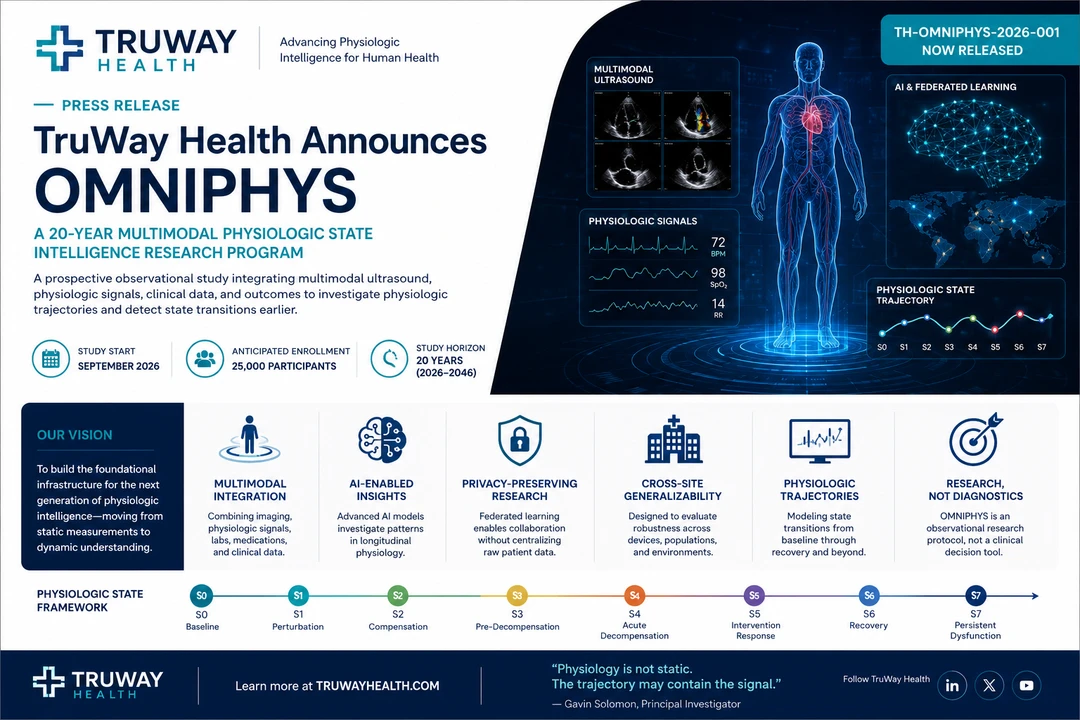
TruWay Health Announces OMNIPHYS: A 20-Year Multimodal Physiologic State Intelligence Research Program

PRESS RELEASE

TruWay Health Announces OMNIPHYS: A 20-Year Multimodal Physiologic State Intelligence Research Program

For Immediate Release
September 2, 2026
TruWay Health — News & Insights

New prospective observational platform will investigate longitudinal physiologic trajectories using multimodal ultrasound, artificial intelligence, and privacy-preserving federated learning

NEW YORK — September 2, 2026TruWay Health today announced the formal release of TH-OMNIPHYS-2026-001, the Multimodal Physiologic State Intelligence Study (OMNIPHYS), a prospective longitudinal observational research program designed to investigate how multimodal physiologic data can be integrated to characterize changes in human physiology over time.

The OMNIPHYS protocol is structured around a central scientific question:

Can longitudinal multimodal physiologic trajectories identify clinically meaningful state transitions earlier and more reliably than isolated, single-time-point measurements?

Rather than focusing on a single disease or organ system, OMNIPHYS establishes a common research architecture for studying physiologic state, trajectory, transition, intervention response, recovery, and clinical outcome across cardiovascular, vascular, pulmonary, renal, and systemic conditions.

From snapshots to trajectories

Traditional clinical measurements frequently represent individual observations in time. OMNIPHYS is designed to investigate the information contained between those observations.

The research framework models a participant's longitudinal physiology through predefined states:

S0 — Baseline → S1 — Physiologic Perturbation → S2 — Compensation → S3 — Pre-Decompensation → S4 — Acute Decompensation → S5 — Intervention Response → S6 — Recovery → S7 — Persistent Dysfunction

The program will investigate whether transitions between these states can be detected computationally using combinations of ultrasound-derived measurements, Doppler parameters, physiologic signals, laboratory information, clinical encounters, medications, diagnoses, and longitudinal outcomes.

A multimodal architecture for physiologic intelligence

OMNIPHYS is designed to integrate:

  • 2D and 3D ultrasound imaging
  • B-mode, color Doppler and spectral Doppler
  • Cardiac structural and functional measurements
  • Vascular flow and hemodynamic observations
  • Pulmonary ultrasound findings
  • ECG and vital signs
  • Oxygen saturation
  • Laboratory measurements
  • Medications and clinical interventions
  • Diagnoses and clinical encounters
  • Longitudinal clinical outcomes

These inputs will contribute to a research-level Physiologic State Vector (PSV) representing multidimensional physiologic observations over time.

The study's flagship endpoint is Physiologic Transition Detection Time (PTDT)—the interval between algorithmic identification of a prespecified clinically meaningful physiologic transition and the corresponding predefined clinical reference event.

Artificial intelligence and federated research

OMNIPHYS incorporates multimodal artificial intelligence as a research methodology for extracting longitudinal patterns from heterogeneous physiologic and imaging data.

Recent research demonstrates expanding applications of AI in point-of-care ultrasound, including image acquisition, interpretation, automated measurements, procedural applications, and quality assurance.

The program will also investigate federated learning, allowing participating research environments to contribute to collaborative model development without requiring centralized pooling of raw medical imaging data. Federated learning has emerged as a major research approach for medical image analysis, while simultaneously presenting important challenges involving data heterogeneity, domain shift, security, and generalizability.

Building for cross-device and cross-site generalizability

A central component of OMNIPHYS is the investigation of whether physiologic AI models remain reliable when exposed to differences in:

  • Ultrasound systems
  • Transducers
  • Imaging protocols
  • Clinical environments
  • Patient populations
  • Acquisition quality
  • Data distributions
  • Geographic and institutional settings
  • Temporal changes in clinical practice

The protocol therefore includes research endpoints addressing cross-site generalizability, cross-device robustness, model drift, temporal stability, uncertainty, out-of-distribution detection, and human-AI concordance.

A 20-year longitudinal research horizon

OMNIPHYS is currently structured as a prospective observational program with an anticipated study horizon from September 2026 through September 2046, allowing investigators to examine physiologic trajectories across extended periods of observation.

The anticipated enrollment is 25,000 participants, including adults undergoing routine clinical evaluation or care as well as healthy reference participants.

Disease-specific analyses may include heart failure, cardiomyopathies, pulmonary hypertension, myocarditis, pericarditis, heart valve disease, hypertension, venous thrombosis, peripheral arterial disease, aortic disease, sepsis, acute kidney injury, pulmonary edema, pulmonary embolism, and other clinically relevant physiologic conditions.

Research—not autonomous clinical decision-making

OMNIPHYS is an observational research program. It does not assign participants to an experimental treatment and is not intended to independently direct clinical care.

The program's AI, digital-twin, federated-learning, DICOM/FHIR, and computational components are intended as research infrastructure for longitudinal physiologic analysis. Clinical data and protected health information remain subject to applicable privacy, security, institutional, ethical, and regulatory requirements.

Any future clinical application of OMNIPHYS-derived technologies would require appropriate validation, regulatory assessment, clinical governance, and authorization as applicable.

A foundation for the next generation of physiologic research

With OMNIPHYS, TruWay Health is establishing a research architecture that moves beyond conventional disease classification toward a more dynamic model of human physiology:

Measure → Integrate → Model → Detect Transition → Characterize Response → Observe Recovery

The objective is not simply to determine whether a patient is abnormal at a particular moment, but to investigate how physiology is changing, how quickly it is changing, and whether those changes precede clinically meaningful events.

“OMNIPHYS is designed around a simple but consequential proposition: physiology is not static. The trajectory itself may contain clinically meaningful information that a single measurement cannot capture.”
Gavin Solomon, Principal Investigator, TruWay Health

About TruWay Health

TruWay Health develops healthcare technology, clinical research infrastructure, medical-device programs, and data-driven systems intended to advance the integration of diagnostic imaging, physiologic data, artificial intelligence, and longitudinal clinical research.

Protocol: TH-OMNIPHYS-2026-001
Study: Multimodal Physiologic State Intelligence Study (OMNIPHYS)
Study Type: Prospective Observational Cohort
Anticipated Enrollment: 25,000
Anticipated Study Period: September 2026–September 2046
Record Status: Released
Principal Investigator: Gavin Solomon


Scientific Context

The scientific rationale for OMNIPHYS is consistent with the rapidly expanding literature surrounding AI-enabled ultrasound, longitudinal physiologic assessment, and distributed/federated medical AI. Recent work has demonstrated the potential for AI-enabled ultrasound to support quantitative cardiac assessment at the point of care, while broader reviews identify substantial opportunities for AI throughout the echocardiography workflow. Federated-learning research further supports investigation of collaborative medical-AI development across distributed datasets without requiring direct cross-site sharing of raw imaging data.

Editorial note: OMNIPHYS is a research protocol and its release does not constitute IRB approval, FDA authorization, clinical validation, or a determination that any investigational algorithm is suitable for clinical decision-making.

Sep 2nd 2026 Truway Health

Truway Health News & Insights

TRUWAY HEALTH INSTAGRAM