
Truway Health Releases TRU-OMNIBODY Whole-Body Digital Twin and Physiologic Resilience Study
FOR IMMEDIATE RELEASE
Truway Health Releases TRU-OMNIBODY Whole-Body Digital Twin and Physiologic Resilience Study
Prospective observational study will evaluate whether a locked computational model can characterize and predict multisystem recovery in approximately 450 adults
NEW YORK — September 1, 2026 — Truway Health, Inc. today announced that the protocol record for the Truway Whole-Body Digital Twin and Physiologic Resilience Study, known as TRU-OMNIBODY, has been released through the ClinicalTrials.gov Protocol Registration and Results System for processing and review.
The study carries the Unique Protocol ID TH-OMNIBODY-DT-2026-001.
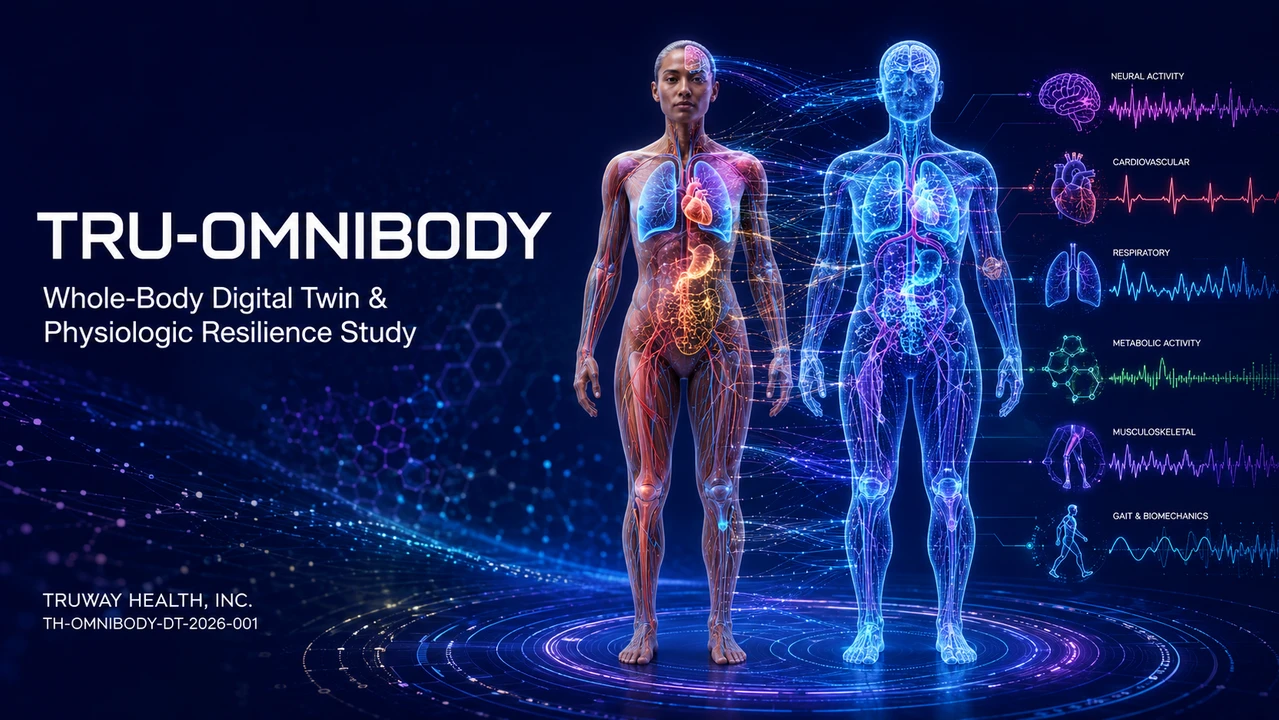
TRU-OMNIBODY is designed as a prospective observational cohort study examining how cardiovascular, respiratory, metabolic, neuromuscular, cognitive, sleep, mobility, and recovery-related signals interact across the whole body.
Approximately 450 adults between 18 and 80 years of age are expected to participate across three planned cohorts. The study will collect longitudinal clinical, physiologic, functional, imaging, wearable, and optional biospecimen-derived data to develop and independently validate a research-only whole-body digital-twin model.
No investigational drug, biologic, or therapeutic treatment will be assigned by the study.
Measuring the Body as an Integrated System
Most clinical measurements evaluate individual organs or variables at isolated moments. TRU-OMNIBODY will instead examine how multiple physiologic systems respond together, compensate for one another, and return toward baseline following standardized, nontherapeutic research assessments.
The planned assessment sequence may include:
- Resting physiologic stabilization
- Active standing and postural transition
- A six-minute walking assessment
- A cognitive dual-task assessment
- Monitored post-assessment recovery
- Continuous or intermittent wearable-sensor measurements
- Electrocardiographic, blood-pressure, respiratory, oxygenation, mobility, sleep, activity, symptom, and functional measurements
- Point-of-care imaging and body-composition assessments
- Optional collection of protocol-specified biospecimens
The study is intended to characterize physiologic reserve—the capacity of the body and its organ systems to respond to stress and recover after the stressor ends.
Building and Locking the Digital Twin
A version-controlled computational model will integrate each participant’s longitudinal physiologic, functional, clinical, imaging, wearable, and optional biospecimen-derived data.
The model will estimate whole-body resilience, organ-system interactions, physiologic reserve, and recovery trajectories. Model development will use a prespecified training sample, followed by locked validation in an independent sample.
The planned study population includes:
- Reference Health Cohort
Approximately 150 adults without the stable chronic conditions defining the comparison cohorts. - Stable Cardiometabolic Cohort
Approximately 150 adults with protocol-defined, clinically stable cardiometabolic conditions. - Stable Respiratory or Mobility Cohort
Approximately 150 adults with stable chronic respiratory conditions or mobility-related functional limitations. Protocol-permitted accommodations may be used when necessary for safe completion of study assessments.
The model-development population is expected to include approximately 300 participants. Once model architecture, parameters, preprocessing rules, and outcome calculations have been finalized, the model will be locked before evaluation in an independent validation population of approximately 150 participants.
This separation is intended to reduce information leakage and provide a more credible assessment of model performance in participants whose outcome data were not used during development.
Primary and Secondary Research Outcomes
The planned primary outcome is the mean absolute prediction error of the locked digital-twin model for the Whole-Body Resilience Index measured 30 minutes after the standardized assessment sequence.
The Whole-Body Resilience Index is a prespecified research composite intended to summarize recovery across multiple physiologic domains. It is not a validated diagnostic score and will not be used to determine participant treatment.
Secondary and exploratory outcomes are expected to include:
- Whole-Body Resilience Index values and changes over time
- Time required for measured variables to return toward baseline
- Multisystem physiologic coordination
- Six-minute walk performance
- Cognitive dual-task cost
- Cardiovascular and respiratory recovery patterns
- Model calibration and prediction error
- Between-cohort differences in physiologic reserve
- Associations between wearable, imaging, functional, and biospecimen-derived measures
- Procedure- or assessment-related adverse events
Investigational and Research-Only Use
The TRU-OMNIBODY digital twin is investigational and research-only. Its outputs will not be used to diagnose disease, select treatment, modify clinical care, determine insurance coverage, or make autonomous medical decisions.
The term “digital twin” refers to an individualized computational research representation developed from longitudinal participant data. It does not imply that the model is clinically equivalent to a participant, independently intelligent, or validated as a medical device.
“Human physiology is not a collection of isolated dashboards,” said Gavin Solomon, President and CEO of Truway Health, Inc. “TRU-OMNIBODY is designed to test whether the way multiple systems respond and recover together can be modeled reproducibly. Our objective is to build the program around prespecified outcomes, locked independent validation, transparent version control, and strong privacy boundaries from the outset.”
Privacy-Conscious Digital Governance
Truway Health is also developing a privacy-conscious governance framework for managing protocol versions, model versions, consent attestations, data-integrity evidence, and authorized research transactions.
Under the proposed architecture, identifiable health information and clinical source data would remain off-chain within access-controlled research systems. No protected health information is intended to be placed on a public blockchain.
If deployed, EVM-compatible components would be limited to nonidentifying cryptographic commitments, document or model-version hashes, consent-status receipts, governance events, audit evidence, and authorized treasury records. Detailed clinical data, direct identifiers, consent documents, and participant-level transaction information would remain off-chain.
Blockchain architecture, encryption, or smart contracts do not independently establish HIPAA compliance. Any operational deployment would require an organization-wide risk analysis, access controls, policies, workforce procedures, business-associate agreements where applicable, incident-response processes, technical validation, and independent privacy and security review.
Research Governance and Participant Protection
Participant enrollment will not begin until all applicable institutional review, human-subject protection, site-readiness, consent, safety, privacy, and study-activation requirements have been satisfied.
Any Truway Health internal protocol, IRB-bonding, governance, or tracking number is an internal administrative reference. It must not be interpreted as approval issued by an independent institutional review board.
The study design, assessments, locations, enrollment targets, dates, endpoints, and analysis procedures may change during scientific, ethical, operational, regulatory, or ClinicalTrials.gov review.
ClinicalTrials.gov Status
As of August 31, 2026, the TRU-OMNIBODY record has a PRS status of Released.
A PRS status of Released means that the sponsor has transmitted the record for ClinicalTrials.gov processing or review. It does not by itself mean that an NCT number has been assigned or that the study record is publicly available on ClinicalTrials.gov.
Truway Health will update its public study information when an official ClinicalTrials.gov identifier becomes available.
Study Information
Official Study Title: Truway Whole-Body Digital Twin and Physiologic Resilience Study
Acronym: TRU-OMNIBODY
Unique Protocol ID: TH-OMNIBODY-DT-2026-001
Sponsor: Truway Health, Inc.
Study Type: Observational
Observational Model: Prospective Cohort
Planned Enrollment: Approximately 450 participants
Number of Cohorts: Three
Age Range: 18–80 years
ClinicalTrials.gov NCT ID: Not assigned as of August 31, 2026
PRS Record Status: Released
Recruitment: Enrollment has not begun
About Truway Health, Inc.
Truway Health, Inc. is a health care and medical technology organization working across medical commerce, diagnostic technologies, clinical research, digital health infrastructure, health care procurement, and data-driven approaches to improving health care operations.
Through its research programs, Truway Health seeks to evaluate emerging technologies and clinical workflows using structured protocols, measurable outcomes, transparent governance, independent validation, and responsible data stewardship.
Media and Research Inquiries
Truway Health, Inc.
Clinical Research and Corporate Communications
Gavin Solomon, President and CEO
Email: gavin@truwayhealth.com
Phone: +1 516-768-5264
Website: https://truwayhealth.com
Clinical Research: https://truwayhealth.com/truay-health-clinical-trials/
Forward-Looking Statement: This release describes a planned observational research protocol and anticipated study activities. Study design, enrollment, dates, locations, assessments, endpoints, model architecture, technology components, regulatory status, and other elements may change during scientific, operational, IRB, privacy, security, or ClinicalTrials.gov review. Nothing in this announcement establishes the safety, effectiveness, clinical validity, regulatory approval, or fitness for clinical use of any digital-twin model, algorithm, device, blockchain system, or research procedure.
Truway Health News & Insights

Moving from RN to Family Nurse Practitioner What You Need to Know
Experienced registered nurses often reach a point where strong bedside skills still leave a lingerin...

The Guidewire Is Not a Commodity: The Hidden Safety Architecture of Coronary Care
How precision engineering, clinical intelligence, and medical-device traceability are redefining exp...

Truth Social Suspends @truwayhealth Without Explanation: Truway Health Challenges Digital Censorship and Demands Accountability
October 9, 2026 | Truway Health News & Insights NEW YORK, NY — Truway Health, Inc. is formally chall...

The Stethoscope Standard: Rethinking the Value of U.S. M1 Through Medical Productive Capacity
Money ultimately derives much of its usefulness from confidence: confidence that a dollar can be exc...

Simple Steps for Seniors to Embrace Healthy and Joyful Living
For seniors seeking holistic wellness, healthy aging can feel harder than it should: the body change...

Healthcare Procurement Readiness: Building a More Resilient Clinical Supply Chain
Healthcare supply chains are often judged by a simple question: Did the product arrive? But for hosp...