
null

Capnography Devices & EtCO₂ Monitoring | Best Practices | Truway Health
Capnography Devices & EtCO₂ Monitoring | Best Practices | Truway Health

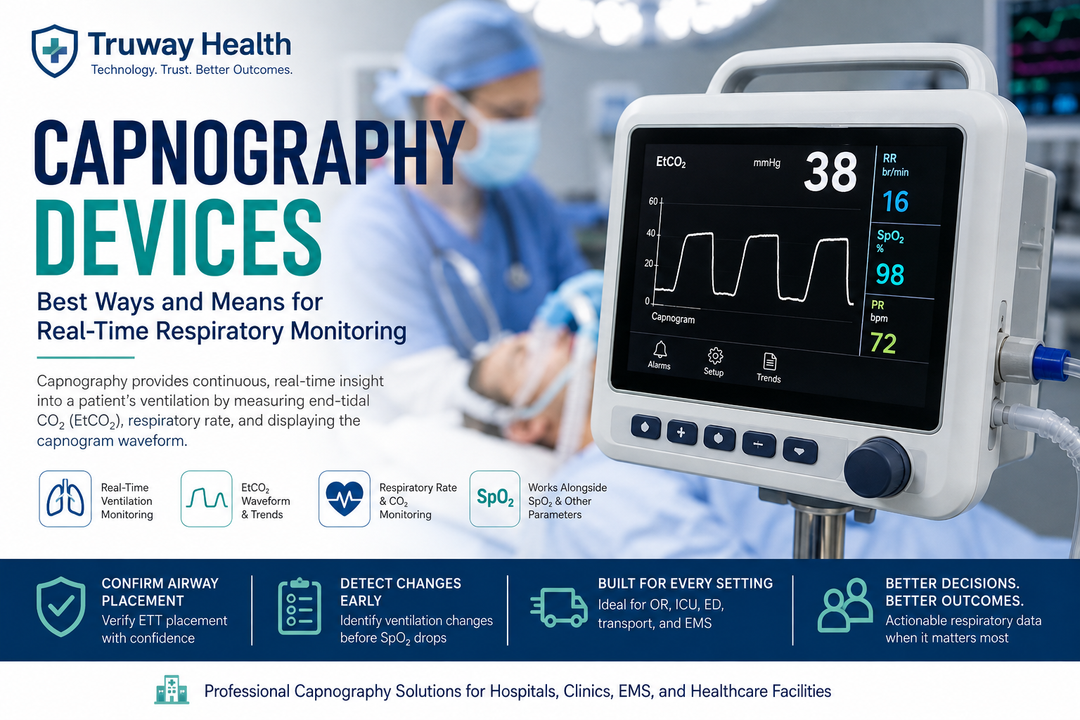
Capnography Devices: Best Ways and Means for Real-Time Respiratory Monitoring

Truway Health, Inc. | Clinical Technology & Respiratory Monitoring

SEO Page Title: Capnography Devices & EtCO₂ Monitoring | Best Practices | Truway Health
Meta Description: Learn how capnography devices measure EtCO₂ and respiratory rate, how waveform capnography differs from pulse oximetry, and best practices for device selection, clinical deployment, monitoring, and maintenance.

Seeing Ventilation in Real Time

In respiratory monitoring, knowing that a patient is oxygenated is not the same as knowing that a patient is ventilating effectively.

Pulse oximetry measures peripheral oxygen saturation, or SpO₂. Capnography measures carbon dioxide throughout the respiratory cycle and typically reports end-tidal carbon dioxide (EtCO₂), respiratory rate, and a continuous CO₂ waveform. Used together, these technologies provide clinicians with substantially different—and complementary—views of cardiopulmonary status.

This distinction is one reason capnography has become an important monitoring modality across anesthesia, procedural sedation, emergency medicine, critical care, patient transport, mechanical ventilation, and resuscitation. The American Society of Anesthesiologists requires continual evaluation of ventilation during anesthesia and specifies continuous analysis of expired carbon dioxide for appropriate airway-management situations. The American Association for Respiratory Care has likewise recommended continuous waveform capnography for confirming and monitoring endotracheal-tube placement and describes additional applications during mechanical ventilation and transport.

What a Capnography Device Actually Measures

A capnograph continuously measures the concentration or partial pressure of carbon dioxide in respiratory gases.

The most commonly displayed value is EtCO₂: the carbon dioxide concentration measured near the end of expiration. A monitor may simultaneously calculate respiratory rate and display a time-based waveform called a capnogram.

For many healthy adults, EtCO₂ is commonly encountered around 35–45 mmHg, although a number alone should never be interpreted independently of the patient's condition, perfusion, ventilation strategy, altitude, equipment configuration, and clinical context.

The waveform is particularly valuable because capnography is not simply a CO₂ number. It can reveal breath-by-breath changes in ventilation, airway patency and breathing pattern before those changes are necessarily reflected by pulse oximetry.

Capnography Versus Pulse Oximetry

The simplest operational distinction is:

Pulse oximetry asks: “How well is the blood being oxygenated?”

Capnography asks: “Is ventilation occurring, and what is happening to exhaled CO₂?”

A patient receiving supplemental oxygen may maintain an apparently satisfactory SpO₂ even while ventilation is deteriorating. Continuous capnography can therefore provide an additional layer of respiratory surveillance by detecting altered respiratory frequency, apnea patterns or changes in exhaled CO₂.

This does not make one technology a replacement for the other. The strongest monitoring strategy frequently combines EtCO₂ waveform + respiratory rate + SpO₂ + pulse, with additional parameters selected according to the patient's clinical requirements.

Mainstream or Sidestream: Choosing the Right Method

Two major measurement architectures dominate modern capnography.

Mainstream capnography places the CO₂ measurement sensor directly at or close to the patient's airway. It can provide rapid waveform response and is commonly associated with intubated or mechanically ventilated patients. The tradeoffs can include additional components at the airway and the need to consider adapter size, weight and dead-space implications for particular patient populations.

Sidestream capnography continuously draws a small respiratory-gas sample through tubing to a sensor inside or connected to the monitor. It is especially useful when monitoring spontaneously breathing patients through appropriately designed nasal or oral-nasal sampling interfaces, and it can also be used with advanced airways depending on the system.

Neither method is universally “better.” The correct platform is the one designed, cleared and configured for the intended patient population and clinical environment.

The Truway Health Best Ways and Means Approach

A dependable capnography program is built around more than buying a monitor. Truway Health recommends treating respiratory monitoring as an integrated clinical system encompassing the device, patient interface, alarms, consumables, workflow, training and data.

  1. Match the technology to the clinical environment. Define whether the system will support anesthesia, procedural sedation, emergency transport, bedside observation, mechanical ventilation, resuscitation, neonatal/pediatric care or multiple applications. Confirm the manufacturer's cleared indications before deployment.
  2. Prioritize continuous waveform capability. A numerical EtCO₂ measurement provides useful information, but the waveform supplies important information about the pattern and continuity of ventilation. AARC guidance recommends continuous waveform capnography for confirmation and ongoing monitoring of endotracheal-tube placement.
  3. Combine ventilation and oxygenation monitoring where appropriate. Integrated EtCO₂, SpO₂, pulse and respiratory-rate monitoring can reduce the need to interpret isolated measurements and creates a more complete respiratory picture.
  4. Treat alarms as clinical tools—not background noise. Alarm limits should follow patient-specific orders, institutional protocols and manufacturer instructions rather than relying automatically on factory defaults. Audible and visual alarm performance should be included in pre-use checks.
  5. Look at trends, not isolated values. An EtCO₂ number becomes much more useful when interpreted alongside waveform morphology, respiratory rate, SpO₂, hemodynamics and changes over time.
  6. Standardize sampling accessories. Cannulas, airway adapters, filters, sampling lines and water-management components should be compatible with the specific monitoring system. Incorrect or obstructed sampling components can compromise performance.
  7. Build capnography into transport workflows. When a patient depends on respiratory support, monitoring should not disappear simply because the patient leaves the ICU, OR or emergency department. AARC guidance specifically supports continuous capnometry during transport of mechanically ventilated patients.
  8. Create a documented inspection and maintenance program. Check batteries, sampling systems, sensor condition, alarms, connectors, software configuration and required calibration or verification according to the manufacturer's instructions for use.

Reading the Waveform

A normal time-based capnogram generally rises during expiration, reaches an alveolar plateau and falls sharply toward baseline with inspiration.

Clinical teams should become familiar with changes in both waveform shape and trend. For example, a progressively sloped expiratory pattern can occur with obstructive airflow conditions; failure to return toward baseline can suggest rebreathing or system-related problems; and a sudden disappearance of a previously reliable waveform requires immediate assessment for possibilities including apnea, airway displacement, disconnection or sampling-system failure.

The critical principle is not to diagnose a condition from the screen alone. Evaluate the patient first and use the capnogram as one component of the overall clinical assessment.

Capnography in Resuscitation and Emergency Care

Capnography also has an important role during cardiopulmonary resuscitation. The AARC guideline describes quantitative waveform capnography as a tool for monitoring cardiopulmonary resuscitation quality and identifying changes associated with return of spontaneous circulation in intubated patients.

The American Heart Association released its newest comprehensive CPR and Emergency Cardiovascular Care guidelines in October 2025, continuing an evidence-based systems approach to resuscitation and emergency cardiovascular care.

Capnography does not replace physical assessment, ECG interpretation, pulse checks when indicated or established resuscitation algorithms. It adds another continuously available physiological signal.

What Healthcare Organizations Should Look for When Procuring a Capnograph

Clinical capability comes first, but the purchasing decision should extend further.

A healthcare organization should examine FDA marketing authorization for the intended application and patient population, waveform quality, EtCO₂ and respiratory-rate performance, mainstream versus sidestream configuration, response time, alarm architecture, battery endurance, portability, mounting options, display readability, consumable availability, infection-control requirements, pediatric/neonatal compatibility where needed, serviceability, data export and interoperability capabilities.

For respiratory gas monitors, buyers and manufacturers may also encounter standards such as ISO 80601-2-55, which addresses basic safety and essential performance requirements for respiratory gas monitoring equipment, including carbon dioxide monitoring. The FDA currently recognizes this standard.

Regulatory status should be verified for the exact model and configuration being purchased rather than assumed from a product family's marketing materials.

The Future Is Integrated Respiratory Intelligence

Capnography is moving beyond the concept of a stand-alone EtCO₂ box.

Modern monitoring architectures increasingly bring together CO₂ waveform, respiratory rate, oxygen saturation, pulse and other physiological signals, while connectivity enables respiratory data to participate in broader clinical-monitoring and documentation workflows.

The most effective systems will not simply generate more measurements. They will make respiratory changes easier for healthcare professionals to recognize, contextualize and act upon.

For Truway Health, that is the central objective: the right monitoring technology, configured for the right patient and clinical environment, delivering actionable respiratory information when it matters.

Explore Capnography Solutions with Truway Health

Truway Health supports healthcare systems, laboratories, procedural environments, government facilities and institutional buyers seeking modern capnography and multi-parameter respiratory-monitoring solutions.

Capabilities may include EtCO₂ waveform monitoring, SpO₂, pulse, respiratory rate, portable configurations, bedside configurations and integration-ready options depending on the selected system.

Truway Health, Inc.
Healthcare Technology • Respiratory Monitoring • Clinical Equipment • Institutional Supply

Clinical information presented here is educational and does not replace professional medical judgment, institutional protocols, the manufacturer's instructions for use, or applicable regulatory requirements.

Aug 6th 2026 Truway Health

Truway Health News & Insights

TRUWAY HEALTH INSTAGRAM