
Building a Better Hospital Wound-Care Formulary
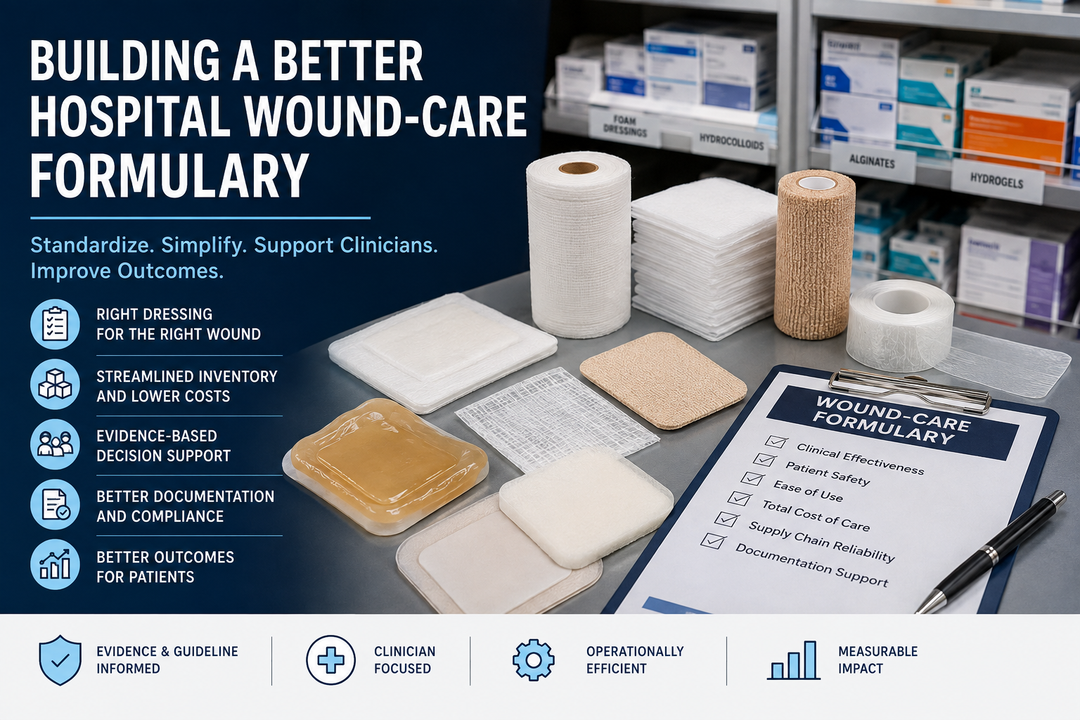
How health systems can standardize dressing selection, control inventory, support clinicians, and reduce unnecessary variation
A hospital wound-care formulary should be more than a list of gauze, foams, hydrogels, alginates, and specialty dressings available from central supply. At its best, the formulary functions as a clinical and operational decision system—giving clinicians enough options to address different wound characteristics while preventing unnecessary SKU proliferation, inconsistent product selection, avoidable waste, and documentation gaps.
That balance matters because wound management is inherently individualized. AHRQ emphasizes that pressure-injury prevention and care are multidisciplinary, multidimensional, and customized to each patient, while still requiring highly standardized and repeatable processes.
For hospitals, ambulatory surgery centers, long-term care facilities, wound clinics, and integrated health systems, the objective is therefore not to stock every dressing available. It is to build a focused wound-care platform that covers the majority of clinical requirements with the fewest appropriate, validated product families.
Start With the Wound—Not the Product
One of the most common formulary mistakes is organizing wound care around manufacturer product names.
A better system begins with the clinical characteristics that influence dressing selection.
A wound-care assessment may consider factors such as wound type, location, dimensions, depth, drainage, surrounding skin, tissue characteristics, infection concerns, patient tolerance, and the frequency with which reassessment or dressing changes are required. CMS documentation requirements for qualifying surgical dressings similarly call for wound type, location, size, drainage, dressing type, quantity and change frequency to be documented.
That suggests a simple principle:
Assess → Define the clinical requirement → Select the dressing category → Select the approved SKU.
Not:
Find a product → Decide where it might be used.
This distinction can dramatically simplify a formulary.
Build the Formulary Around Functional Categories
Instead of carrying numerous overlapping brands, hospitals can establish a core set of dressing categories, with one or a limited number of approved products within each category.
A practical hospital formulary might include:
| Dressing Category | Primary Formulary Function |
|---|---|
| Gauze & absorbent dressings | Basic absorption, coverage and secondary dressing |
| Non-adherent contact layers | Protect the wound surface while limiting adherence |
| Oil-emulsion/petrolatum contact layers | Non-adherent wound contact and protective interface |
| Transparent films | Thin protective barrier and visualization |
| Hydrogels | Moisture management where moisture donation is clinically appropriate |
| Hydrocolloids | Occlusive/semi-occlusive wound protection and moisture management |
| Alginate/gelling-fiber dressings | Exudate absorption and fluid management |
| Foam dressings | Absorption, protection and cushioning |
| Composite dressings | Integrated contact, absorbent and/or protective layers |
| Antimicrobial dressings | Specialized use under defined clinical criteria |
| Specialty wound products | Restricted-use products for defined protocols |
| Secondary fixation products | Roll gauze, retention dressings, tape and securement |
CMS distinguishes between primary dressings, which directly contact the wound, and secondary dressings, which provide a therapeutic or protective function and may secure the primary dressing. Examples of secondary materials include tape, roll gauze, bandages and certain compression materials.
Thinking in those functional categories makes substitutions and supply-chain management substantially easier.
The Goal Is Coverage, Not SKU Count
Imagine a hospital carrying:
- six hydrocolloid brands,
- nine foam dressings,
- five alginates,
- four non-adherent contact layers,
- seven antimicrobial dressings, and
- dozens of nearly identical gauze configurations.
The clinical department may technically have more choice, but purchasing, inventory management, staff education and replenishment become much more complicated.
A stronger formulary might use several carefully selected core platforms, each available in the dimensions clinicians actually need.
For example:
Core Foam Platform
Small, medium and large sizes; bordered and non-bordered configurations where justified.
Core Alginate/Gelling Platform
Sheet and rope configurations in a limited number of standardized sizes.
Core Hydrogel Platform
Amorphous gel plus sheet configuration if both have demonstrated utilization.
Core Contact-Layer Platform
Non-adherent or oil-emulsion gauze in standardized dimensions.
The result is not necessarily fewer treatment capabilities.
It is less duplication.
Establish a Dressing-Selection Matrix
Every approved dressing should have an identifiable role.
Hospitals can create an internal matrix linking product classes to characteristics such as:
Exudate level: low, moderate or high
Wound depth: superficial, partial-depth or deeper wound
Contact requirement: direct contact or secondary layer
Moisture objective: protect, maintain, donate or absorb
Periwound concern: fragile, maceration-prone or otherwise compromised skin
Change frequency: anticipated clinical interval
Special function: antimicrobial, odor management, hemostatic support or other defined purpose
Care environment: inpatient, OR, ED, ICU, outpatient wound clinic, home transition or other setting
The matrix should remain a clinical decision aid rather than a substitute for assessment, manufacturer instructions for use, institutional protocols or clinician judgment.
AHRQ specifically recommends standardized assessment and care pathways so that individualized care can still be delivered consistently across a hospital.
Pay Particular Attention to Wound Contact Layers
The wound-contact layer deserves special consideration because it is the material placed directly against the wound.
Hospitals may maintain different contact-layer options for different clinical needs, including non-adherent mesh, oil-emulsion gauze, petrolatum-impregnated gauze, silicone interfaces and other specialized materials.
From a formulary standpoint, teams should evaluate:
Atraumatic removal characteristics
Will removal unnecessarily disrupt the wound or surrounding tissue?
Conformability
Can the dressing conform to irregular anatomical areas?
Fluid transfer
Can exudate move appropriately into a secondary absorbent layer when the dressing is intended to function that way?
Secondary-dressing compatibility
Can clinicians pair the contact layer with the hospital's approved gauze, foam or absorbent products?
Packaging and sterility configuration
Is the unit packaging appropriate for the intended clinical setting?
Size availability
Are commonly required dimensions available without excessive cutting or waste?
A well-designed contact-layer category can become one of the most versatile components of the entire formulary.
Standardize Sizes Along With Materials
Hospitals often concentrate on dressing chemistry while overlooking something much simpler:
dimensions.
An excessive number of sizes can create nearly as much inventory complexity as excessive brands.
Analyze actual utilization and identify the dimensions responsible for most dressing use.
A standardized family might include:
5 cm × 5 cm — small wound/application
10 cm × 10 cm — general-purpose configuration
10 cm × 20 cm — larger or elongated areas
Roll or customizable format — only where operationally justified
The exact sizes should be determined by each organization's patient population and historical utilization.
The objective is to reduce situations where staff open an oversized expensive dressing only to cut away and discard much of it.
Treat Antimicrobial Dressings as a Deliberate Category
Silver, PHMB, iodine and other antimicrobial-containing wound products should not simply be added to the formulary because they represent a "premium" version of a standard dressing.
They should have a defined clinical role, approved indications and escalation/de-escalation pathway established by the appropriate clinical team.
Regulatory review is especially important in this category. FDA's wound-dressing framework distinguishes among different types of wound dressings, and regulatory requirements can differ based on composition, intended use and whether antimicrobials or other chemicals are incorporated. FDA has historically classified several basic dressing types—including nonresorbable gauze/sponges, hydrophilic dressings, occlusive dressings and hydrogel wound/burn dressings—as Class I device types, while products incorporating additional active components may follow different regulatory pathways.
For procurement teams, that means regulatory review should be performed at the individual product level, rather than assuming all products within a dressing category carry identical regulatory status.
Build Infection Prevention Into the Formulary
Product selection is only one component of safe wound care.
CDC's core infection-prevention framework emphasizes Standard Precautions throughout healthcare, including hand hygiene, appropriate use of personal protective equipment and proper management of patient-care equipment and the environment.
The wound formulary should therefore integrate with hospital policies covering:
- hand hygiene,
- aseptic or clean technique as clinically appropriate,
- PPE,
- single-use products,
- storage and handling,
- contaminated dressing disposal,
- environmental cleaning,
- isolation precautions when applicable,
- and product-specific instructions for use.
Patients with excessive wound drainage may also require additional infection-control considerations depending on the clinical situation. CDC notes that Contact Precautions may apply where wound drainage or other body discharges create increased potential for environmental contamination and transmission.
The dressing cabinet and the infection-control policy should never operate as two unrelated systems.
Documentation Should Influence Formulary Design
A strong wound-care formulary also makes documentation easier.
CMS's current surgical-dressing guidance illustrates how important documentation can become: the agency reports a 57.6% improper-payment rate for surgical dressings in the 2024 reporting period, with lack of documentation and insufficient documentation representing the overwhelming majority of identified payment errors.
Even when a hospital is not billing an individual dressing under the Medicare surgical-dressing benefit, the lesson is useful.
Standardization makes it easier for EHR workflows to capture:
Wound type
Location
Length × width × depth
Drainage
Approved dressing category
Product used
Quantity
Change frequency
Reassessment findings
CMS currently requires many of these elements when determining medical necessity for covered surgical dressings.
Instead of asking clinicians to document hundreds of proprietary products, hospitals can map formulary SKUs directly into predefined EHR selections.
Evaluate Total Cost Per Episode—Not Dressing Price Alone
The cheapest dressing is not necessarily the lowest-cost product.
Procurement analysis should consider:
Acquisition cost
Price per dressing.
Utilization rate
How many dressings are actually consumed?
Change frequency
How frequently does the approved protocol require replacement?
Nursing time
What is involved in application, removal and redressing?
Secondary materials
Does the product require additional gauze, fixation or absorbent layers?
Waste
How frequently are dressings partially used or discarded?
Inventory carrying cost
How many configurations must remain stocked?
Expiration loss
Do slow-moving specialty dressings routinely expire?
Training burden
How many different application procedures must clinical staff understand?
A $3 dressing used efficiently can be economically preferable to a $1 dressing that creates unnecessary changes, secondary-material consumption or waste.
Formulary committees should therefore evaluate cost per clinically appropriate treatment pathway, not simply price per unit.
Separate Core, Specialty and Restricted Products
One of the most effective structures is a three-tier formulary.
Tier 1 — Core Formulary
Products readily available across appropriate hospital units.
Examples could include:
gauze, absorbent pads, non-adherent contact layers, basic foams, hydrogel, hydrocolloid and alginate/gelling products.
Tier 2 — Specialty Formulary
Products stocked in defined departments or central supply.
These might include specialized antimicrobial dressings, advanced cavity products or other lower-volume configurations.
Tier 3 — Restricted / Wound-Team Authorization
High-cost or highly specialized products requiring defined authorization, indication or consultation.
This structure preserves clinical flexibility without requiring every nursing unit to maintain every advanced product.
Make the Wound-Care Team Part of Procurement
Wound-care products should rarely be selected by purchasing departments alone.
A hospital formulary committee can include representatives from:
Wound/ostomy nursing
Nursing leadership
Surgery
Emergency medicine
Infection prevention
Pharmacy where applicable
Supply chain/procurement
Value analysis
Materials management
Finance/reimbursement
Quality and patient safety
AHRQ similarly describes pressure-injury care as a multidisciplinary process involving nurses, physicians, dietitians, physical therapists, patients and families.
Supply-chain expertise and clinical expertise need to intersect.
Measure the Formulary
A wound-care formulary should evolve based on data rather than remain unchanged for years.
Useful KPIs can include:
- Dressing cost per occupied bed
- Dressing cost per wound-care encounter
- Number of active wound-care SKUs
- Percentage of spend concentrated in core SKUs
- Dressing changes per patient episode
- Product waste and expiration rate
- Stockout frequency
- Emergency/non-formulary purchasing
- Nursing satisfaction
- Contract compliance
- Documentation completeness
- Pressure-injury incidence and other applicable quality measures
- Time required to replenish nursing-unit inventory
Hospitals can review these metrics quarterly and determine whether products should be expanded, consolidated, substituted or removed.
A Better Formulary Is a Better Supply Chain
The strongest wound-care formularies connect five disciplines:
Clinical assessment → Product standardization → Procurement → Documentation → Outcomes measurement
When those systems are disconnected, hospitals can accumulate redundant products, fragmented protocols, expired inventory and unnecessary purchasing complexity.
When they are connected, wound care becomes easier to teach, easier to supply and easier to measure.
The goal should never be to eliminate clinical choice.
The goal is to make the right choices easier to identify, obtain, document and reproduce throughout the organization.
The Truway Health Approach
Truway Health supports a formulary strategy centered on standardized wound-care categories, clearly differentiated dressing configurations and scalable procurement for healthcare organizations.
Whether a facility is evaluating non-adherent contact layers, oil-emulsion gauze, hydrogel dressings, hydrocolloids, alginates, medical honey dressings, foam dressings or other advanced wound-care products, procurement should begin with the clinical requirement and work backward toward the appropriate product configuration.
A better wound-care formulary is ultimately not about stocking more.
It is about creating a smarter system around every dressing that enters the hospital.
Clinical note: This article is intended for healthcare procurement and educational purposes. Dressing selection and treatment decisions should be based on patient assessment, institutional policy, applicable regulatory requirements, product labeling/instructions for use and qualified clinical judgment.
Truway Health News & Insights

Healthcare Equipment Interoperability: Understanding DICOM, HL7, and FHIR
Truway Health | Medical Technology, Digital Infrastructure & Healthcare Innovation Modern medical eq...

Medical-Grade Stainless Steel: Comparing 304 and 316 for Healthcare Equipment
Truway Health | Medical Equipment, Materials Engineering & Healthcare Procurement Not all stainless...

Winter Respiratory Season Preparedness: Essential Supplies for Caregivers and Clinics
Published October 18, 2026 | Truway Health News & Insights When respiratory illnesses rise, preparat...

What Families Should Know When a Loved One Enters Hospice Care
For families with a terminally ill loved one, the start of hospice can land like two realities at on...

Moving from RN to Family Nurse Practitioner What You Need to Know
Experienced registered nurses often reach a point where strong bedside skills still leave a lingerin...

The Guidewire Is Not a Commodity: The Hidden Safety Architecture of Coronary Care
How precision engineering, clinical intelligence, and medical-device traceability are redefining exp...