
null

Understanding Central-Line, Angiography, and Cath-Lab Procedure Packs
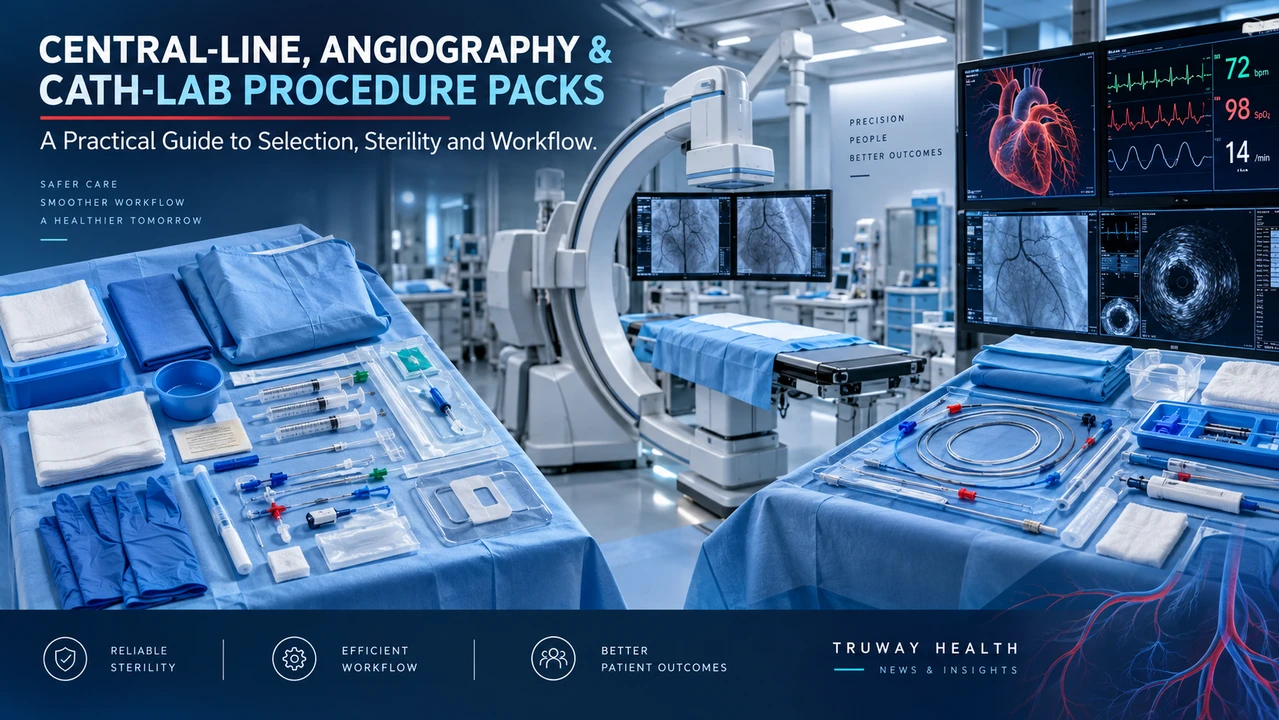
Understanding Central-Line, Angiography, and Cath-Lab Procedure Packs

In vascular access and interventional medicine, preparation is directly connected to efficiency, consistency, and infection prevention. Central-line, angiography, and cardiac catheterization laboratory procedure packs help healthcare teams organize commonly required sterile supplies into a single, procedure-focused package.

Although these packs may contain similar items—such as drapes, gowns, towels, syringes, needles, gauze, bowls, and preparation accessories—they are not interchangeable. Each pack is designed around a different clinical environment and workflow.

What Is a Sterile Procedure Pack?

A sterile procedure pack is a preassembled collection of disposable medical supplies selected for a particular procedure or family of procedures. The components are arranged, packaged, and sterilized to support efficient setup while limiting the number of separately opened packages.

Common objectives include:

  • Standardizing procedural setup
  • Reducing preparation time
  • Supporting aseptic technique
  • Limiting unnecessary package handling
  • Simplifying inventory management
  • Reducing omitted or substituted supplies
  • Improving consistency across clinical teams

A procedure pack does not necessarily contain every product required for the procedure. Catheters, guidewires, introducer sheaths, contrast-delivery devices, medications, implants, and other specialized components may be packaged separately.

Central-Line Procedure Packs

Central-line packs are primarily configured to support the insertion of central venous access devices. Depending on the facility and pack configuration, they may be used in an intensive-care unit, emergency department, operating room, interventional suite, or another controlled clinical environment.

Central venous access may be required for purposes such as hemodynamic monitoring, medication administration, fluid therapy, parenteral nutrition, blood sampling, or other medically indicated applications.

Typical central-line pack components

A central-line procedure pack may contain:

  • Full-body or fenestrated sterile drape
  • Sterile gown
  • Surgical mask and cap
  • Sterile gloves
  • Absorbent towels
  • Gauze sponges
  • Skin-preparation applicator
  • Chlorhexidine-based preparation solution, when specified
  • Syringes and needles
  • Scalpel
  • Suture or catheter-securing accessories
  • Transparent or gauze dressing
  • Labeling materials
  • Waste bag or protective wrap

Exact contents vary. The central venous catheter, guidewire, dilator, introducer needle, and other insertion components may be included in a separate manufacturer-specific catheter kit.

Central-line packs should support the facility’s infection-prevention protocol. CDC guidance for central venous catheter insertion includes hand hygiene, aseptic technique, maximal sterile barrier precautions, and appropriate skin preparation. Maximal barrier precautions generally involve a cap, mask, sterile gown, sterile gloves, and a sterile full-body drape. CDC intravascular-catheter infection-prevention guidelines

Angiography Procedure Packs

Angiography packs are designed for diagnostic or interventional vascular procedures performed under imaging guidance. They usually provide a larger sterile field and more fluid-management supplies than a standard central-line pack.

Depending on their configuration, angiography packs may support peripheral, cerebral, renal, visceral, or other vascular imaging procedures. The pack typically supports room preparation and sterile access; it does not automatically include every catheter, guidewire, sheath, balloon, stent, or contrast-administration component required for the case.

Typical angiography pack components

An angiography pack may include:

  • Large angiography drape
  • Equipment, back-table, or instrument-table cover
  • Sterile gowns
  • Absorbent towels
  • Reinforced surgical drapes
  • Basin or solution bowl
  • Guidewire bowl
  • Medicine cups
  • Syringes
  • Needles
  • Gauze sponges
  • Radiopaque sponges
  • Hemostats
  • Scalpel
  • Labels
  • Fluid-collection pouch
  • Waste bag

Some configurations contain separate sections that allow the circulating and scrub teams to establish the sterile field in a defined sequence.

Cath-Lab Procedure Packs

Cath-lab packs are configured for the specialized workflow of a cardiac catheterization laboratory. They may support diagnostic coronary angiography, right- or left-heart catheterization, percutaneous coronary intervention, electrophysiology procedures, structural-heart procedures, or related cardiovascular interventions.

The term “angiography/cath-lab pack” is sometimes used as a combined product category because the two pack types share many components. However, a cardiac catheterization laboratory may require different drape dimensions, access-site configurations, absorbency levels, table covers, fluid-control features, and accessory quantities.

Typical cath-lab pack components

A cath-lab pack may contain:

  • Large femoral, radial, or universal access drape
  • Patient underpad
  • Instrument- or procedure-table covers
  • Sterile gowns
  • Towels
  • Gauze and radiopaque sponges
  • Bowls and medicine cups
  • Syringes and needles
  • Scalpel
  • Hemostats
  • Fluid-collection pouch
  • Equipment covers
  • Labels and markers
  • Waste-management components

Procedure-specific devices—including diagnostic or guiding catheters, pressure lines, manifolds, transducers, guidewires, introducer sheaths, closure devices, balloons, stents, and intracardiac imaging catheters—are often supplied separately.

Comparing the Three Pack Types

Characteristic Central-Line Pack Angiography Pack Cath-Lab Pack
Primary application Central venous access Image-guided vascular procedures Cardiac catheterization and intervention
Typical environment ICU, ED, OR or procedure room Interventional radiology or vascular suite Cardiac catheterization laboratory
Sterile-field size Focused to full-body barrier Large procedural field Large, equipment-intensive field
Common access sites Neck, chest or groin Radial, femoral or other vascular sites Radial, femoral or venous access
Fluid-management needs Generally moderate Moderate to high Moderate to high
Equipment covers Limited or optional Common Common
Specialized devices included Usually separate Usually separate Usually separate
Main purchasing priority Barrier protection and standardized insertion Imaging-suite workflow and fluid control Cardiac workflow, access configuration and equipment coverage

How Procedure Packs Support Infection Prevention

A procedure pack cannot independently prevent infection, but a properly selected pack can support an established infection-control program by ensuring that required sterile barriers and supplies are available at the point of care.

Important considerations include:

  • Package integrity
  • Sterility status and sterilization method
  • Expiration date
  • Lot traceability
  • Component labeling
  • Storage conditions
  • Correct opening technique
  • Compatibility with the facility’s written protocol
  • Safe disposal of sharps and contaminated materials

The FDA explains that sterile medical devices may be processed using steam, radiation, ethylene oxide, vaporized hydrogen peroxide, or other validated methods. Manufacturers are responsible for validating the sterilization approach and supplying appropriate labeling for devices marketed as sterile. FDA: Sterilization for Medical Devices

A pack should not be used if its packaging is wet, torn, punctured, opened, incorrectly labeled, expired, or otherwise compromised.

Standard Packs vs. Custom Procedure Packs

Healthcare organizations can purchase standard packs or work with a supplier to develop customized configurations.

Standard packs

Standard configurations may offer:

  • Faster availability
  • Lower minimum-order quantities
  • Established component lists
  • Easier product comparison
  • Less implementation work

Custom packs

Customized packs may help facilities:

  • Match a defined clinical workflow
  • Remove consistently unused components
  • Add frequently opened supplies
  • Standardize products across departments
  • Reduce setup steps
  • Consolidate purchasing
  • Address clinician preferences

Customization should be based on documented utilization data rather than preference alone. A pack with too few components creates additional opening and retrieval steps, while an overfilled pack can increase cost and waste.

What Procurement Teams Should Evaluate

Before selecting a central-line, angiography, or cath-lab pack, procurement teams should request and review:

  1. Complete component list
    Confirm every component, size, quantity, material, and manufacturer reference.
  2. Clinical application
    Determine whether the configuration is intended for central access, general angiography, cardiac catheterization, or a more specific procedure.
  3. Drape design
    Review dimensions, fenestration placement, reinforcement, adhesive areas, absorbency, and access-site orientation.
  4. Sterility documentation
    Confirm sterilization method, packaging configuration, shelf life, lot identification, and applicable quality documentation.
  5. Material and allergy considerations
    Identify natural-rubber latex, preparation solutions, adhesives, coatings, and other materials that may affect facility requirements.
  6. Sharps configuration
    Verify needle gauges, syringe sizes, scalpel type, safety features, and compatibility with the clinical protocol.
  7. Device exclusions
    Clearly establish which catheters, guidewires, sheaths, medications, implants, and accessories must be ordered separately.
  8. Storage and case packaging
    Evaluate package dimensions, case quantity, shelf-space requirements, weight, and environmental storage conditions.
  9. Substitution policy
    Determine whether the supplier may substitute components and how changes will be communicated and approved.
  10. Supply continuity
    Review production lead time, available inventory, manufacturing location, alternate configurations, and contingency planning.

The Importance of Configuration Review

Product names alone are not sufficient for selecting a procedure pack. Two products labeled “cath-lab pack” may have significantly different contents and layouts.

The final configuration should be reviewed by the appropriate clinicians, infection-prevention personnel, supply-chain representatives, and other facility stakeholders. The contents must align with the facility’s policies, equipment, access techniques, and patient population.

Final Perspective

Central-line, angiography, and cath-lab procedure packs share a common purpose: placing organized sterile supplies within immediate reach of the clinical team. Their individual configurations, however, reflect very different procedural settings.

Central-line packs emphasize barrier precautions and vascular-access setup. Angiography packs support larger imaging-guided vascular procedures. Cath-lab packs are structured around cardiac catheterization workflows, specialized equipment, and radial, femoral, or venous access.

Careful review of pack contents, sterility documentation, drape design, materials, traceability, workflow compatibility, and supply continuity can help healthcare organizations select a configuration that supports both clinical and operational requirements.

Truway Health supplies sterile procedure packs, including angiographic and cath-lab packs, for hospitals, cardiovascular programs, interventional departments, and institutional healthcare buyers.

This article is intended for general educational and procurement information. Product selection and clinical use must follow the manufacturer’s instructions, facility policies, applicable regulations, and the judgment of qualified healthcare professionals.

Sep 14th 2026 Truway Health

Truway Health News & Insights

TRUWAY HEALTH INSTAGRAM