
The Stethoscope Standard: Rethinking the Value of U.S. M1 Through Medical Productive Capacity
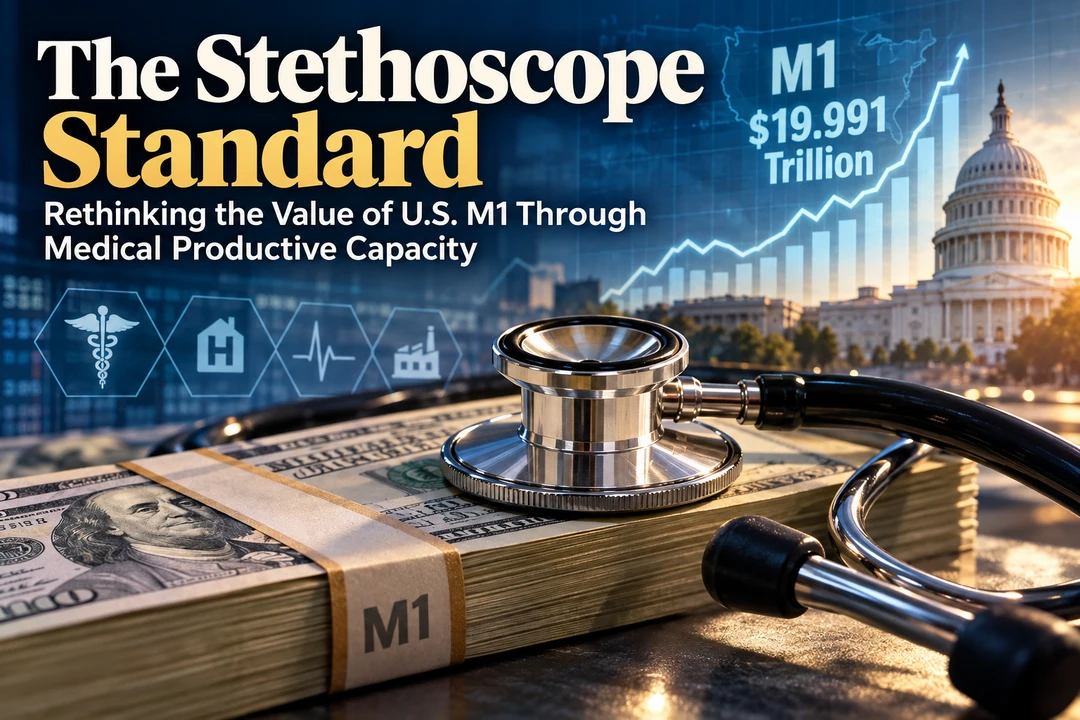
Money ultimately derives much of its usefulness from confidence: confidence that a dollar can be exchanged tomorrow for goods, labor, energy, technology, food, housing, or healthcare. That principle raises an unusual but useful economic thought experiment: what if the value of the United States’ most liquid money supply were conceptually benchmarked against a standardized medical stethoscope?
As of August 2026, the Federal Reserve’s seasonally adjusted measure of M1 stood at approximately $19.991 trillion. M1 presently includes currency, demand deposits, and other highly liquid deposits rather than being backed by any particular commodity.
A hypothetical “stethoscope standard” would therefore not mean replacing dollars with medical equipment. Instead, it could function as a real-economy purchasing-power benchmark: a way of asking how much standardized medical productive capacity the liquid monetary system represents.
Why a Medical Stethoscope?
Historically, societies have anchored money to scarce commodities such as gold and silver. A stethoscope represents a very different kind of reference asset. Its economic significance arises not primarily from scarcity but from its relationship to human capital, healthcare infrastructure, manufacturing, clinical labor, education, and productive capacity.
A stethoscope is compact, durable, globally recognizable, and associated with one of the economy’s most essential services: healthcare. Its production requires materials, manufacturing equipment, quality control, logistics, intellectual property, trained labor, distribution networks, and functioning clinical institutions.
The instrument can therefore be treated conceptually as a miniature basket of industrial and healthcare inputs.
Under such a framework, one might define a Stethoscope Purchasing-Power Unit, or SPU:
[
SPU = \frac{M1}{P_s}
]
where:
-
(M1) = total U.S. M1 money stock,
-
(P_s) = standardized market price of one qualifying medical stethoscope.
Suppose, purely for illustration, that the benchmark stethoscope were priced at $200.
With M1 at approximately $19.991 trillion:
[
SPU = \frac{19.9911 \text{ trillion}}{200}
]
yielding roughly:
[
99.96 \text{ billion stethoscope-equivalent units}
]
This does not imply that nearly 100 billion physical stethoscopes should or could be manufactured. Rather, it illustrates the scale of immediately liquid money in relation to the price of a tangible clinical instrument.
From Commodity Money to Productive-Capacity Money
The economic significance of such a benchmark becomes clearer when compared with a classical gold standard.
Gold derives monetary attractiveness from scarcity, durability, divisibility, and historical acceptance. Yet gold itself measures very little about the productive condition of hospitals, laboratories, factories, transportation networks, or medical personnel.
A healthcare-oriented benchmark would emphasize something different: productive usefulness.
The theoretical monetary anchor would effectively ask:
How much real medical capability can a unit of currency command?
If the cost of manufacturing a standardized diagnostic instrument rose dramatically while the monetary supply expanded even faster, the relationship could reveal erosion in the dollar's medical purchasing power.
Conversely, technological improvements that lowered manufacturing costs could increase healthcare purchasing power even without changes in the nominal money supply.
A Medical Purchasing-Power Index
Rather than literally pegging the dollar to one product, economists could construct a broader Medical Productive Capacity Index.
A stethoscope might serve as the symbolic base unit while the index incorporates prices for:
-
diagnostic instruments,
-
hospital consumables,
-
ultrasound equipment,
-
sterile instruments,
-
clinical labor,
-
electricity,
-
medical-grade polymers and metals,
-
freight and logistics,
-
digital medical infrastructure,
-
and manufacturing capacity.
The resulting index could be expressed as:
[
MPCI_t = \frac{M1_t}{H_t}
]
where (H_t) represents the cost of a standardized healthcare-capability basket at time (t).
The change in medical monetary purchasing power could then be measured as:
[
\Delta MPPC =
\frac{MPCI_t-MPCI_{t-1}}
{MPCI_{t-1}}
\times100
]
A falling value would indicate that liquid dollars were growing more slowly than healthcare purchasing costs, while a rapidly rising value could indicate increased nominal liquidity relative to the medical basket.
The Difference Between a Benchmark and a True Peg
There is an important distinction between measuring money against stethoscopes and actually pegging the dollar to stethoscopes.
A genuine monetary peg would require an issuing authority to promise some defined convertibility relationship—for example, one monetary unit redeemable for a fixed quantity of a standardized instrument or claims upon such instruments.
That would be impractical for modern monetary policy. Stethoscopes differ by manufacturer, quality, technology, materials, certification, and geographic market. Their supply is also elastic: manufacturers can simply produce more of them.
A literal peg could therefore produce severe distortions. If the benchmark price were fixed above the free-market price, manufacturers might overproduce stethoscopes simply to exploit the monetary conversion mechanism. If the fixed price were below market equilibrium, shortages could emerge.
For this reason, the stronger economic concept is not physical convertibility but indexation.
M1 as a Claim on American Productive Capacity
The broader insight is that M1 can be viewed as an enormous collection of immediately exercisable claims on goods and services.
The Federal Reserve currently defines M1 through monetary instruments rather than physical backing; beginning in May 2020, its construction was broadened to include other liquid deposits alongside currency and demand deposits.
Those dollars acquire practical meaning when exchanged against the productive economy.
A $100 balance is economically meaningful because it can purchase groceries, transportation, telecommunications, medical services, equipment, or labor.
The proposed stethoscope benchmark simply makes that relationship visible.
Instead of saying:
M1 = approximately $19.991 trillion
one could additionally say:
M1 represents approximately 99.96 billion $200 stethoscope-equivalent purchasing units.
This alternative denomination converts a monetary aggregate into something tangible.
Healthcare as a Monetary Reference Sector
Healthcare has several characteristics that make it especially interesting for monetary analysis.
Demand is persistent across business cycles. Healthcare production combines advanced technology with human labor. Medical supply chains span domestic manufacturing, imports, logistics, pharmaceuticals, electronics, metals, plastics, software, insurance, and government procurement.
Healthcare inflation can therefore capture cost pressures originating throughout the wider economy.
A medical-equipment monetary benchmark might consequently function as a specialized indicator of whether growth in money and credit is being matched by growth in real productive capability.
The theoretical objective would not be to maximize the number of stethoscopes produced.
The objective would be to preserve the relationship:
[
\text{Money} \longleftrightarrow \text{Real Productive Capacity}
]
The Stethoscope as an Economic Symbol
There is also a philosophical difference between a gold-based monetary symbol and a medical one.
Gold represents accumulated wealth.
A stethoscope represents applied knowledge.
Its economic value exists because physicians, nurses, engineers, manufacturers, logistics companies, universities, hospitals, and patients participate in a functioning institutional network.
In that sense, the stethoscope standard would conceptualize national wealth not merely as stored assets, but as society's capacity to diagnose, treat, manufacture, transport, innovate, and preserve human life.
A sophisticated modern economy may therefore benefit from viewing monetary strength not solely through foreign-exchange rates, precious metals, or asset prices, but through what its currency can reliably command in essential productive sectors.
Conclusion
The United States does not operate a stethoscope-backed monetary system, nor would physically redeeming dollars for medical instruments be a practical monetary architecture.
Yet the thought experiment provides a useful economic lens.
With U.S. M1 approaching $20 trillion, measuring that liquidity against a standardized clinical instrument transforms an abstract monetary aggregate into a representation of tangible purchasing power.
The resulting “stethoscope standard” could serve as a conceptual measure of medical purchasing power, industrial capacity, healthcare inflation, and monetary productivity.
Its central proposition is simple:
The long-run value of money should ultimately be judged by what the productive economy can deliver in exchange for it.
Under that framework, the stethoscope becomes more than a diagnostic instrument. It becomes a symbolic monetary yardstick linking American liquidity to manufacturing, medicine, human capital, and real economic capability.
Truway Health News & Insights

Healthcare Equipment Interoperability: Understanding DICOM, HL7, and FHIR
Truway Health | Medical Technology, Digital Infrastructure & Healthcare Innovation Modern medical eq...

Medical-Grade Stainless Steel: Comparing 304 and 316 for Healthcare Equipment
Truway Health | Medical Equipment, Materials Engineering & Healthcare Procurement Not all stainless...

Winter Respiratory Season Preparedness: Essential Supplies for Caregivers and Clinics
Published October 18, 2026 | Truway Health News & Insights When respiratory illnesses rise, preparat...

What Families Should Know When a Loved One Enters Hospice Care
For families with a terminally ill loved one, the start of hospice can land like two realities at on...

Moving from RN to Family Nurse Practitioner What You Need to Know
Experienced registered nurses often reach a point where strong bedside skills still leave a lingerin...

The Guidewire Is Not a Commodity: The Hidden Safety Architecture of Coronary Care
How precision engineering, clinical intelligence, and medical-device traceability are redefining exp...