
The Guidewire Is Not a Commodity: The Hidden Safety Architecture of Coronary Care
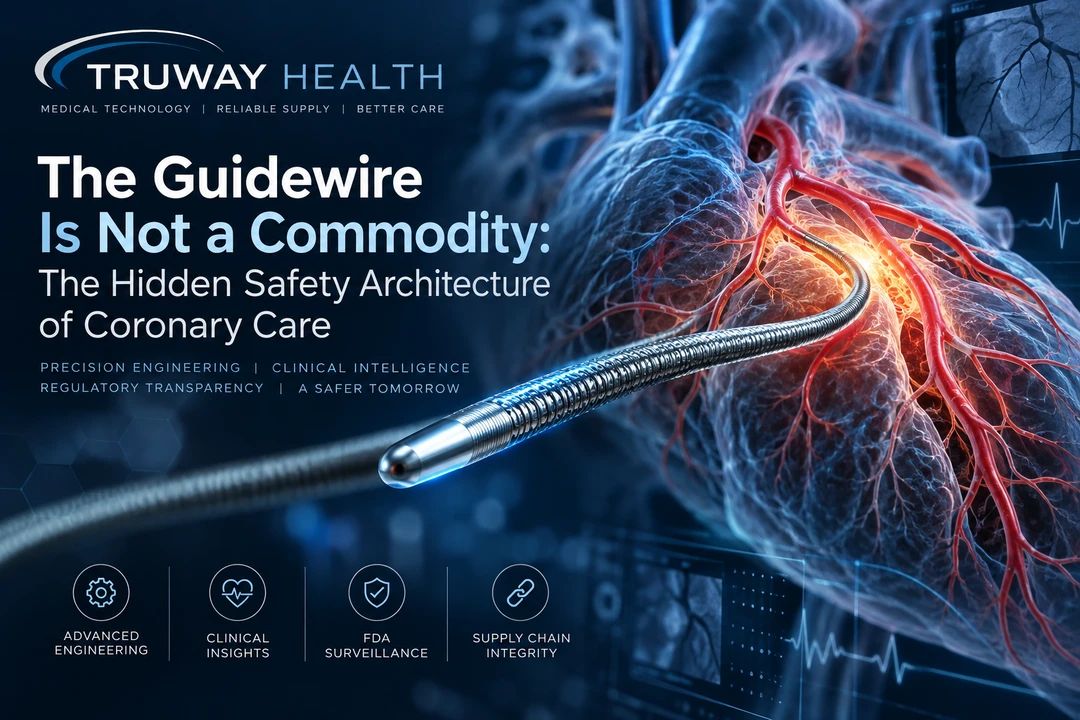
How precision engineering, clinical intelligence, and medical-device traceability are redefining expectations for modern cardiovascular medicine.
By Truway Health | Medical Technology & Clinical Intelligence
In cardiovascular medicine, some of the smallest instruments carry the greatest responsibilities.
A guidewire may be only a fraction of a millimeter in diameter, yet its mechanical behavior can influence the success of an intricate vascular intervention. It must navigate challenging anatomy, provide the necessary support for compatible devices, and respond predictably to a clinician's movements.
For hospitals and healthcare suppliers, that raises an important question: Are we treating medical guidewires as precision-engineered clinical technologies—or merely as interchangeable inventory?
At Truway Health, we believe the distinction matters.
The Engineering Behind Every Intervention
Guidewires are essential components of many minimally invasive cardiovascular and vascular-access procedures. Their design reflects a carefully balanced combination of mechanical properties, materials science, and intended clinical use.
A guidewire's performance can be influenced by its core construction, tip configuration, coating, flexibility, torque transmission, and resistance to deformation.
Stainless steel and specialized alloys provide different mechanical characteristics. Hydrophilic and other surface coatings may affect lubricity and handling. Tip designs influence how a wire behaves as it encounters changes in vessel anatomy.
There is no universally appropriate guidewire for every procedure.
A wire designed for one vascular application should not automatically be substituted for a coronary intervention or another anatomical indication. Compatibility, manufacturer labeling, and the clinician's judgment must guide selection.
The objective is not simply to create a wire that can move through a vessel. It is to engineer a device whose performance can be understood, documented, and evaluated.
When Millimeters Become Clinical Consequences
Percutaneous coronary intervention (PCI) has transformed the treatment of coronary artery disease, allowing clinicians to treat selected arterial obstructions using catheter-based techniques.
Nevertheless, coronary interventions carry risks.
A 2025 scientific review of PCI complications discusses vessel perforation, acute vessel closure, and equipment loss. Another contemporary review examines coronary dissection, perforation, and guidewire entrapment, emphasizing the importance of prevention, prompt recognition, and appropriate management.
These findings underscore an essential reality: even advanced interventional technologies operate within biological and mechanical limits.
Device quality alone cannot eliminate procedural risk. Anatomy, clinical decisions, technique, and equipment interactions all contribute to outcomes.
For medical-device suppliers, the responsibility is therefore to support transparency around product specifications, intended use, performance documentation, and applicable quality requirements.
The Supply Chain Is Part of the Patient-Safety Equation
Modern cardiovascular care depends on more than the equipment present inside a catheterization laboratory.
Behind every sterile procedural package is an interconnected manufacturing and distribution system.
Raw materials must be procured. Components must be manufactured under appropriate quality controls. Finished products require labeling, packaging, handling, and distribution consistent with applicable requirements.
An interruption anywhere in this chain can create operational challenges for healthcare institutions.
The consequences of a shortage may include delayed procurement, additional sourcing reviews, and the need to evaluate alternative products.
But alternative sourcing cannot come at the expense of clinical compatibility.
At Truway Health, our view is that resilient procurement should be evaluated through three connected dimensions: availability, documentation, and clinical suitability.
Reliable supply is important. Reliable information about that supply is equally important.
From Product Identification to Intelligent Surveillance
The next frontier of medical-device accountability involves connecting physical products with reliable digital records.
The FDA's Unique Device Identification system provides a framework for identifying medical devices throughout their distribution and use, subject to applicable requirements and exceptions.
Depending on the device and labeling requirements, identification information can support recognition of the specific product version or model and relevant production details.
This creates important opportunities for manufacturers, distributors, and healthcare institutions.
When applicable identifiers, lot information, manufacturing records, and procurement documentation are preserved accurately, organizations can improve the efficiency of investigations and product identification.
However, traceability should not end with a barcode.
A more comprehensive surveillance framework also considers published research, device performance observations, adverse-event reports, recalls, and other regulatory information.
The FDA's Manufacturer and User Facility Device Experience (MAUDE) database provides one source of medical-device adverse-event reports.
Crucially, an adverse-event report is not proof that a device caused an injury or malfunction. The FDA cautions that passive reporting data cannot independently establish event rates or causation.
Responsible surveillance requires careful interpretation rather than sensational conclusions.
Turning PubMed Research Into Practical Questions
Medical literature provides another dimension of clinical intelligence.
Studies published through PubMed can help researchers understand emerging procedural techniques, recognized complications, changing clinical practices, and unanswered scientific questions.
But gathering publications is only the beginning.
An effective research strategy asks whether new findings are reproducible, relevant to a specific device category, supported by adequate evidence, and capable of informing future clinical investigation.
For guidewires and coronary interventions, research priorities may include mechanical performance, biocompatibility, vessel injury mechanisms, coating integrity, procedural complications, and long-term clinical outcomes.
This is where the intersection of biomedical engineering, procurement, and evidence surveillance becomes particularly valuable.
Clinical evidence can inform product evaluation, while real-world observations can generate new research questions.
A New Standard of Accountability
Healthcare institutions should expect more from the medical-device ecosystem than a product description and a shipping confirmation.
They should have access to accurate device identification, appropriate instructions for use, manufacturer-supported technical specifications, and clear information about applicable regulatory status.
Purchasing decisions should reflect clinical requirements rather than commercial availability alone.
Manufacturers and distributors can contribute by maintaining reliable documentation, communicating verified availability, and responding appropriately to quality concerns.
Researchers can contribute by examining adverse-event patterns without confusing correlation with causation.
And clinicians remain central to evaluating whether an instrument is appropriate for a specific patient and intervention.
The future of cardiovascular device safety depends on connecting all four perspectives.
The Truway Health Perspective
At Truway Health, we view medical technology as part of a larger continuum connecting manufacturing, distribution, clinical practice, scientific research, and patient safety.
Our interest in vascular-access technologies and cardiovascular equipment reflects a broader commitment to informed medical procurement and responsible innovation.
The industry has an opportunity to move beyond fragmented product catalogs and isolated safety reports toward more connected systems of clinical intelligence.
Such systems should be evidence-driven, technically rigorous, and transparent about their limitations.
A guidewire may appear simple.
Its engineering is not.
Its clinical significance is not.
And the systems responsible for bringing it safely into healthcare environments should never be taken for granted.
Because precision in medicine begins long before a device reaches the patient.
Explore Medical Technology With Truway Health
Discover medical equipment, vascular-access technologies, and healthcare procurement resources through Truway Health.
For product inquiries, technical documentation, or institutional sourcing requirements, contact Truway Health through our official website.
Editorial Notice: This article is intended for educational and industry-information purposes. It does not constitute medical advice, establish the suitability of any particular device, or substitute for manufacturer instructions, regulatory documentation, or professional clinical judgment.
Scientific and Regulatory References
-
Kumar S, et al. (2025). Update on the diagnosis and treatment of coronary complications of percutaneous coronary interventions. Journal of Invasive Cardiology. PubMed PMID: 39565942
-
Al-Ogaili A, Gill GS, Brilakis ES. (2025). Complications of percutaneous coronary intervention. Progress in Cardiovascular Diseases. PubMed PMID: 39788341
-
U.S. FDA. About the MAUDE Database.
-
U.S. FDA. Unique Device Identification: UDI Basics.
Truway Health News & Insights
The Guidewire Is Not a Commodity: The Hidden Safety Architecture of Coronary Care
How precision engineering, clinical intelligence, and medical-device traceability are redefining exp...

Truth Social Suspends @truwayhealth Without Explanation: Truway Health Challenges Digital Censorship and Demands Accountability
October 9, 2026 | Truway Health News & Insights NEW YORK, NY — Truway Health, Inc. is formally chall...

The Stethoscope Standard: Rethinking the Value of U.S. M1 Through Medical Productive Capacity
Money ultimately derives much of its usefulness from confidence: confidence that a dollar can be exc...

Simple Steps for Seniors to Embrace Healthy and Joyful Living
For seniors seeking holistic wellness, healthy aging can feel harder than it should: the body change...

Healthcare Procurement Readiness: Building a More Resilient Clinical Supply Chain
Healthcare supply chains are often judged by a simple question: Did the product arrive? But for hosp...

Pass-Through Chambers and Material Flow in Controlled Healthcare Environments
Controlled healthcare environments depend on more than clean surfaces and filtered air. The way mate...