
Medical-Grade Stainless Steel: Comparing 304 and 316 for Healthcare Equipment
Truway Health | Medical Equipment, Materials Engineering & Healthcare Procurement
Not all stainless steel is created equal. In healthcare environments, selecting the right material can influence equipment durability, corrosion resistance, maintenance costs, and long-term operational reliability.
From surgical instrument trays and operating room furniture to laboratory workstations, sterile storage cabinets, and mortuary equipment, stainless steel plays an important role in modern healthcare infrastructure.
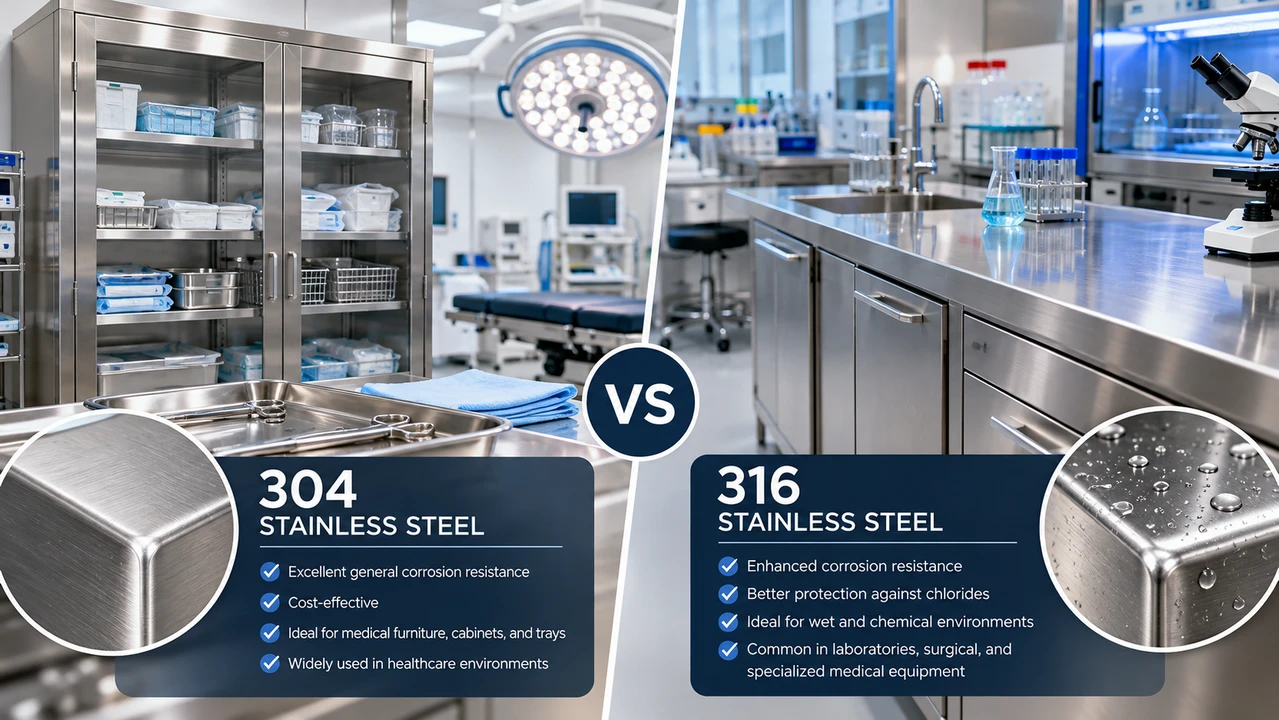
Two of the most commonly specified grades are 304 and 316 stainless steel. Although both belong to the austenitic stainless steel family and offer excellent utility in medical environments, their chemical compositions and corrosion resistance differ in important ways.
Understanding these differences helps healthcare procurement professionals, biomedical engineers, facility managers, and clinical equipment buyers make better-informed purchasing decisions.
In this guide, Truway Health examines the engineering characteristics, practical applications, maintenance considerations, and procurement factors that distinguish 304 from 316 stainless steel.
1. What Makes Stainless Steel Suitable for Healthcare Equipment?
Stainless steel is an iron-based alloy containing at least approximately 10.5% chromium.
Chromium enables the formation of a thin, protective oxide film on the surface of the metal. This passive layer provides resistance to many forms of corrosion and can reform when suitable environmental conditions are present.
Several characteristics make stainless steel particularly useful in healthcare:
-
Corrosion resistance: Helps preserve equipment integrity in environments exposed to moisture and cleaning agents.
-
Mechanical durability: Provides strength for carts, workstations, cabinets, and instrument-handling equipment.
-
Cleanable surfaces: Properly finished stainless steel can support established environmental cleaning and infection-control procedures.
-
Temperature tolerance: Suitable grades and equipment designs can withstand demanding processing conditions.
-
Long service life: Appropriate material selection and maintenance can reduce premature replacement requirements.
-
Manufacturing versatility: Stainless steel can be fabricated into shelves, trays, tanks, structural components, and specialized equipment.
However, stainless steel is not inherently sterile, antimicrobial, or immune to corrosion.
Surface finish, fabrication quality, cleaning procedures, and equipment design all influence its suitability for a particular healthcare application.
2. Understanding 304 Stainless Steel
Grade 304 is one of the most widely used stainless steels for general-purpose equipment.
It is often called 18/8 stainless steel because its nominal composition includes approximately 18% chromium and 8% nickel.
Typical characteristics
-
Chromium content of approximately 18–20%.
-
Nickel content of approximately 8–10.5%.
-
Good general corrosion resistance.
-
Excellent formability and weldability.
-
Suitable for many indoor healthcare environments.
-
Generally lower material cost than 316 stainless steel.
Common healthcare applications
304 stainless steel may be appropriate for:
-
Hospital utility carts and storage racks.
-
Medical instrument trays and noncritical accessories.
-
Examination room furniture.
-
Sterile storage cabinet interiors.
-
Laboratory benches and equipment enclosures.
-
Operating room furniture.
-
Selected autopsy tables and mortuary equipment.
For example, Truway Health offers a sterile storage cabinet with a 304 stainless steel interior, illustrating the practical use of this material in institutional healthcare storage equipment.
Where 304 performs best: Controlled indoor environments with suitable cleaning protocols, limited aggressive chemical exposure, and manageable corrosion risks.
Its combination of durability, workability, and cost efficiency makes it an attractive option for many healthcare purchasing applications.
3. Understanding 316 Stainless Steel
Grade 316 is another austenitic stainless steel, but it contains an important additional alloying element: molybdenum.
Typically present at approximately 2–3%, molybdenum improves resistance to localized corrosion, particularly in environments involving chlorides.
This advantage can be valuable where equipment experiences frequent wet cleaning, chemical exposure, or potentially corrosive operating conditions.
Typical characteristics
-
Chromium content of approximately 16–18%.
-
Nickel content of approximately 10–14%.
-
Molybdenum content of approximately 2–3%.
-
Greater resistance to chloride-induced pitting than 304.
-
Improved resistance to certain forms of crevice corrosion.
-
Generally higher acquisition cost than 304.
Common healthcare applications
Depending on the operating conditions and technical specifications, 316 stainless steel may be selected for:
-
Laboratory processing equipment.
-
Pharmaceutical manufacturing components.
-
Medical washdown environments.
-
Specialized sinks and wet-processing equipment.
-
Certain reusable instrument components.
-
High-humidity equipment enclosures.
-
Premium mortuary or pathology equipment.
What is 316L stainless steel?
316L is a low-carbon version of 316 stainless steel.
The reduced carbon content helps limit susceptibility to certain forms of corrosion associated with welding and sensitization.
This can make 316L particularly attractive for fabricated, welded equipment assemblies.
However, 316L does not automatically mean implant-grade stainless steel. Materials used for implants must meet the appropriate implant-specific specifications and device requirements.
4. 304 vs. 316 Stainless Steel: Technical Comparison
| Characteristic | 304 Stainless Steel | 316 Stainless Steel |
|---|---|---|
| Material family | Austenitic | Austenitic |
| Chromium | ~18–20% | ~16–18% |
| Nickel | ~8–10.5% | ~10–14% |
| Molybdenum | Not intentionally added | ~2–3% |
| General corrosion resistance | Good | Good to excellent |
| Chloride pitting resistance | Lower | Higher |
| Weldability | Good | Good |
| Typical material cost | Lower | Higher |
| Routine indoor medical furniture | Often suitable | Often suitable |
| Challenging wet environments | Requires greater evaluation | Often preferred |
| Sterilization suitability | Device dependent | Device dependent |
Composition ranges are approximate and depend on the applicable material standard.
Neither grade is universally superior. Appropriate selection depends on the actual environmental exposure, fabrication requirements, validated cleaning procedures, and expected service life.
5. Why Corrosion Resistance Matters in Medical Environments
Healthcare equipment is frequently exposed to water, detergents, disinfectants, bodily fluids, and other potentially corrosive substances.
Two important corrosion mechanisms are pitting corrosion and crevice corrosion.
Pitting corrosion
Pitting occurs when localized areas of the protective surface layer break down, potentially creating small cavities in the metal.
Chloride-containing environments are a common concern.
316 stainless steel generally provides stronger resistance to chloride-induced pitting because of its molybdenum content.
However, neither 304 nor 316 is completely immune.
Crevice corrosion
Crevice corrosion can develop in narrow gaps where moisture and contaminants accumulate.
Examples include:
-
Bolted connections.
-
Cabinet seams.
-
Hinges and joints.
-
Areas beneath gaskets.
-
Welded intersections.
-
Poorly drained equipment surfaces.
A well-designed 304 stainless steel assembly may perform better in a given environment than a poorly fabricated 316 assembly.
The key procurement lesson: Alloy selection matters, but drainage, weld quality, surface finishing, cleaning compatibility, and maintenance are equally important engineering considerations.
6. Cleaning, Disinfection, and Sterilization Compatibility
One common misconception is that 316 stainless steel is automatically easier to sterilize than 304 stainless steel.
In practice, sterilization effectiveness depends on the complete device design and the validated reprocessing method—not simply the stainless steel grade.
The U.S. Food and Drug Administration emphasizes that reusable medical devices require appropriate cleaning followed by disinfection or sterilization according to their intended use and validated manufacturer instructions.
Considerations for healthcare facilities
Surface finish: Smooth, properly finished surfaces can make routine cleaning more manageable.
Weld integrity: Poorly finished welds and recessed gaps may retain contamination.
Chemical compatibility: Disinfectants must be compatible with the equipment materials and finishes.
Water quality: Mineral deposits and chloride-containing residues may affect long-term surface condition.
Reprocessing instructions: Steam sterilization, ultrasonic cleaning, thermal disinfection, and chemical treatment should only be used when permitted by the device manufacturer.
Important caution about bleach
Sodium hypochlorite and other chlorine-containing chemicals can attack stainless steel surfaces, including 316.
Healthcare facilities should not assume that higher-grade stainless steel can tolerate unrestricted bleach exposure.
Always follow both the equipment manufacturer's instructions and the disinfectant's labeling.
7. Applications Across Healthcare Facilities
Hospitals and surgical centers
304 stainless steel is often a practical choice for cabinets, carts, work surfaces, and furniture used under controlled indoor conditions.
316 may be worth considering when equipment faces more demanding chemical, moisture, or chloride exposure.
Laboratories and pharmaceutical facilities
Laboratory equipment selection should consider chemical exposure, material compatibility, cleaning methods, and process contamination risks.
In specialized pharmaceutical processing applications, 316L is commonly evaluated for product-contact and welded components, subject to process-specific engineering requirements.
Surgical instruments
The selection of materials for surgical instruments is more complex than choosing between 304 and 316.
Cutting instruments may require hardened stainless alloys, while other surgical tools require specific mechanical properties, surface finishes, and reprocessing compatibility.
ASTM F899 addresses chemical requirements for several classes of wrought stainless steels used in surgical instruments.
Buyers should request product-specific documentation rather than assuming that the phrase “surgical stainless steel” identifies a particular alloy.
Mortuary and pathology equipment
Autopsy tables, specimen-handling stations, washdown systems, and refrigeration equipment require careful consideration of moisture exposure, drainage, construction quality, and cleaning.
304 stainless steel is used in commercial pathology equipment, while 316 or 316L may be evaluated for more aggressive operating environments or customized premium configurations.
The material upgrade should be justified by the anticipated exposure and the equipment's complete design.
8. Surface Finishing and Passivation: Why They Matter
Two products manufactured from the same stainless steel grade may perform differently over time because of their surface preparation.
Manufacturing operations, welding, grinding, and handling can leave contamination or surface imperfections.
What is passivation?
Passivation treatments are used to remove certain surface contaminants, particularly free iron, and help establish an appropriate corrosion-resistant surface condition.
ASTM A967/A967M provides specifications for chemical passivation treatments of stainless steel parts.
Related ASTM practices address cleaning, descaling, and surface preparation.
Questions buyers should ask
-
Has the stainless steel been mechanically finished and chemically treated as specified?
-
Are weld seams smooth, complete, and accessible for cleaning?
-
Does the manufacturer provide surface finish requirements?
-
Are material certifications and relevant inspection reports available?
-
Are cleaning and maintenance procedures documented?
A premium steel grade without appropriate fabrication controls may not deliver the expected service life.
9. Cost Considerations: Is 316 Worth the Investment?
316 stainless steel generally carries a higher raw-material cost because of its alloy composition.
But material price is only one component of the purchasing decision.
Healthcare facilities should consider:
-
Initial equipment purchase price.
-
Cleaning and maintenance requirements.
-
Expected corrosion exposure.
-
Equipment downtime and replacement costs.
-
Availability of repair parts.
-
Warranty coverage.
-
Service life and total cost of ownership.
When 304 may be the better investment
For many indoor carts, shelving systems, examination room fixtures, and medical storage applications, properly manufactured 304 equipment can provide excellent value.
When 316 may justify its premium
316 may offer greater value when corrosion risks are substantial enough to increase maintenance, replacement, or operational disruption costs.
Rather than specifying 316 universally, procurement teams should identify the exposure conditions that justify its use.
A higher material grade does not necessarily produce a better purchasing outcome unless it solves a meaningful operational problem.
10. What Does “Medical-Grade Stainless Steel” Actually Mean?
The term medical-grade stainless steel is commonly used in equipment marketing, but it does not identify one universal metallurgical specification or automatically establish FDA clearance.
Different applications require different material properties and standards.
Examples include:
| Standard | General relevance |
|---|---|
| ASTM F899 | Wrought stainless steels for surgical instruments |
| ASTM F1089 | Corrosion testing of surgical instruments |
| ASTM A967/A967M | Chemical passivation treatments |
| ASTM A380/A380M | Cleaning, descaling, and passivation practices |
| ASTM F138 | Specific stainless steel bar and wire for surgical implants |
| ISO 5832-1 | Wrought stainless steel materials for surgical implants |
The relevance of each standard depends on the product.
Medical instruments, implants, and ordinary healthcare furniture should not be treated as interchangeable regulatory categories.
For regulated medical devices, material selection forms only one part of the applicable safety, performance, and regulatory assessment.
11. Healthcare Procurement Checklist: Choosing the Right Grade
Before purchasing stainless steel medical equipment, consider the following:
-
Define the intended application. Is the equipment a storage fixture, work surface, reusable instrument, or regulated medical device?
-
Assess environmental exposure. Consider water, humidity, disinfectants, and chemicals.
-
Confirm the precise steel grade. Request written alloy identification and any necessary mill test reports.
-
Evaluate surface finish and fabrication. Inspect welded seams, corners, drainage, and accessibility for cleaning.
-
Review cleaning compatibility. Obtain manufacturer-approved maintenance and reprocessing instructions.
-
Check applicable standards. Confirm which standards actually apply to the intended equipment.
-
Compare lifecycle costs. Evaluate the potential benefit of corrosion resistance against the purchase premium.
-
Verify documentation. Request technical drawings, warranties, and compliance evidence appropriate to the application.
For institutional RFQs, avoid accepting the phrase “medical-grade stainless steel” as a substitute for a measurable material specification.
Instead, define the required alloy, material standard, finish, gauge or thickness, welding requirements, performance characteristics, and inspection criteria.
12. How Truway Health Supports Medical Equipment Procurement
Truway Health provides healthcare equipment and supplies for hospitals, outpatient facilities, laboratories, surgical centers, and other professional care environments.
Our product portfolio includes stainless steel equipment used in clinical storage, operating rooms, pathology facilities, and related institutional applications.
Examples include:
Sterile Storage Cabinets
Explore the Truway Health sterile storage cabinet featuring a specified 304 stainless steel interior.
View Truway Health Sterile Storage Cabinet
Operating Room Equipment
Browse surgical room fixtures, stands, cabinets, and related equipment.
Explore Operating Room Equipment
Mortuary and Forensic Pathology Equipment
Explore specialized equipment for pathology laboratories, medical examiner facilities, and funeral service operations.
Surgical Instruments
Browse the surgical instrument catalog and evaluate the material and reprocessing specifications for individual products.
Material grades and technical specifications vary by manufacturer and model. Buyers should verify the selected product's documentation before placing an order.
Frequently Asked Questions
Is 316 stainless steel better than 304 for medical equipment?
316 generally provides better resistance to chloride-induced pitting and certain other corrosive conditions. However, 304 may be more economical and entirely suitable for many indoor healthcare applications.
Can 304 stainless steel be sterilized?
Some devices made with 304 stainless steel are compatible with validated sterilization processes. Compatibility must be established for the complete device, including joints, coatings, adhesives, and other components, using the manufacturer's instructions.
Is 316L stainless steel implant grade?
Not automatically. Implant materials must meet appropriate implant-specific standards and device requirements. A general-purpose 316L designation alone is insufficient to establish implant suitability.
Does stainless steel kill bacteria?
Ordinary stainless steel should not be considered inherently antimicrobial. Proper cleaning, disinfection, and sterilization where required remain necessary.
Is 316 stainless steel rustproof?
No. Although 316 has enhanced corrosion resistance, it can still experience corrosion under sufficiently aggressive chemical or environmental conditions.
Conclusion: Choose the Right Steel for the Right Clinical Environment
304 and 316 stainless steel both have important roles in modern healthcare equipment.
304 stainless steel offers an effective balance of durability, corrosion resistance, fabrication versatility, and affordability for many routine healthcare environments.
316 stainless steel offers additional protection against certain corrosive conditions, making it attractive for selected laboratory, pharmaceutical, wet-processing, and specialized medical applications.
Ultimately, the best purchasing decision considers much more than the alloy number.
Surface finish, material traceability, cleaning compatibility, manufacturing quality, equipment design, and lifecycle cost should all inform the selection process.
Source Smarter. Equip with Confidence.
Planning an equipment purchase or institutional procurement project?
Explore Truway Health's medical equipment offerings and request product specifications appropriate to your facility.
Shop Medical Equipment at Truway Health
For specialized requirements, submit an inquiry identifying your preferred stainless steel grade, equipment dimensions, application, quantities, and expected operating conditions.
Technical References
-
British Stainless Steel Association — Corrosion Mechanisms in Stainless Steel
-
FDA — ASTM F899-23: Stainless Steels for Surgical Instruments
Disclaimer: This article provides general technical and procurement information. Material suitability, cleaning procedures, device compliance, and manufacturing specifications must be evaluated for the intended application.
© 2026 Truway Health, Inc. All Rights Reserved.
Truway Health News & Insights

Healthcare Equipment Interoperability: Understanding DICOM, HL7, and FHIR
Truway Health | Medical Technology, Digital Infrastructure & Healthcare Innovation Modern medical eq...

Medical-Grade Stainless Steel: Comparing 304 and 316 for Healthcare Equipment
Truway Health | Medical Equipment, Materials Engineering & Healthcare Procurement Not all stainless...

Winter Respiratory Season Preparedness: Essential Supplies for Caregivers and Clinics
Published October 18, 2026 | Truway Health News & Insights When respiratory illnesses rise, preparat...

What Families Should Know When a Loved One Enters Hospice Care
For families with a terminally ill loved one, the start of hospice can land like two realities at on...

Moving from RN to Family Nurse Practitioner What You Need to Know
Experienced registered nurses often reach a point where strong bedside skills still leave a lingerin...

The Guidewire Is Not a Commodity: The Hidden Safety Architecture of Coronary Care
How precision engineering, clinical intelligence, and medical-device traceability are redefining exp...