
When Public Health Meets Institutional Accountability: Why Evidence, Transparency, and Ethics Still Matter
Public health depends on trust. But trust is not created by slogans, authority, corporate branding, or repetition. It is earned through accurate information, transparent evidence, meaningful informed consent, responsible correction of mistakes, and institutional accountability.
The COVID-19 pandemic placed pharmaceutical manufacturers, government agencies, healthcare organizations, employers, universities, and media institutions under extraordinary pressure. Decisions were made quickly, evidence evolved rapidly, billions of dollars changed hands, and public messaging often had immediate consequences for individual medical decisions.
That history deserves careful review—not through conspiracy theories or predetermined conclusions, but through the records that can establish what actually happened.
At Truway Health, we believe the standard should be straightforward:
What was known? When was it known? What was communicated publicly? What qualifications were provided? What changed? And when the evidence changed, was the public record corrected?
Truway Health Reports Pfizer/BioNTech Vaccine-Marketing Concerns for Further Review
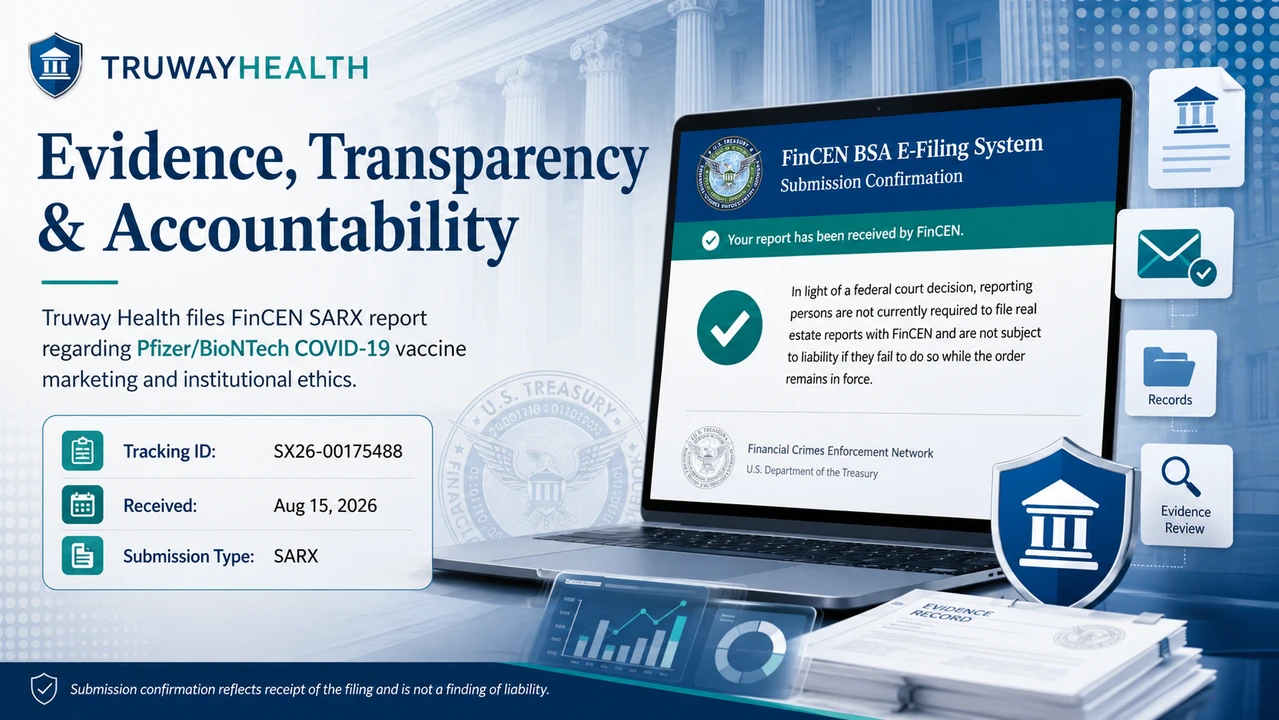
On August 15, 2026, Truway Health President & CEO Gavin Solomon submitted a report through the U.S. Financial Crimes Enforcement Network's BSA E-Filing System concerning allegations involving Pfizer's COVID-19 vaccine marketing, institutional communications, financial representations, and related ethical concerns.
The electronic system issued the following submission confirmation:
Tracking ID: SX26-00175488
Received: August 15, 2026 at 1:08:41 PM EDT
Submission Type: SARX
Owner: Gavin Solomon
Filing Name: Pfizer Vaccine Lies
The confirmation establishes that the filing was received electronically. It does not mean FinCEN, the U.S. Department of the Treasury, a court, or another government agency has determined that Pfizer Inc., BioNTech SE, or any individual committed fraud or another violation.
That distinction matters.
Accountability requires evidence—and the same evidentiary standard must apply both to powerful institutions and to those making allegations against them.
The Central Question: Did Public Messaging Match the Evidence?
One of the most important lessons from the pandemic is that different scientific questions should never be treated as though they are interchangeable.
For example:
Protection against symptomatic disease is not necessarily the same scientific endpoint as preventing infection.
Preventing infection is not automatically equivalent to preventing onward transmission.
Effectiveness observed during one stage of a pandemic may not remain unchanged as circulating variants, population immunity, time since vaccination, or other conditions change.
None of these distinctions prove misconduct.
But they demonstrate why precise language matters when governments, pharmaceutical companies, clinicians, employers, and the public are making consequential decisions.
The appropriate review is therefore not whether a slogan was popular or unpopular. It is whether individual representations were properly supported by the evidence available at the moment they were made.
Why Internal Communications Matter
Public statements tell only one side of an institutional story.
Internal communications can establish what executives, scientists, regulatory specialists, pharmacovigilance teams, marketing departments, government-affairs personnel, and other decision-makers understood at particular points in time.
That makes proper evidence preservation critical.
Potentially relevant records may include:
- executive and scientific email;
- clinical-development analyses;
- vaccine-effectiveness studies;
- regulatory correspondence;
- pharmacovigilance assessments;
- adverse-event evaluations;
- marketing substantiation;
- advertising drafts;
- public-relations talking points;
- government communications;
- procurement records;
- investor communications;
- commercial forecasts;
- meeting minutes; and
- authenticated electronic messages and document histories.
Screenshots circulating online should not automatically be treated as verified “insider emails.”
A serious investigation requires more.
Original message headers, timestamps, sender and recipient information, attachments, metadata, custody records, and other evidence should be used to determine whether a communication is authentic.
The goal should be simple:
Preserve the email. Authenticate it. Establish when it was written. Determine what information the participants possessed. Then compare that record with what was communicated publicly at the same time.
Follow the Evidence—and Follow the Money Carefully
The COVID-19 vaccine market involved enormous government procurement programs and commercial revenues.
That alone does not prove fraud.
Making money from a lawful product does not make the revenue illicit. Likewise, receiving a government contract does not establish a false claim.
Financial scrutiny becomes meaningful only when evidence connects a potentially false or misleading representation to an identifiable transaction.
Questions worthy of review include:
- What representations were provided to government purchasers?
- What certifications accompanied payments or procurement contracts?
- Were representations material to purchasing decisions?
- Did responsible personnel possess materially different information internally?
- Were investor disclosures consistent with known scientific, regulatory, and commercial information?
- Were corrections made when earlier representations required qualification?
This is the difference between simply saying “follow the money” and actually conducting a credible financial-integrity review.
Institutional Ethics Cannot Be Optional During an Emergency
Emergency conditions may require decisions under uncertainty.
They do not eliminate fundamental medical ethics.
Patients still deserve meaningful informed consent.
Healthcare professionals still deserve scientifically accurate information.
Government purchasers still deserve truthful representations.
Investors still deserve materially accurate disclosures.
Regulators still require complete and reliable information.
And manufacturers entrusted with products used by millions of people retain responsibilities involving safety surveillance, scientific accuracy, evidence preservation, transparency, and correction of material error.
An emergency may explain uncertainty.
It should never become a blanket justification for avoiding scrutiny.
Scientific Change Is Not Automatically Evidence of Deception
Accountability also requires intellectual discipline.
Scientific knowledge changes.
Clinical recommendations change.
Viruses evolve.
New adverse-event information can emerge.
Effectiveness can change over time.
Earlier assumptions can prove incomplete.
Those facts alone do not establish fraud.
A responsible integrity review should distinguish among:
good-faith scientific uncertainty, later scientific revision, administrative mistakes, negligent communication, material omission, reckless disregard, and intentional deception.
Those are not interchangeable concepts.
Determining which category applies requires documents, chronology, context, materiality, and—where intentional misconduct is alleged—evidence concerning knowledge and intent.
Public Trust Requires Correction, Not Revisionist History
When institutions discover that an earlier statement requires qualification, the ethical response is not to pretend the earlier uncertainty never existed.
It is to correct the record.
Public trust is strengthened when institutions can say:
Here is what we knew then.
Here is what we know now.
Here is what changed.
Here is why our recommendation changed.
That approach is scientifically stronger than presenting every revised conclusion as though it had always been obvious.
It is also more respectful to patients.
A Higher Standard for Healthcare Integrity
Healthcare integrity cannot operate selectively.
Pharmaceutical manufacturers should face evidence-based scrutiny.
Government agencies should face evidence-based scrutiny.
Healthcare systems should face evidence-based scrutiny.
The media should be held to factual standards.
Critics and independent investigators should also be held to factual standards.
Unsupported accusations should not substitute for evidence.
But institutional prestige should never substitute for evidence either.
At Truway Health, our position is that the same rule should apply to everyone:
Preserve the evidence. Authenticate the communications. Reconstruct the timeline. Compare internal knowledge with external representations. Trace material statements into financial and institutional decisions. Correct demonstrated inaccuracies. Refer supported violations to authorities possessing lawful jurisdiction.
The Records Matter
Years after the height of the pandemic, arguments about COVID-19 remain emotionally and politically charged.
The documentary record provides a better path.
Emails have dates.
Clinical analyses have endpoints.
Regulatory submissions have versions.
Safety assessments have timelines.
Contracts contain representations.
Financial statements contain numbers.
Public statements can be compared with contemporaneous evidence.
That is where meaningful accountability begins.
Not with blind institutional trust.
Not with automatic distrust.
With evidence.
About the PHX-AFK-US Healthcare Integrity Program
This matter has been entered into Truway Health's Healthcare Integrity & Anti-Fraud Enforcement (PHX-AFK-US) framework under:
Protocol ID: PRS-HI-AFK-SC-US-101325-GS
Clinical Identifier: NCT07217730
Federal Filing Tracking ID: SX26-00175488
The program emphasizes evidence preservation, healthcare-market integrity, transparent institutional practices, supply-chain accountability, and responsible documentation of potential compliance concerns.
Important Notice
The submission discussed in this article reflects receipt of an electronic filing. It does not constitute a finding by FinCEN, the U.S. Department of the Treasury, a court, or another governmental authority that Pfizer Inc., BioNTech SE, or any other party committed fraud, criminal misconduct, or another violation. Allegations require investigation, authentication, applicable legal analysis, and adjudication by authorities possessing jurisdiction.
Truway Health News & Insights

Moving from RN to Family Nurse Practitioner What You Need to Know
Experienced registered nurses often reach a point where strong bedside skills still leave a lingerin...

The Guidewire Is Not a Commodity: The Hidden Safety Architecture of Coronary Care
How precision engineering, clinical intelligence, and medical-device traceability are redefining exp...

Truth Social Suspends @truwayhealth Without Explanation: Truway Health Challenges Digital Censorship and Demands Accountability
October 9, 2026 | Truway Health News & Insights NEW YORK, NY — Truway Health, Inc. is formally chall...

The Stethoscope Standard: Rethinking the Value of U.S. M1 Through Medical Productive Capacity
Money ultimately derives much of its usefulness from confidence: confidence that a dollar can be exc...

Simple Steps for Seniors to Embrace Healthy and Joyful Living
For seniors seeking holistic wellness, healthy aging can feel harder than it should: the body change...

Healthcare Procurement Readiness: Building a More Resilient Clinical Supply Chain
Healthcare supply chains are often judged by a simple question: Did the product arrive? But for hosp...