
Understanding Interferon Response Pathways: Why Type I and Type III Interferons Matter in Modern Diagnostics and Product Development
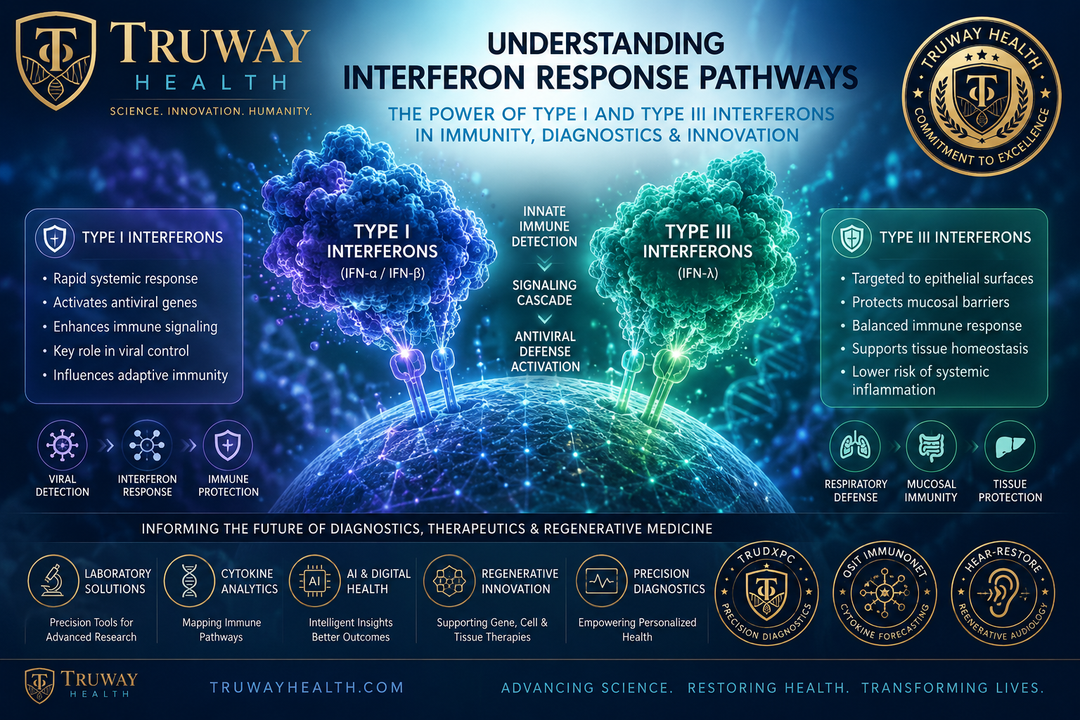
June 22, 2026 | Truway Health Insights
The human immune system relies on an intricate communication network to recognize pathogens and coordinate protective responses. Among the most important signaling molecules involved in this process are interferons, a family of proteins that help cells detect and respond to viral infections and other biological stressors.
Understanding interferon biology is increasingly important for the future of diagnostics, laboratory medicine, regenerative therapies, and computational health technologies.
What Are Interferons?
Interferons are naturally occurring cytokines produced by cells in response to viral invasion, inflammation, and tissue injury. They serve as early-warning messengers, activating hundreds of genes involved in antiviral defense and immune regulation.
The three principal interferon families are:
-
Type I Interferons
-
Interferon-α (IFN-α)
-
Interferon-β (IFN-β)
-
-
Type II Interferon
-
Interferon-γ (IFN-γ)
-
-
Type III Interferons
-
Interferon-λ (IFN-λ)
-
Among these groups, Type I and Type III interferons play particularly important roles in antiviral immunity and mucosal defense.
Type I Interferons: The First Responders
Type I interferons are produced rapidly when cells recognize viral RNA or DNA. Through pathways involving pattern recognition receptors such as:
-
Toll-like receptors (TLRs)
-
RIG-I-like receptors
-
MDA5 sensors
-
cGAS-STING pathways
cells initiate signaling cascades that activate transcription factors including:
-
IRF3
-
IRF7
-
NF-κB
These pathways stimulate expression of interferon-stimulated genes (ISGs), which work to:
-
Inhibit viral replication.
-
Activate natural killer cells.
-
Enhance antigen presentation.
-
Coordinate adaptive immune responses.
-
Promote cellular antiviral states.
Because Type I interferons act systemically, they represent one of the body's most powerful innate defense mechanisms.
Type III Interferons: Guardians of Barrier Tissues
Type III interferons, primarily interferon-λ, perform many similar antiviral functions but act more selectively.
Their receptors are concentrated on epithelial surfaces, including:
-
Respiratory tissues.
-
Gastrointestinal mucosa.
-
Nasal passages.
-
Liver and biliary tissues.
This localized action allows Type III interferons to provide protection while minimizing excessive inflammation.
Researchers continue to investigate their potential importance in:
-
Respiratory viral infections.
-
Mucosal immunity.
-
Gastrointestinal diseases.
-
Tissue regeneration.
-
Precision immunology.
Why Interferon Pathways Matter
Interferon signaling influences numerous areas of biomedical research:
Viral Load Assessment
Changes in interferon activity often correlate with:
-
Viral burden.
-
Disease progression.
-
Recovery phases.
-
Host immune competence.
Cytokine Forecasting
Interferon pathways interact with cytokines including:
-
IL-6
-
TNF-α
-
IL-1β
-
CXCL10
-
MCP-1
Mapping these networks may improve understanding of inflammatory dynamics and immune responses.
Gene Therapy
Adeno-associated virus (AAV) vectors and other delivery systems interact with innate immune pathways. Understanding interferon responses may help optimize:
-
Transgene expression.
-
Vector design.
-
Tissue targeting.
-
Safety considerations.
Cell Culture and Histopathology
Interferon signatures are increasingly being studied across:
-
Mammalian cell lines.
-
Tissue samples.
-
Histopathological analysis.
-
Digital pathology workflows.
Artificial Intelligence
Large language models and multimodal AI systems are beginning to assist researchers in:
-
Literature analysis.
-
Cytokine pathway interpretation.
-
Biomarker discovery.
-
Histopathological image annotation.
-
Computational biology workflows.
Opportunities for Future Product Development
At Truway Health, understanding interferon biology supports long-term innovation across several areas:
Laboratory and Research Tools
Potential opportunities include:
-
Cytokine assay kits.
-
Laboratory consumables.
-
Cell culture products.
-
Histopathology accessories.
-
Sample preparation systems.
-
Clinical diagnostics support products.
Digital Health Platforms
Emerging technologies may enable:
-
AI-assisted pathology.
-
Biomarker interpretation engines.
-
Cytokine forecasting models.
-
Predictive immune network mapping.
-
Knowledge graph applications.
Regenerative and Precision Medicine
Future developments in:
-
Gene therapies.
-
Extracellular vesicle biology.
-
Stem cell research.
-
Immunomodulation.
-
Personalized medicine.
may increasingly rely on accurate characterization of interferon signaling pathways.
Looking Ahead
The study of Type I and Type III interferons represents one of the most exciting intersections of immunology, molecular biology, diagnostics, and artificial intelligence.
As biomedical research advances, deeper understanding of these pathways may help inform next-generation approaches to laboratory medicine, computational pathology, regenerative therapies, and precision health technologies.
Through continued scientific surveillance and collaboration, Truway Health remains committed to exploring technologies that support better diagnostics, more informed research, and improved understanding of human biology.
Disclaimer: This article is intended for educational and informational purposes only. It does not constitute medical advice, diagnosis, or treatment recommendations.
Truway Health News & Insights

Moving from RN to Family Nurse Practitioner What You Need to Know
Experienced registered nurses often reach a point where strong bedside skills still leave a lingerin...
The Guidewire Is Not a Commodity: The Hidden Safety Architecture of Coronary Care
How precision engineering, clinical intelligence, and medical-device traceability are redefining exp...

Truth Social Suspends @truwayhealth Without Explanation: Truway Health Challenges Digital Censorship and Demands Accountability
October 9, 2026 | Truway Health News & Insights NEW YORK, NY — Truway Health, Inc. is formally chall...

The Stethoscope Standard: Rethinking the Value of U.S. M1 Through Medical Productive Capacity
Money ultimately derives much of its usefulness from confidence: confidence that a dollar can be exc...

Simple Steps for Seniors to Embrace Healthy and Joyful Living
For seniors seeking holistic wellness, healthy aging can feel harder than it should: the body change...

Healthcare Procurement Readiness: Building a More Resilient Clinical Supply Chain
Healthcare supply chains are often judged by a simple question: Did the product arrive? But for hosp...