
The Science of Auscultation: What Modern Stethoscopes Must Deliver for Accurate Diagnosis
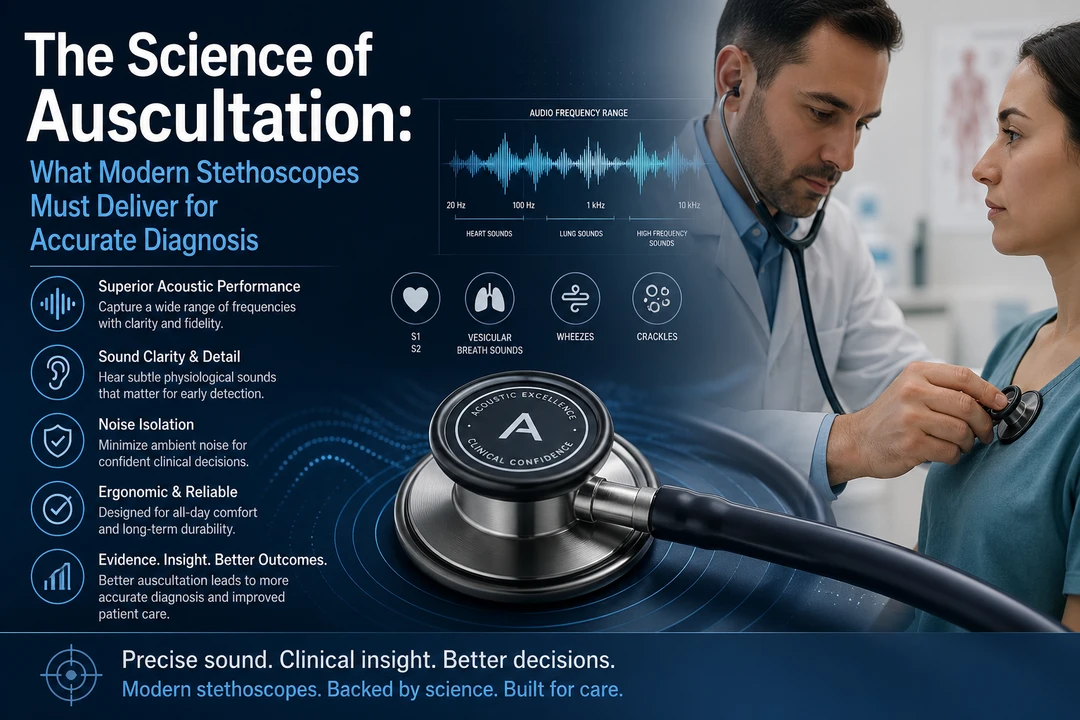
Auscultation remains one of the most fundamental—and deceptively sophisticated—skills in clinical medicine. Long before advanced imaging or AI‑driven diagnostics, clinicians relied on the ear. Today, even with modern technology, the stethoscope continues to be a frontline diagnostic instrument. But the science behind auscultation has evolved, and so have the expectations for what a modern stethoscope must deliver.
This article breaks down the acoustic science, engineering principles, and clinical performance standards that define a truly modern, high‑precision stethoscope.
1. Why Auscultation Still Matters in 2026
Despite the rise of digital diagnostics, auscultation remains essential because it provides:
-
Immediate, real‑time assessment without power or connectivity
-
Early detection of subtle cardiopulmonary abnormalities
-
Low‑cost, high‑value triage in emergency and field settings
-
Clinical nuance that algorithms still struggle to replicate
A clinician’s ability to hear faint murmurs, subtle crackles, or abnormal bowel sounds depends on the acoustic fidelity of the instrument in their hands.
2. The Physics Behind High‑Quality Auscultation
Modern stethoscopes must optimize three core acoustic principles:
A. Frequency Response
Different clinical sounds occupy different frequency ranges:
-
Heart sounds: 20–150 Hz
-
Lung sounds: 200–2,000 Hz
-
Bowel sounds: 100–500 Hz
A high‑performance stethoscope must transmit these frequencies without distortion, dampening, or loss of detail.
B. Acoustic Impedance Matching
The stethoscope must efficiently transfer sound energy from:
Patient → Diaphragm/Bell → Tubing → Ear Tips → Clinician
Any mismatch—poor tubing material, loose seals, low‑grade metals—reduces clarity.
C. Noise Isolation
Clinicians work in noisy environments. Modern stethoscopes must minimize:
-
Ambient noise
-
Handling noise
-
Tubing friction noise
-
Air leakage
This is where engineering meets clinical reality.
3. Engineering Features That Matter in Modern Stethoscopes
A modern cardiology‑grade stethoscope must deliver precision acoustics through deliberate material and structural choices.
1. Dual‑Head Stainless Steel Chestpiece
Stainless steel provides superior sound conduction compared to aluminum or zinc alloys. A dual‑head design allows clinicians to switch between:
-
Diaphragm mode (higher frequencies)
-
Bell mode (lower frequencies)
2. Tunable Diaphragm Technology
A tunable diaphragm allows clinicians to hear different frequency ranges by adjusting pressure:
-
Light pressure: low‑frequency sounds
-
Firm pressure: high‑frequency sounds
This eliminates the need to flip the chestpiece in many scenarios.
3. Latex‑Free, Thick‑Walled Tubing
Premium tubing must be:
-
Latex‑free for safety
-
Oil‑ and alcohol‑resistant for durability
-
Thick‑walled to prevent acoustic interference
-
Flexible without kinking
This is where many low‑cost stethoscopes fail.
4. Soft‑Seal Ear Tips
A proper acoustic seal is essential. Soft‑seal ear tips:
-
Improve comfort
-
Reduce ambient noise
-
Enhance low‑frequency sound transmission
5. Precision Machining & Assembly
Even the best materials fail without:
-
Tight tolerances
-
Leak‑proof joints
-
Balanced chestpiece mass
-
Smooth internal surfaces
Acoustics is unforgiving—small imperfections create big losses.
4. Clinical Performance Standards for Accurate Diagnosis
A modern stethoscope must excel in four diagnostic domains:
1. Cardiac Auscultation
It must clearly reproduce:
-
S1 and S2
-
S3 and S4
-
Systolic and diastolic murmurs
-
Gallops, clicks, and rubs
Cardiology‑grade instruments must capture low‑amplitude, low‑frequency sounds with precision.
2. Pulmonary Auscultation
Clinicians must detect:
-
Crackles
-
Wheezes
-
Rhonchi
-
Stridor
-
Diminished breath sounds
This requires strong mid‑ to high‑frequency performance.
3. Abdominal Auscultation
Bowel sounds are subtle and easily masked by noise. A good stethoscope must isolate and amplify these frequencies.
4. Peripheral & Vascular Assessment
For bruits and blood pressure measurement, the stethoscope must deliver:
-
Clean low‑frequency response
-
Minimal handling noise
-
Strong diaphragm sensitivity
5. Why Material Quality and Manufacturing Integrity Matter
Inexpensive stethoscopes often fail because they use:
-
Low‑density metals
-
Thin, porous tubing
-
Poorly machined components
-
Inconsistent assembly
These flaws lead to:
-
Frequency loss
-
Air leakage
-
Distortion
-
Reduced diagnostic accuracy
For clinicians, this isn’t a minor inconvenience—it’s a patient safety issue.
Modern stethoscopes must be engineered with validator‑grade precision, ensuring every unit performs consistently across clinical environments.
6. The Future of Auscultation: Where Innovation Is Heading
The next decade will bring:
-
AI‑assisted acoustic interpretation
-
Digital waveform capture for telehealth
-
Hybrid acoustic‑electronic systems
-
Noise‑cancellation technology
-
Cloud‑based auscultation libraries for training and benchmarking
But even as innovation accelerates, the foundation remains the same: A stethoscope must deliver clean, accurate, undistorted sound.
Final Takeaway
Auscultation is both an art and a science. Modern clinicians need instruments that honor both. A high‑quality stethoscope isn’t just a tool—it’s a diagnostic extension of the clinician’s senses.
For accurate diagnosis, a modern stethoscope must deliver:
-
Precision frequency response
-
Superior acoustic conduction
-
Noise isolation
-
Durable, medical‑grade materials
-
Consistent, validator‑grade manufacturing
This is the standard Truway Health builds toward: clinical‑grade performance engineered with uncompromising integrity.
Hear more. Diagnose faster. Trust your tools. Shop our professional‑grade stethoscopes designed for accurate auscultation in every clinical environment: https://truwayhealth.com/diagnostic-equipment/stethoscopes/
Truway Health News & Insights

Moving from RN to Family Nurse Practitioner What You Need to Know
Experienced registered nurses often reach a point where strong bedside skills still leave a lingerin...

The Guidewire Is Not a Commodity: The Hidden Safety Architecture of Coronary Care
How precision engineering, clinical intelligence, and medical-device traceability are redefining exp...

Truth Social Suspends @truwayhealth Without Explanation: Truway Health Challenges Digital Censorship and Demands Accountability
October 9, 2026 | Truway Health News & Insights NEW YORK, NY — Truway Health, Inc. is formally chall...

The Stethoscope Standard: Rethinking the Value of U.S. M1 Through Medical Productive Capacity
Money ultimately derives much of its usefulness from confidence: confidence that a dollar can be exc...

Simple Steps for Seniors to Embrace Healthy and Joyful Living
For seniors seeking holistic wellness, healthy aging can feel harder than it should: the body change...

Healthcare Procurement Readiness: Building a More Resilient Clinical Supply Chain
Healthcare supply chains are often judged by a simple question: Did the product arrive? But for hosp...