
NeuroFinance Human Stress Trial During Financial and Informational Volatility (NFHST-2026-001) Released for Observational Enrollment Review
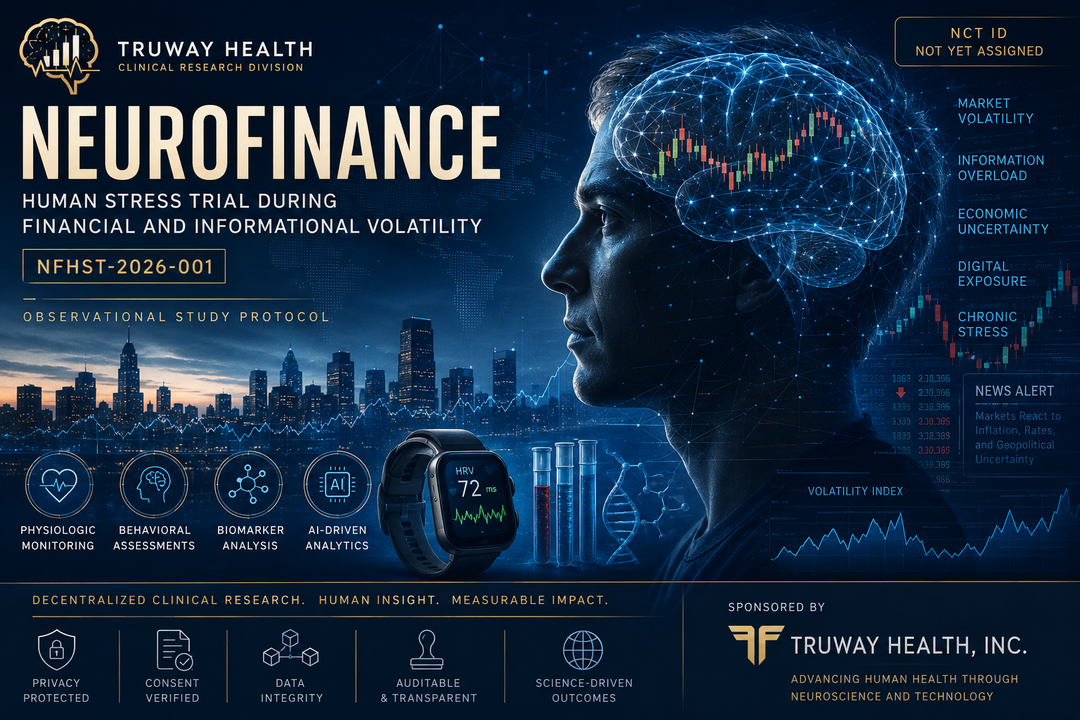
Truway Health, Inc. announced the release of the observational research protocol entitled NeuroFinance Human Stress Trial During Financial and Informational Volatility (NFHST-2026-001), a longitudinal human behavioral and biomarker study designed to evaluate the physiologic and neurocognitive effects of financial market instability, informational saturation, and macroeconomic volatility on adult participants.
The protocol has entered formal registry processing status and was released internally for protocol administration and observational enrollment review on May 15, 2026.
The NFHST initiative represents a multidisciplinary convergence of behavioral finance, stress physiology, wearable telemetry, machine learning analytics, and longitudinal human observational research. The study is sponsored by Truway Health, Inc. and is being administered through the organization’s NeuroFinance and Human Systems Research Division.
Background
Periods of heightened informational volatility—including rapid financial news cycles, geopolitical uncertainty, inflationary stressors, digital overload, and market dislocation—have increasingly been associated with measurable alterations in human stress response systems. Existing literature has demonstrated correlations between chronic stress exposure and:
- elevated cortisol levels,
- autonomic dysregulation,
- sleep fragmentation,
- impaired cognitive flexibility,
- and inflammatory biomarker activation.
However, prospective observational frameworks evaluating the combined impact of financial and informational volatility in real-world participants remain limited.
The NFHST protocol was developed to address this gap through continuous observational monitoring of participants exposed to evolving economic and informational conditions.
Study Design
NFHST-2026-001 is structured as a multi-cohort observational study utilizing:
- wearable physiologic monitoring,
- self-reported psychometric assessments,
- biospecimen analysis,
- financial sentiment indexing,
- and AI-assisted volatility modeling.
Participants may be stratified into cohorts according to occupational exposure, investment activity, media exposure intensity, sleep irregularity, and macroeconomic stress sensitivity.
Primary monitoring variables include:
- heart rate variability (HRV),
- cortisol and inflammatory biomarkers,
- sleep efficiency,
- anxiety and cognitive stress scores,
- digital exposure intensity,
- and adaptive behavioral response metrics.
The study further incorporates blockchain-backed audit trails and research-chain verification methods developed through Truway Health’s decentralized clinical infrastructure initiative.
Research Infrastructure and Data Integrity
The protocol integrates a proprietary distributed ledger architecture known internally as the NFHST ResearchChain™, which was developed to support:
- participant onboarding,
- informed consent verification,
- biospecimen chain-of-custody,
- longitudinal telemetry tracking,
- treasury and procurement auditing,
- and publication-grade results verification.
The system employs SHA-256 event hashing, immutable timestamp verification, encrypted participant identifiers, and layered clinical audit trails designed to improve transparency and reproducibility.
Additional modules include:
- volatility oracle feeds,
- AI-assisted findings analysis,
- participant compensation ledgers,
- and institutional governance registries.
Clinical and Translational Objectives
Investigators intend to evaluate whether persistent exposure to financial and informational instability produces measurable physiologic signatures that may contribute to:
- chronic stress adaptation,
- cardiovascular dysregulation,
- impaired sleep architecture,
- neurocognitive fatigue,
- and inflammatory activation.
The observational findings may contribute to future translational frameworks involving:
- digital health surveillance,
- behavioral finance medicine,
- occupational stress intervention,
- neuroeconomic resilience modeling,
- and predictive public health analytics.
IPD and Publication Policy
Truway Health stated that de-identified participant data, supporting protocol materials, analytic methodologies, and selected statistical analysis frameworks may become available to qualified researchers following publication review and institutional authorization procedures.
The organization indicated that:
- participant privacy protections,
- informed consent controls,
- and data governance restrictions
will remain central to all future data-sharing initiatives associated with the NFHST registry.
Official Protocol Information
| Field | Information |
|---|---|
| Official Title | NeuroFinance Human Stress Trial During Financial and Informational Volatility |
| Protocol Identifier | NFHST-2026-001 |
| Registry Status | Released |
| Sponsor | Truway Health, Inc. |
| Study Type | Observational |
| Enrollment | Anticipated |
| Lead Investigator | Gavin Solomon |
| Study Infrastructure | NFHST ResearchChain™ |
Forward-Looking Statement
This research initiative is investigational and observational in nature. The protocol is not intended to diagnose, treat, cure, or prevent disease. All study activities remain subject to institutional oversight, ethics review, participant consent requirements, and applicable regulatory frameworks.
For additional information regarding the NeuroFinance Human Stress Trial During Financial and Informational Volatility (NFHST-2026-001), visit:
Truway Health News & Insights

Moving from RN to Family Nurse Practitioner What You Need to Know
Experienced registered nurses often reach a point where strong bedside skills still leave a lingerin...

The Guidewire Is Not a Commodity: The Hidden Safety Architecture of Coronary Care
How precision engineering, clinical intelligence, and medical-device traceability are redefining exp...

Truth Social Suspends @truwayhealth Without Explanation: Truway Health Challenges Digital Censorship and Demands Accountability
October 9, 2026 | Truway Health News & Insights NEW YORK, NY — Truway Health, Inc. is formally chall...

The Stethoscope Standard: Rethinking the Value of U.S. M1 Through Medical Productive Capacity
Money ultimately derives much of its usefulness from confidence: confidence that a dollar can be exc...

Simple Steps for Seniors to Embrace Healthy and Joyful Living
For seniors seeking holistic wellness, healthy aging can feel harder than it should: the body change...

Healthcare Procurement Readiness: Building a More Resilient Clinical Supply Chain
Healthcare supply chains are often judged by a simple question: Did the product arrive? But for hosp...