
Sleep, Dreams, and Morning Readiness: What Today's Research Reveals About Brain Recovery
By Truway Health Research Team
June 2, 2026
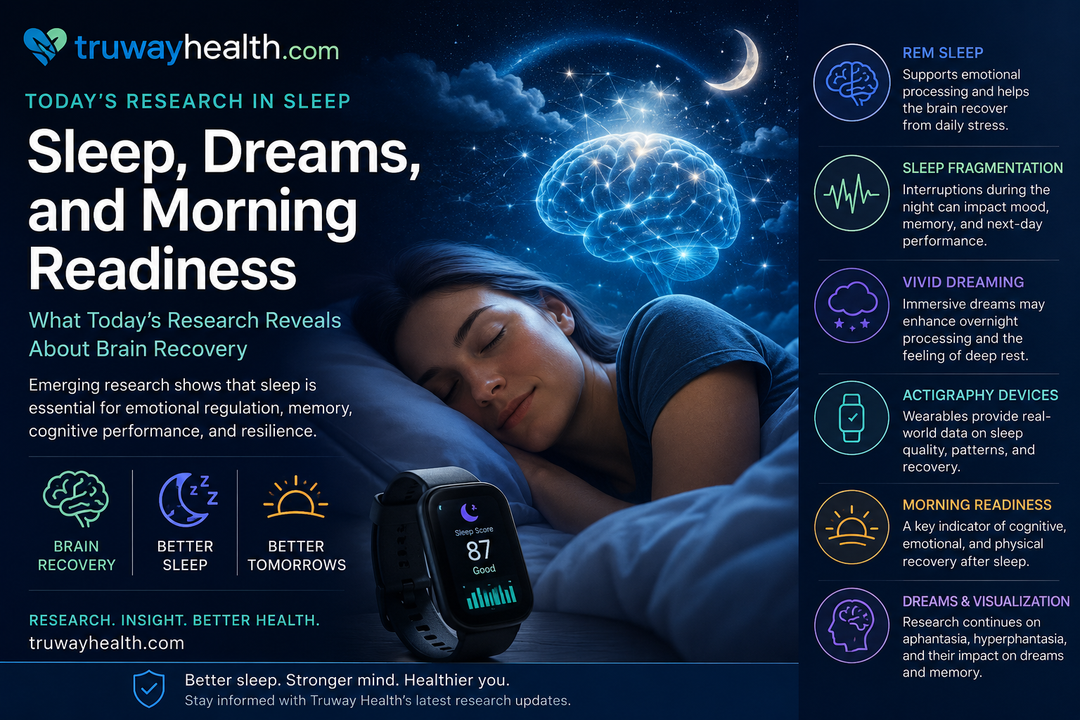
Sleep is far more than a period of rest. Emerging research continues to demonstrate that sleep functions as one of the body's most sophisticated recovery systems, influencing emotional regulation, memory formation, cognitive performance, and overall resilience.
During today's research intelligence sweep, the Truway Health Research Team reviewed recent findings involving REM sleep, dream-state cognition, actigraphy monitoring devices, emotional processing, sleep fragmentation, vivid dreaming, nightmares, aphantasia, and morning readiness.
Why REM Sleep Matters
Rapid Eye Movement (REM) sleep remains one of the most fascinating stages of human sleep architecture. Researchers increasingly describe REM sleep as a biological environment where emotional experiences can be processed and integrated while stress-related neurochemical activity is reduced.
Studies suggest that REM sleep may help decrease the emotional intensity associated with difficult experiences, potentially contributing to improved psychological resilience and emotional stability following stressful events.
For healthcare professionals, executives, traders, students, and individuals operating in high-stress environments, maintaining healthy REM sleep may represent an important component of cognitive recovery.
The Hidden Cost of Sleep Fragmentation
One of the strongest recurring themes in current sleep research involves sleep fragmentation.
Sleep fragmentation occurs when an individual experiences repeated awakenings or interruptions throughout the night. Even when total sleep duration appears adequate, fragmented sleep can reduce restorative value and impair next-day performance.
Research continues to associate fragmented sleep with:
-
Reduced emotional regulation
-
Increased stress sensitivity
-
Impaired memory consolidation
-
Lower cognitive performance
-
Poorer morning readiness
-
Increased daytime fatigue
These findings reinforce the importance of evaluating not only how long individuals sleep, but how well they sleep.
Vivid Dreams May Be More Important Than Previously Thought
A particularly interesting 2026 study suggests that vivid and immersive dreams may contribute to the subjective feeling of having experienced deeper, more restorative sleep.
Researchers found that emotionally rich and immersive dream experiences were associated with greater perceptions of sleep depth, even when traditional physiological measures suggested lighter stages of sleep. This raises important questions about the role dreams play in recovery and well-being.
Rather than being meaningless byproducts of sleep, dreams may represent active components of overnight brain processing.
Actigraphy and the Future of Sleep Monitoring
Wearable technology continues to advance the science of sleep assessment.
Modern actigraphy devices can monitor:
-
Sleep duration
-
Sleep efficiency
-
Wake-after-sleep-onset events
-
Circadian consistency
-
Sleep fragmentation
-
Activity recovery patterns
These technologies offer opportunities for longitudinal health monitoring and may become increasingly important in both clinical and research settings.
At Truway Health, we believe passive sleep monitoring technologies will play a significant role in future personalized wellness programs.
Aphantasia, Visualization, and Dream States
Researchers are also exploring the relationship between visualization ability and dream experiences.
Individuals with aphantasia report limited or absent voluntary mental imagery, while those with hyperphantasia often experience exceptionally vivid internal visualization.
Questions currently under investigation include:
-
How visualization ability affects dream recall
-
Whether dream vividness influences emotional processing
-
The relationship between imagery and memory consolidation
-
Potential differences in sleep architecture across visualization profiles
This remains a rapidly developing area of neuroscience research.
Morning Readiness: The New Health Metric
One emerging concept receiving increasing attention is "morning readiness."
Morning readiness refers to an individual's cognitive, emotional, and physiological capacity upon awakening.
Factors influencing morning readiness include:
-
REM continuity
-
Sleep efficiency
-
Circadian alignment
-
Emotional processing during sleep
-
Reduced sleep fragmentation
Future health monitoring systems may increasingly utilize morning readiness scores as indicators of recovery, resilience, and performance potential.
Looking Ahead
Sleep science is entering a new era.
As researchers continue to investigate REM sleep, dream-state cognition, wearable monitoring systems, and emotional processing during sleep, the evidence increasingly supports the view that sleep serves as a fundamental biological recovery mechanism.
The future of health optimization may depend not only on nutrition and exercise, but also on understanding the complex relationship between sleep quality, dreams, emotional regulation, and cognitive resilience.
At Truway Health, we will continue monitoring developments in sleep medicine, neurotechnology, and digital health to identify emerging opportunities that support patient wellness, performance, and recovery.
Research Topics Monitored Today
-
REM Sleep
-
Sleep Fragmentation
-
Actigraphy Devices
-
Emotional Regulation
-
Morning Readiness
-
Dream Recall
-
Vivid Dreaming
-
Nightmares
-
Aphantasia
-
Hyperphantasia
-
Circadian Rhythm Optimization
-
Neurocognitive Recovery
-
Wearable Sleep Technologies
-
Sleep Biomarkers
-
Brain Recovery Science
Truway Health Research Intelligence Division
Advancing Healthcare Through Research, Data, and Innovation.
Truway Health News & Insights

When Fall Feels Heavy: Seasonal Changes and Emotional Well-Being
Autumn arrives with golden leaves, cooler mornings, and invitations to get cozy. But you do not have...
The $20 Accessory That Can Sideline a $20,000 Device
The equipment has arrived. The team has cleared space, scheduled training, and prepared to put the n...

Can Your Sterile Storage Workflow Survive a Busy Monday?
It is 7:10 a.m. The first procedures are approaching, an add-on case has changed the schedule, and t...

Truway Health Surgical Instrument Kits & Trays: The Details Behind a Well-Configured Set
A surgical instrument kit is more than a collection of instruments. Its value lies in the details: t...
Introducing NeuroVista: Truway Health’s Research Platform for Imaging and Connected Medical Data
Understanding medical data requires more than a clear image or a single measurement. Researchers als...

Clinical Technology Outlook 2026–2030: From Isolated Measurements to Continuous, Connected Care
Clinical technology is entering a new phase. For decades, healthcare has largely been organized arou...