
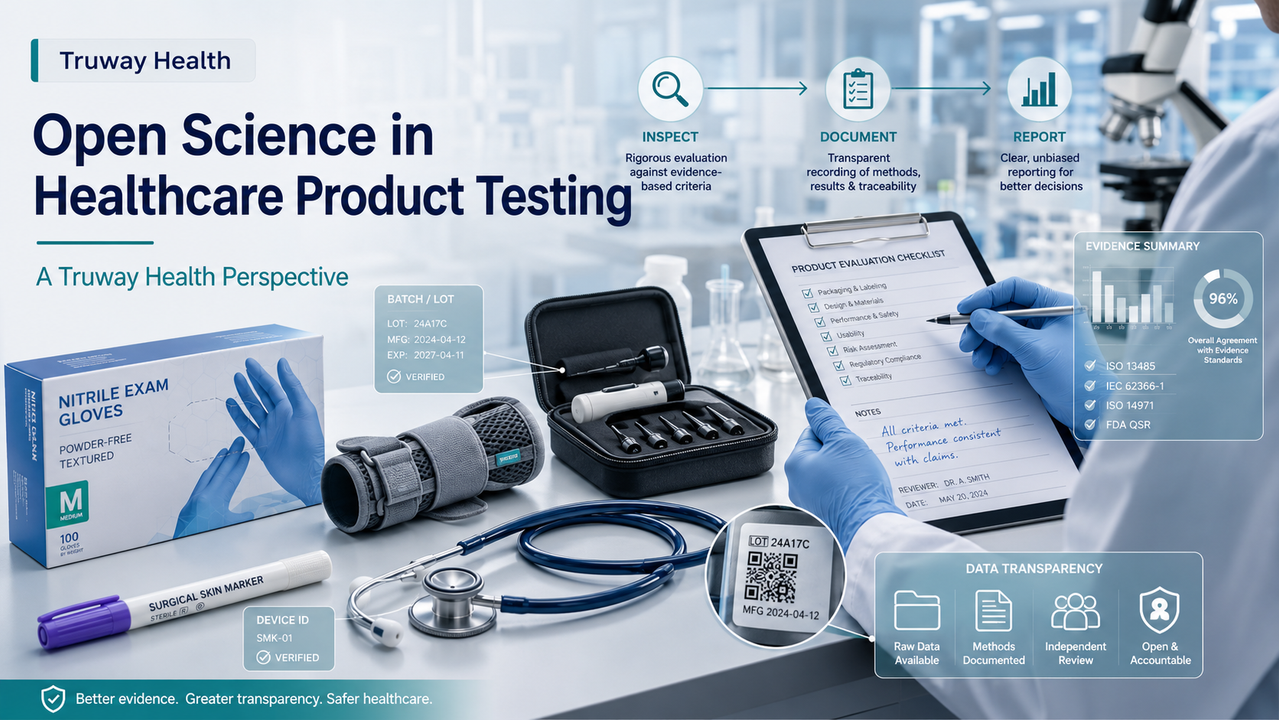
Open Science in Healthcare Product Testing: A Truway Health Perspective
By Truway Health, Inc.
Category: Healthcare Product Testing, Quality Systems, Medical Supply Intelligence
In healthcare, trust begins with evidence. Every product used in a clinical, laboratory, emergency, or home-care setting carries a responsibility: it must be understandable, inspectable, traceable, and fit for its intended purpose. At Truway Health, Inc., we view healthcare product testing not only as a quality-control activity, but as a transparent, evidence-building process that supports safer purchasing, better documentation, and stronger institutional confidence.
Open science in healthcare product testing means creating a testing culture where observations, methods, limitations, and product impressions are documented clearly. It does not replace formal regulatory review, accredited laboratory testing, FDA clearance, ISO certification, or manufacturer validation. Instead, it strengthens the product intelligence layer that buyers, clinicians, laboratories, distributors, and healthcare organizations rely on when evaluating real-world usability.
Why Open Science Matters in Healthcare Products
Healthcare products are often evaluated through specifications, marketing materials, manufacturer claims, certificates, and regulatory identifiers. Those are important, but they do not always show how a product performs in ordinary handling, inspection, storage, or simulated use.
Open science encourages a more complete view. It asks practical questions:
How does the product present out of the package?
Are the labeling, markings, instructions, and identifiers clear?
Does the product appear consistent with its stated use case?
Can the product be documented in a way that supports procurement, inventory, and quality review?
What observations should be recorded before larger institutional adoption?
This kind of structured observation helps bridge the gap between product listing data and real-world product confidence.
The Truway Health Approach
Truway Health’s perspective is built around practical documentation, repeatable inspection, and responsible communication. Product testing should be performed with care, with clear boundaries, and with respect for the difference between observational product review and formal regulatory testing.
A strong healthcare product testing file may include:
- Product name, model, REF number, lot number, SKU, UPC, GTIN, or other identifiers
- Manufacturer, distributor, or supply source information
- Packaging condition and labeling review
- Intended-use summary
- Visual inspection notes
- Handling observations
- Basic functionality impressions, where appropriate
- Storage, sterility, expiration, or environmental considerations
- Photographic documentation
- Limitations of the test
- Final product intelligence summary
This structure helps create a more reliable evidence trail. It also supports internal quality systems, product listing accuracy, procurement review, and future vendor comparison.
Testing Is Not Just About Pass or Fail
In modern healthcare commerce, testing should not be reduced to a simple pass-or-fail statement unless a validated standard requires it. Many product reviews are better understood as layered observations.
For example, a product may be suitable for one use case but not another. It may have strong packaging and labeling but require clearer instructions. It may perform well during handling but need additional documentation before institutional procurement. A transparent testing report should capture those details instead of forcing an oversimplified conclusion.
At Truway Health, this means product testing should support better decisions, not exaggerated claims.
Responsible Product Claims
Healthcare product testing must be careful with language. A product should not be described as sterile, FDA-cleared, surgical-grade, antimicrobial, diagnostic, therapeutic, or clinically validated unless that claim is supported by proper documentation.
Open science works best when claims are separated from observations. For example:
An observation may say that a marker produced visible lines during a test pattern.
A regulatory claim would require evidence that the product meets the applicable standard or clearance requirement.
A clinical claim would require appropriate clinical validation.
This distinction protects patients, buyers, healthcare organizations, and suppliers.
Product Testing as a Supply Chain Tool
Healthcare buyers need dependable information. Product testing can support procurement by helping institutions compare products beyond price alone.
A strong product intelligence file can help answer:
Is the item clearly identifiable?
Can it be reordered accurately?
Can it be matched to a purchase order, invoice, SKU, UPC, or GS1 record?
Does the packaging support inventory control?
Are there obvious documentation gaps?
Is the product appropriate for the buyer’s intended environment?
For distributors and healthcare platforms, this type of testing can improve catalog quality, reduce purchasing errors, and support better customer service.
Open Science and Documentation Integrity
Documentation integrity is central to the Truway Health model. Every product observation should be written in a way that another reviewer can understand. Dates, locations, personnel, product identifiers, photographs, and methods should be recorded consistently.
Good documentation creates accountability. It allows a product file to evolve from a basic observation into a more complete record that may support quality assurance, vendor review, product listing, or institutional procurement.
A Practical Testing Framework
Truway Health supports a practical testing framework built around five pillars:
1. Identify
Record the product name, identifiers, manufacturer, lot number, REF number, SKU, UPC, and source.
2. Inspect
Review packaging, labeling, physical condition, instructions, and visible product characteristics.
3. Observe
Document how the product handles, presents, functions, or performs under limited non-clinical conditions.
4. Verify
Compare observations against available documentation, certificates, labeling, specifications, and intended-use statements.
5. Report
Create a clear product testing note, inspection report, or product intelligence file with limitations and next steps.
The Future of Healthcare Product Testing
As healthcare commerce becomes more digital, product evidence will become more important. Buyers will expect better product data, stronger traceability, clearer regulatory documentation, and more transparent supply chains.
Open science can help move healthcare product evaluation toward a more accountable model. It encourages better notes, better images, better identifiers, better testing files, and better decision-making.
For Truway Health, healthcare product testing is not only about products. It is about trust, quality, transparency, and institutional readiness.
Conclusion
Open science in healthcare product testing gives healthcare organizations a clearer way to understand the products they purchase, list, distribute, and use. When testing is documented responsibly, it strengthens product confidence without overstating claims.
Truway Health, Inc. supports a practical, transparent, and evidence-oriented approach to healthcare product intelligence. By combining product identification, inspection, observation, verification, and reporting, healthcare suppliers and buyers can build a stronger foundation for safe, informed, and accountable procurement.
Truway Health Perspective: Better documentation creates better healthcare commerce. Better product intelligence creates better institutional trust.
Truway Health News & Insights
TruWay Health Announces OMNIPHYS: A 20-Year Multimodal Physiologic State Intelligence Research Program
PRESS RELEASE TruWay Health Announces OMNIPHYS: A 20-Year Multimodal Physiologic State Intellige...
Truway Health Announces ClinicalTrials.gov Registration of 50-Year Prospective Study Examining “Clinical Time” and Temporal Dynamics in Patient Health
PRESS RELEASE Truway Health Announces ClinicalTrials.gov Registration of 50-Year Prospective...

TruWay Health Advances FUSION-72 Study to Investigate Multimodal Digital Biomarkers for Acute Deterioration
TruWay Health Advances FUSION-72 Study to Investigate Multimodal Digital Biomarkers for Acute Deteri...

Truway Health Releases TRU-OMNIBODY Whole-Body Digital Twin and Physiologic Resilience Study
FOR IMMEDIATE RELEASE Truway Health Releases TRU-OMNIBODY Whole-Body Digital Twin and Physiologic Re...

Choosing Surgical Loupes: 2.5× vs. 3.5× Magnification
Surgical loupes provide a magnified view of the working area, helping healthcare professionals see f...

TruWay Health Announces Registration of New Research Protocol for Federated Learning in Point-of-Care Cardiac Ultrasound
Protocol establishes a privacy-conscious framework for multi-site research integrating point-of-care...