
Truway Health Product Intelligence: Turning Catalog Data Into Better Buyer Decisions
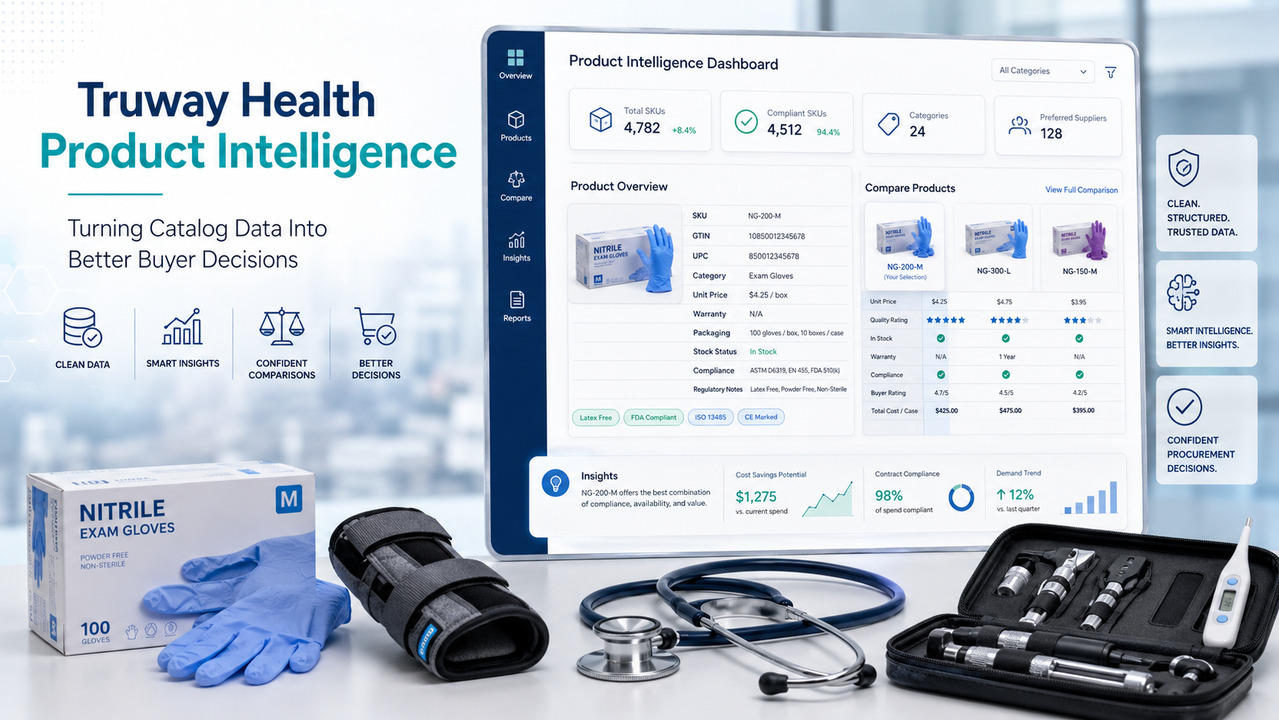
In healthcare procurement, every product listing tells a story. A medical supply is not just a name, SKU, price, and image. Behind every item is a larger decision framework involving clinical use, product classification, compliance status, packaging format, durability, warranty coverage, inventory planning, and institutional buyer confidence.
At Truway Health, Product Intelligence means transforming ordinary catalog data into structured, decision-ready information that helps healthcare buyers move faster, compare products more accurately, and purchase with greater confidence.
Why Product Intelligence Matters
Healthcare buyers are often required to evaluate products across multiple dimensions at once. A clinic may need to compare exam gloves by material, cuff length, packaging quantity, FDA status, and price per unit. A physical therapy office may need to evaluate orthopedic braces by size range, support level, warranty coverage, and reimbursement category. A government buyer may need to confirm vendor documentation, product identifiers, country of origin, delivery terms, and institutional pricing.
A basic catalog listing may show what a product is. A Product Intelligence system explains why the product matters, how it should be evaluated, and where it fits in a buyer’s operational workflow.
This is where Truway Health’s catalog strategy becomes more than e-commerce. It becomes a healthcare decision-support layer.
From Static Listings to Structured Product Records
Traditional online product catalogs are often built for simple retail transactions. Healthcare purchasing requires more structure.
A stronger healthcare product record may include:
-
Product name and model number
-
SKU, UPC, GTIN, and internal catalog identifier
-
Manufacturer or brand
-
Device or supply category
-
Intended use
-
Packaging configuration
-
Material specifications
-
Warranty terms
-
Regulatory references, where applicable
-
Institutional pricing logic
-
Minimum order quantity
-
Shipping and fulfillment notes
-
Inspection or open-science testing notes
-
Buyer-facing use cases
This structure allows a buyer to move from a simple product view to a more complete procurement decision.
Better Data Creates Better Comparisons
Healthcare buyers do not usually purchase in isolation. They compare. They ask whether one product is more suitable than another, whether a substitute is acceptable, whether the product meets internal standards, and whether the documentation is strong enough for institutional purchasing.
Product Intelligence helps answer questions such as:
Which brace is best for wrist stabilization versus light compression?
Which glove configuration is more cost-effective for high-volume use?
Which diagnostic tool has stronger documentation for clinic intake?
Which product should be stocked for emergency readiness?
Which item needs additional inspection, warranty review, or compliance confirmation?
By organizing catalog data into clear fields, Truway Health can help buyers make side-by-side decisions instead of relying only on images, short descriptions, or generic sales copy.
Product Intelligence Supports Clinical and Operational Workflows
In healthcare, a product is rarely just a product. It is part of a workflow.
A surgical skin marker may support pre-operative site marking, training demonstrations, or inspection documentation. A wrist brace may support orthopedic recovery, occupational therapy, or retail DME use. A diagnostic kit may support intake exams, clinical screening, or mobile care delivery.
When product data is organized around real-world use, buyers can understand not only what they are purchasing, but how the product fits into their environment.
That means product pages should be built with practical workflow questions in mind:
Who is the buyer?
Where will the product be used?
What problem does it solve?
What documentation does the buyer need?
How should the item be stored, inspected, issued, or reordered?
This approach makes the catalog more useful for clinics, institutions, distributors, and healthcare purchasing teams.
The Role of Identifiers: SKU, UPC, GTIN, and Internal Control Numbers
Healthcare procurement depends on clear identification. Product identifiers help prevent confusion between similar items, improve inventory control, and support smoother purchasing, fulfillment, and reordering.
A SKU may help Truway Health manage internal catalog organization. A UPC or GTIN may help align the product with retail and distribution systems. A manufacturer reference number may help buyers confirm they are ordering the correct item. Internal control numbers may support inspection reports, warranty files, and procurement records.
When identifiers are clearly presented, buyers can reduce ordering errors and improve traceability.
Turning Product Pages Into Buyer Tools
A well-built product page should do more than sell. It should help the buyer decide.
For Truway Health, this means product listings can include educational summaries, product specifications, warranty language, procurement notes, inspection observations, and recommended use cases. This gives the buyer a more complete picture before purchase.
Strong product pages can also support search visibility. Buyers often search for products using practical terms rather than exact catalog names. A Product Intelligence approach allows Truway Health to include relevant keywords, alternate product descriptions, clinical-use language, and procurement terminology in a natural and helpful way.
Open-Science Product Notes
Truway Health’s Product Intelligence model may also include open-science style observations when products are evaluated internally. These notes can document visual inspection, packaging review, use-case testing, labeling observations, and practical buyer considerations.
Open-science notes do not replace formal regulatory review, manufacturer specifications, or clinical judgment. However, they can add transparency and create a stronger internal record of how a product was reviewed, described, and prepared for catalog placement.
This type of documentation is especially useful for emerging product categories, private-label development, institutional purchasing, and quality assurance workflows.
Product Intelligence and Institutional Trust
Healthcare buyers need trust. They want to know that a vendor understands more than checkout pages and shipping labels. They want product clarity, documentation, responsive support, and reliable information.
By investing in Product Intelligence, Truway Health can create a stronger bridge between product discovery and procurement execution. The catalog becomes a knowledge system. The product page becomes a decision record. The buyer experience becomes more structured, transparent, and useful.
The Truway Health Approach
Truway Health’s Product Intelligence strategy is built around a simple principle: better product data leads to better healthcare purchasing decisions.
By combining structured catalog fields, practical use-case summaries, identifiers, inspection notes, pricing logic, and buyer-facing documentation, Truway Health can help customers evaluate products with greater speed and confidence.
In a healthcare market where supply chains, regulations, and buyer expectations continue to evolve, intelligent catalog design is no longer optional. It is part of the infrastructure of modern healthcare commerce.
Conclusion
The future of healthcare e-commerce is not just about listing more products. It is about making each product easier to understand, compare, document, and procure.
Truway Health Product Intelligence turns catalog data into a strategic asset. It helps buyers see the full value of a product, supports institutional purchasing workflows, and creates a more transparent path from product discovery to healthcare delivery.
For clinics, distributors, healthcare offices, and institutional buyers, better data means better decisions. For Truway Health, it means building a smarter, more trusted healthcare marketplace.
Truway Health News & Insights
Truway Health Releases TVA-2026 Clinical Study Evaluating Ultrasound-Guided Peripheral Vascular Access
FOR IMMEDIATE RELEASE Truway Health Releases TVA-2026 Clinical Study Evaluating Ultrasound-Guided Pe...

Truway Health Releases ICE-ACCESS Clinical Study Record to ClinicalTrials.gov PRS Review
New observational research program will examine intracardiac echocardiography catheter availability,...

Creating a Multipurpose Wellness Space to Boost Your Home and Health
Busy parents juggling work, family schedules, and self-care often want a healthier home but don’t ha...

Beetroots: Nutrition, Nitric Oxide, Exercise Performance & Everyday Wellness
Beetroots have moved far beyond the produce aisle. Once known mainly as a colorful root vegetable, b...

Internet of Medical Things (IoMT): What Healthcare Leaders Need to Know
Healthcare is becoming increasingly connected. Patient monitors communicate with clinical systems, m...

When Public Health Meets Institutional Accountability: Why Evidence, Transparency, and Ethics Still Matter
Public health depends on trust. But trust is not created by slogans, authority, corporate branding,...