
Mapping the Next Frontier of Immunotherapy: QSIT Expands Its Scientific Intelligence Program
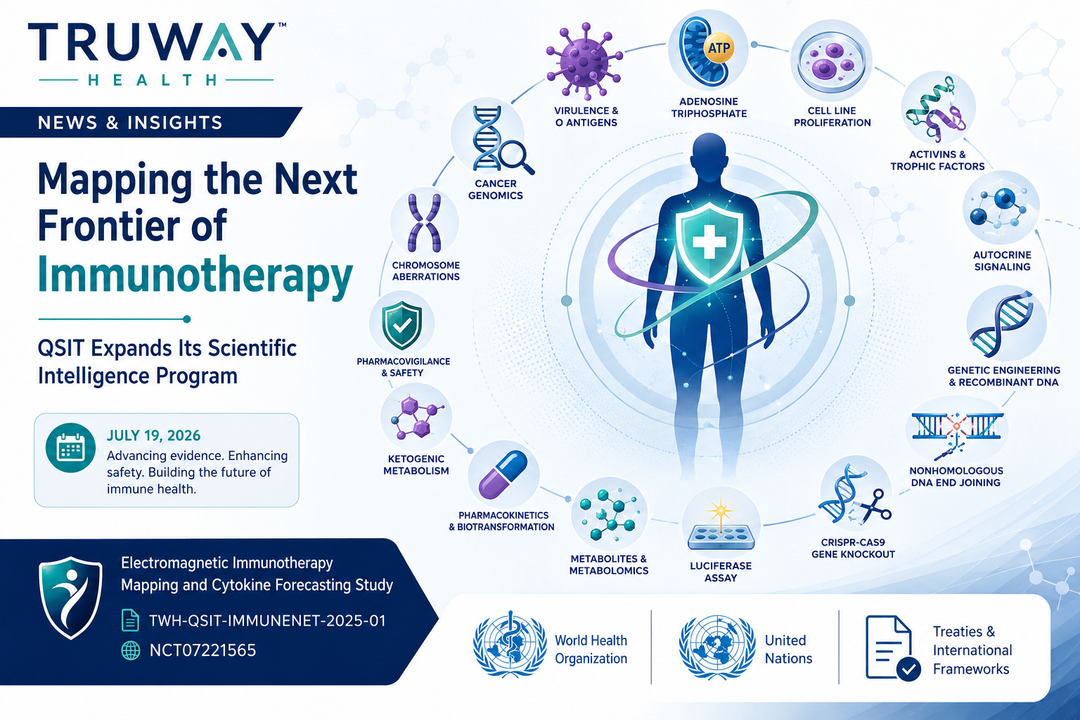
Truway Health has expanded the scientific-intelligence framework supporting the Electromagnetic Immunotherapy Mapping and Cytokine Forecasting Study, identified as TWH-QSIT-IMMUNENET-2025-01 and NCT07221565.
The July 19, 2026 PubMed Intelligence Sweep broadens the study’s continuous monitoring across immunology, cellular metabolism, genetic engineering, cancer genomics, pharmacokinetics, pharmacovigilance, and international research governance.
Connecting Immune Signaling, Energy, and Genomic Regulation
Immune behavior is shaped by more than the presence or absence of a single cytokine. Cellular energy, microbial exposure, metabolic state, genetic regulation, DNA repair, and tissue-level signaling may all influence how immune responses develop over time.
The latest QSIT intelligence sweep examines research involving:
-
Microbial virulence and O-antigen-mediated immune activation
-
Adenosine triphosphate and mitochondrial energy metabolism
-
Cell-line proliferation, viability, apoptosis, and treatment response
-
Activins, trophic factors, and autocrine signaling
-
Biotransformation, metabolites, and pharmacokinetic variability
-
Recombinant DNA and genetic-engineering platforms
-
Nonhomologous DNA end joining and genomic stability
-
CRISPR-Cas9 gene-knockout models
-
RNA helicases and transcript regulation
-
Luciferase reporter assays
-
Ketogenic metabolism and immune-cell energetics
-
Pharmacovigilance and adverse-event signal detection
-
Chromosome aberrations and cancer genomics
-
World Health Organization, United Nations, and treaty-related research frameworks
Together, these areas provide a broader foundation for understanding how biological systems respond to therapeutic, environmental, metabolic, and electromagnetic influences.
Why Cytokine Forecasting Requires a Multi-System Approach
Cytokines operate within interconnected networks rather than isolated pathways. A measurable inflammatory response may be influenced by mitochondrial function, microbial antigens, receptor activation, gene expression, metabolite availability, DNA damage, or pharmacological exposure.
QSIT is developing an evidence-mapping approach that may help researchers compare these variables across laboratory, computational, and observational data.
The objective is not to treat every new publication as proof of clinical effectiveness. Instead, the program is designed to identify credible patterns, assess reproducibility, detect safety signals, and determine which findings justify further validation.
Expanding the Evidence-Monitoring Framework
The QSIT literature-surveillance process prioritizes systematic reviews, controlled trials, translational studies, validated assay methods, genomic analyses, and high-quality mechanistic research.
New publications may be categorized according to:
-
Biological pathway or therapeutic target
-
Cytokine, chemokine, gene, metabolite, or antigen studied
-
Experimental model and sample size
-
Electromagnetic or biophysical exposure parameters
-
Assay methodology and analytical platform
-
Pharmacokinetic or metabolic findings
-
Genomic-stability observations
-
Reported adverse events
-
Reproducibility and evidence quality
-
Potential relevance to future QSIT research arms
The monitoring framework also tracks article corrections, retractions, conflicting results, and methodological limitations.
Potential Future Research Areas
Subject to formal scientific, ethical, institutional, and regulatory review, future QSIT development may include several research pathways.
An observational biomarker arm could examine longitudinal cytokine, metabolic, mitochondrial, genomic, and physiological measurements.
A cellular assay arm could assess proliferation, viability, inflammatory signaling, activin activity, trophic-factor response, and luciferase-reporter outputs under controlled laboratory conditions.
A metabolomic and pharmacokinetic arm could explore how metabolic profiles, biotransformation products, ketogenic-state indicators, and exposure-response relationships affect immune variability.
A cancer-genomics and genomic-stability arm could examine DNA-repair pathways, chromosomal abnormalities, tumor-associated immune signaling, and treatment-resistance mechanisms.
An electromagnetic exposure-mapping arm could compare predefined noninvasive exposure parameters with sham controls, standardized dosimetry, and physiological monitoring.
Laboratory-based genetic-mechanism research may also evaluate recombinant DNA, RNA helicases, CRISPR-associated pathways, and nonhomologous end joining. Any human gene-editing intervention would require a separate protocol, specialized biosafety oversight, regulatory authorization, and long-term participant monitoring.
Building Safety Into Scientific Expansion
Safety and governance remain central to the QSIT research framework.
Continuous monitoring will include:
-
Unexpected immune activation
-
Cytokine dysregulation
-
Genotoxicity
-
Off-target genomic effects
-
Chromosomal rearrangements
-
Pharmacokinetic variability
-
Delayed adverse events
-
Data privacy and genomic security
-
Dual-use research concerns
-
International research and biosafety guidance
The program will maintain a clear distinction between literature intelligence, nonclinical laboratory research, observational data collection, and authorized clinical interventions.
Looking Ahead
Future QSIT intelligence sweeps are expected to expand into single-cell sequencing, spatial transcriptomics, proteomics, epigenomics, immune checkpoints, inflammasomes, ferroptosis, autophagy, pharmacogenomics, microbiome-derived metabolites, base editing, prime editing, RNA editing, and engineered immune-cell platforms.
By integrating diverse scientific disciplines into a structured evidence matrix, Truway Health aims to improve the quality of research prioritization and support more responsible development of immune-system forecasting tools.
The July 19, 2026 intelligence update represents another step toward a research model that is broader, more transparent, and increasingly responsive to new scientific evidence.
Study: Electromagnetic Immunotherapy Mapping and Cytokine Forecasting Study
Protocol ID: TWH-QSIT-IMMUNENET-2025-01
ClinicalTrials.gov Identifier: NCT07221565
Research Organization: Truway Health, Inc.
This article describes scientific-literature surveillance and prospective research planning. It does not establish clinical efficacy, authorize experimental treatment, or provide medical advice.
Suggested Tags: Immunotherapy, Cytokines, QSIT, Cancer Genomics, CRISPR, Metabolomics, Pharmacovigilance, Biomedical Research, Genetic Engineering, Precision Medicine
Truway Health News & Insights

Moving from RN to Family Nurse Practitioner What You Need to Know
Experienced registered nurses often reach a point where strong bedside skills still leave a lingerin...

The Guidewire Is Not a Commodity: The Hidden Safety Architecture of Coronary Care
How precision engineering, clinical intelligence, and medical-device traceability are redefining exp...

Truth Social Suspends @truwayhealth Without Explanation: Truway Health Challenges Digital Censorship and Demands Accountability
October 9, 2026 | Truway Health News & Insights NEW YORK, NY — Truway Health, Inc. is formally chall...

The Stethoscope Standard: Rethinking the Value of U.S. M1 Through Medical Productive Capacity
Money ultimately derives much of its usefulness from confidence: confidence that a dollar can be exc...

Simple Steps for Seniors to Embrace Healthy and Joyful Living
For seniors seeking holistic wellness, healthy aging can feel harder than it should: the body change...

Healthcare Procurement Readiness: Building a More Resilient Clinical Supply Chain
Healthcare supply chains are often judged by a simple question: Did the product arrive? But for hosp...