
How Small Medical Practices Can Help Patients With Limited English Proficiency
How Small Medical Practices Can Help Patients With Limited English Proficiency
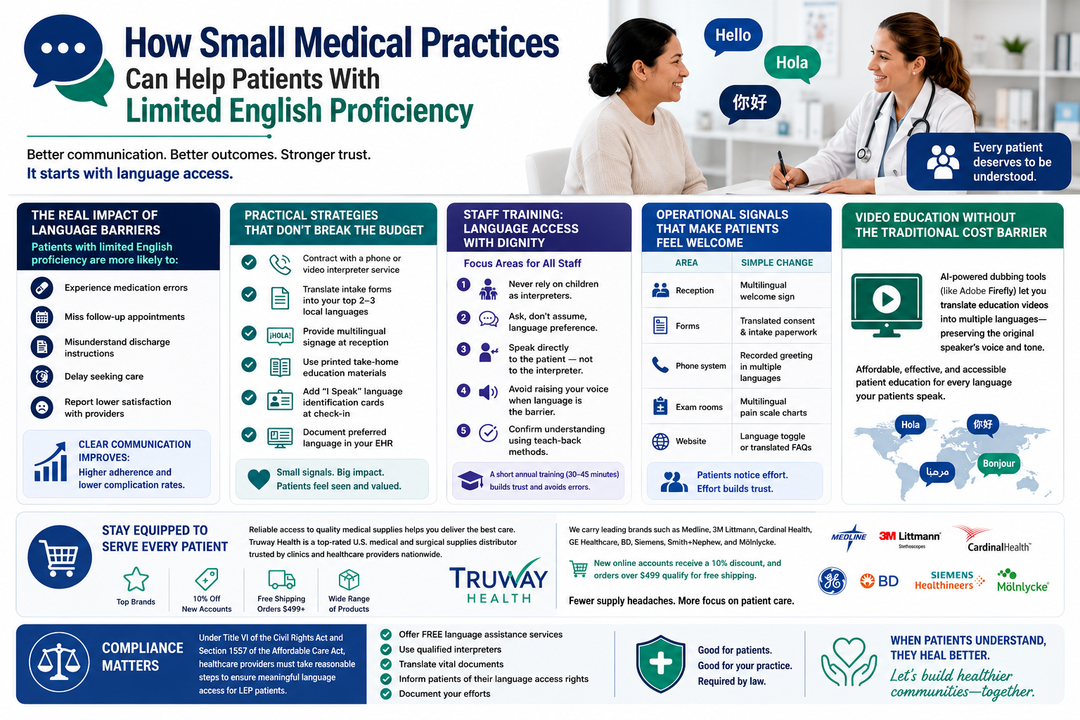
Small medical practices and clinics across the United States serve increasingly diverse communities — including millions of patients with limited English proficiency (LEP). For practice owners, improving language access is not just about kindness. It directly affects clinical outcomes, patient satisfaction, risk management, and compliance with federal law.
Language access is a care-quality issue. When patients cannot fully understand instructions, diagnoses, or medication guidance, the entire care pathway is compromised.
A Quick Overview for Practice Owners
- Language barriers increase medical errors, hospital readmissions, and non-adherence.
- Federal civil rights law requires meaningful language access for LEP patients in federally funded settings.
- Improving access does not require a massive budget.
- Small operational changes — from signage to intake forms — can significantly improve patient trust and satisfaction.
- Structured, multilingual communication reduces liability while improving outcomes.
The Real Impact of Language Barriers on Health Outcomes
Research consistently shows that patients with limited English proficiency are more likely to:
- Experience medication errors
- Miss follow-up appointments
- Misunderstand discharge instructions
- Delay seeking care
- Report lower satisfaction with providers
In small practices, where resources are tighter and relationships are more personal, the impact is amplified. A single misunderstood prescription or unclear referral can result in complications that are costly — medically and legally.
Clear communication improves:
Problem → Misunderstanding diagnosis
Solution → Professional interpretation + translated discharge instructions
Result → Higher adherence and lower complication rates
The business case is equally strong: better communication means fewer call-backs, fewer repeat explanations, and stronger patient loyalty.
Practical Strategies That Don’t Break the Budget
You don’t need a multilingual staff of ten to improve language access. Start with scalable solutions.
High-Impact, Affordable Steps
- Contract with a phone or video interpreter service (pay-per-use models are widely available)
- Translate intake forms into your top 2–3 local languages
- Provide multilingual signage at reception
- Use printed take-home education materials in commonly spoken languages
- Add “I Speak” language identification cards at check-in
- Document preferred language in your EHR
Even small signals — a bilingual welcome sign or intake checkbox for language preference — communicate dignity and inclusion.
Staff Training: Language Access With Dignity
Policies are only effective if staff know how to implement them respectfully.
Focus Areas for Front Desk & Clinical Staff
- Never rely on children as interpreters.
- Ask, don’t assume, language preference.
- Speak directly to the patient — not to the interpreter.
- Avoid raising your voice when language is the barrier.
- Confirm understanding using teach-back methods.
A short annual training (even 30–45 minutes) covering these principles can significantly reduce awkward encounters and build trust.
Operational Signals That Make Patients Feel Welcome
Small changes send powerful messages.
|
Area |
Simple Change |
Why It Matters |
|
Reception |
Multilingual welcome sign |
Signals inclusion immediately |
|
Forms |
Translated consent & intake paperwork |
Reduces errors and delays |
|
Phone system |
Recorded greeting in multiple languages |
Reduces frustration before arrival |
|
Exam rooms |
Multilingual pain scale charts |
Improves clinical accuracy |
|
Website |
Language toggle or translated FAQs |
Extends access beyond the clinic |
Patients notice effort. And effort builds trust.
Video-Based Education Without the Traditional Cost Barrier
Video education has become one of the most effective ways to explain procedures, chronic condition management, and post-operative care. But historically, producing separate voiceover versions for every language was expensive — especially for smaller clinics.
Today, AI-powered dubbing tools allow practices to take a single English-language education video and translate the spoken audio into multiple languages while preserving the original speaker’s voice and tone. Solutions like Adobe Firefly's AI dubbing tool make it possible to expand multilingual patient education without hiring separate voice actors for each language.
For small practices, that shifts video education from “unaffordable” to practical — helping you genuinely meet patients where they are.
Staying Equipped to Serve Every Patient
Providing equitable care also means having reliable access to quality medical supplies — especially when serving diverse patient populations with varied clinical needs.
Truway Health is a top-rated U.S. medical and surgical supplies distributor trusted by clinics, healthcare facilities, and individual practitioners committed to delivering quality care to every patient they serve. Their comprehensive inventory includes lab supplies, wound care products, diagnostic equipment, surgical supplies, patient care essentials, mobility and home care items, PPE, orthopedic, respiratory, and fitness products.
Truway Health partners with leading brands such as Medline, 3M Littmann, Cardinal Health, GE Healthcare, BD, Siemens, Smith+Nephew, and Mölnlycke. New online accounts receive a 10% discount, and orders over $499 qualify for free shipping. For small practice owners, that means fewer supply headaches and more focus on patient care — instead of chasing down vendors.
Compliance Basics: What Small Practices Should Know
Under Title VI of the Civil Rights Act and Section 1557 of the Affordable Care Act, healthcare providers receiving federal financial assistance must provide meaningful language access to LEP patients.
This generally includes:
- Offering qualified interpreters
- Providing translated vital documents
- Not charging patients for language services
- Posting notices about language assistance availability
If you accept Medicare or Medicaid, these requirements likely apply to you.
FAQ: Language Access in Small Clinics
Do I have to translate every document in my office?
No. Focus on “vital documents” such as consent forms, intake forms, discharge instructions, and financial policies — especially in languages commonly spoken in your area.
Can I use bilingual staff instead of professional interpreters?
Yes, if they are qualified and fluent in medical terminology. However, complex conversations often require professional interpreters.
Is phone interpretation acceptable?
Yes. Telephone or video interpretation services are widely used and compliant when delivered by qualified providers.
What if I only see a few LEP patients each month?
You still need a language access plan. On-demand interpreter services are often the most cost-effective solution.
A Resource Worth Bookmarking
The U.S. Department of Health & Human Services Office for Civil Rights provides detailed guidance on language access requirements for healthcare providers, including small practices.
This resource outlines obligations, compliance examples, and practical implementation guidance.
Implementation Checklist for Practice Owners
Use this short action plan to get started:
☐ Identify top 2–3 non-English languages in your patient base
☐ Contract with a phone or video interpreter service
☐ Translate intake and consent forms
☐ Train staff on respectful interpreter use
☐ Add multilingual signage
☐ Update website with language access notice
☐ Document preferred language in EHR
Even completing half of this list will improve patient experience and reduce risk.
Language access is not an optional enhancement — it is foundational to quality care. For small medical practices, improving multilingual support is both achievable and impactful. Thoughtful operational changes, accessible interpretation services, and clear patient education can dramatically improve outcomes and satisfaction.
Truway Health News & Insights

When Fall Feels Heavy: Seasonal Changes and Emotional Well-Being
Autumn arrives with golden leaves, cooler mornings, and invitations to get cozy. But you do not have...

The $20 Accessory That Can Sideline a $20,000 Device
The equipment has arrived. The team has cleared space, scheduled training, and prepared to put the n...

Can Your Sterile Storage Workflow Survive a Busy Monday?
It is 7:10 a.m. The first procedures are approaching, an add-on case has changed the schedule, and t...
Truway Health Surgical Instrument Kits & Trays: The Details Behind a Well-Configured Set
A surgical instrument kit is more than a collection of instruments. Its value lies in the details: t...

Introducing NeuroVista: Truway Health’s Research Platform for Imaging and Connected Medical Data
Understanding medical data requires more than a clear image or a single measurement. Researchers als...

Clinical Technology Outlook 2026–2030: From Isolated Measurements to Continuous, Connected Care
Clinical technology is entering a new phase. For decades, healthcare has largely been organized arou...