
Why Instrument Material Matters in Modern Surgery
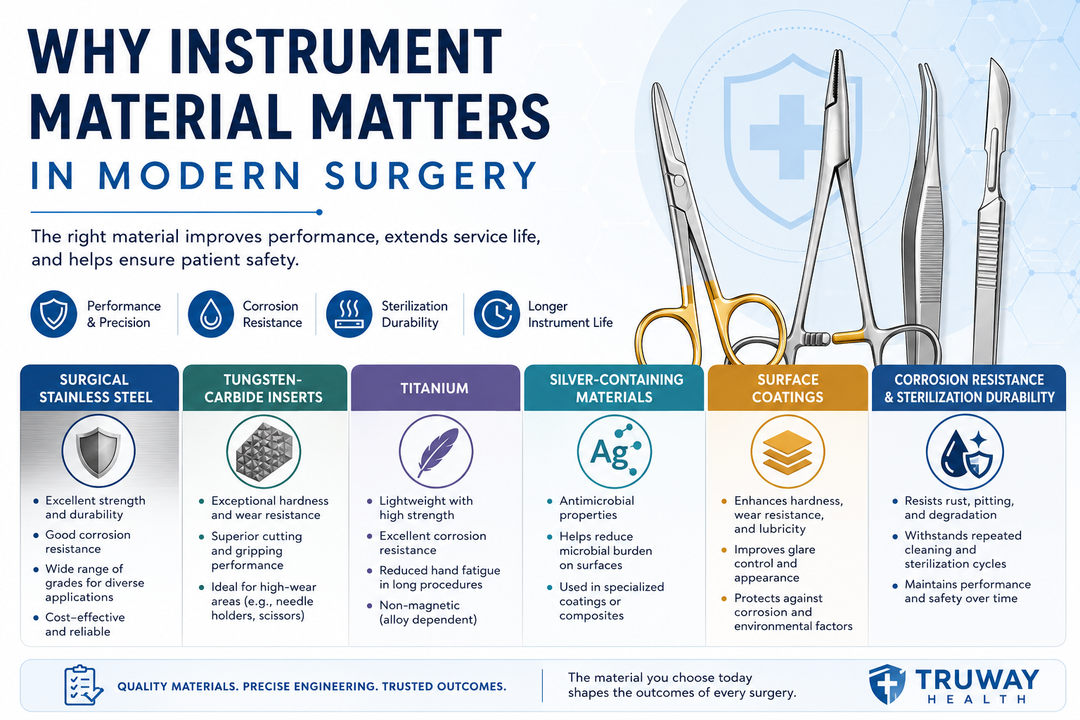
Material Is a Functional Decision, Not Just a Specification
A surgical instrument may look simple, but its material affects nearly every aspect of its performance: sharpness, grip, weight, stiffness, fatigue resistance, corrosion behavior, reprocessing compatibility and useful service life.
Two instruments with the same shape can perform very differently when their alloy, heat treatment, surface finish or insert material changes. A well-designed instrument must maintain its intended function while repeatedly encountering blood, saline, detergents, mechanical washing, temperature changes and sterilization cycles.
That is why healthcare buyers should evaluate more than an instrument’s name and appearance. Material composition, manufacturing controls, surface treatment and validated reprocessing instructions all matter.
ASTM F899 identifies several classes of wrought stainless steel used in surgical instruments, including austenitic, martensitic, precipitation-hardening and ferritic steels. ASTM F1089 provides testing procedures and evaluation criteria for corrosion resistance in new and reusable stainless-steel surgical instruments.
Surgical Stainless Steel: The Established Standard
Stainless steel remains the most widely recognized material family for reusable surgical instruments because it provides a practical balance of strength, manufacturability, corrosion resistance and cost.
However, “stainless steel” is not a single material. Different grades and heat treatments are selected for different functions.
Martensitic stainless steel
Martensitic grades can be hardened through heat treatment. They are commonly suited to instruments that require:
- Sharp cutting edges
- High hardness
- Firm jaw geometry
- Resistance to deformation
- Precise mechanical engagement
Scissors, osteotomes, chisels and certain forceps components may use martensitic steel because edge retention and hardness are important. The tradeoff is that harder grades may require careful passivation, finishing and maintenance to preserve corrosion resistance.
Austenitic stainless steel
Austenitic grades generally provide strong corrosion resistance and good formability. They may be used for instrument components, tubing, trays and devices where extreme cutting hardness is not the primary requirement.
Precipitation-hardening stainless steel
Precipitation-hardening grades can combine high strength with favorable corrosion resistance. They may be selected for components exposed to repeated stress or where dimensional stability is important.
What buyers should verify
A quality stainless-steel specification should address more than a vague claim such as “surgical grade.” Buyers should request documentation covering:
- Material grade or recognized material specification
- Heat-treatment process
- Hardness range where functionally relevant
- Passivation and surface finishing
- Corrosion testing
- Joint alignment and functional testing
- Cleaning and sterilization compatibility
- Traceability to the manufacturing lot
The stainless-steel grade must match the intended function. A very hard material may preserve a cutting edge but become more brittle. A more ductile grade may better tolerate bending but provide weaker edge retention.
Tungsten-Carbide Inserts: Hardness Where It Matters Most
Tungsten carbide is commonly used as an insert rather than as the entire body of an instrument. Cemented tungsten carbide is valued industrially as a hard, wear-resistant material, making it useful where a surgical instrument needs durable gripping or cutting surfaces.
Common applications include:
- Needle-holder jaws
- Scissor cutting edges
- Wire-cutting surfaces
- High-wear gripping areas
In a needle holder, tungsten-carbide inserts can provide a firm gripping surface that helps control a surgical needle. In scissors, carbide inserts can improve wear resistance and support longer-lasting cutting performance.
Tungsten carbide also presents design considerations. It is harder but less forgiving than many steels. Inserts must be securely bonded, brazed or otherwise integrated into the instrument. Manufacturing quality is therefore critical. Buyers should inspect for insert separation, chipping, uneven jaw contact and damage at the interface between the carbide insert and instrument body.
Tungsten-carbide instruments should not automatically be assumed superior in every application. They are most valuable when their hardness directly improves a specific function.
Titanium: Lower Weight and High Corrosion Resistance
Titanium and titanium alloys offer a high strength-to-weight ratio, low density and strong corrosion resistance. Titanium forms a protective oxide layer that contributes to its corrosion-resistant behavior.
For surgical instruments, potential advantages include:
- Lower instrument weight
- Reduced hand fatigue during long procedures
- Strong resistance to many corrosive environments
- Nonferromagnetic or weakly magnetic behavior, depending on the specific alloy and component design
- Reduced glare when paired with an appropriate matte finish
Weight reduction can be particularly valuable in microsurgery, neurosurgery and other procedures requiring prolonged fine-motor control. Research on titanium sheet components also describes weight reduction and corrosion resistance as motivations for replacing stainless steel in some instrument designs.
Titanium is not automatically the best material for every instrument. It is generally more expensive to source and manufacture. Its lower elastic modulus and different wear behavior must also be considered in hinges, ratchets, cutting interfaces and other high-contact areas.
A titanium instrument may still incorporate harder materials at the working surface. For example, a lightweight titanium needle holder could use specialized jaw inserts where additional wear resistance is required.
Silver-Containing Materials: Promising, but Frequently Misunderstood
Silver is associated with antimicrobial technologies and may be incorporated into certain coatings, surface treatments, dressings or medical-device materials. However, silver-containing does not necessarily mean that an instrument is self-sterilizing, infection-proof or suitable for every surgical application.
Pure silver and sterling silver are relatively soft compared with hardened surgical steels and tungsten carbide. For this reason, they are generally not ideal as the primary structural material for load-bearing cutting, clamping or impact instruments unless the complete device design has been specifically engineered and validated for that use.
Silver may be more appropriately considered in forms such as:
- A controlled surface coating
- An antimicrobial additive
- A validated composite material
- A non-load-bearing component
- A specialized application supported by performance and biocompatibility testing
Silver-containing surfaces can also change through wear, tarnishing, chemical exposure or repeated reprocessing. Any antimicrobial claim should therefore be supported by testing that reflects the finished device, intended organisms, expected wear and validated service life.
The presence of silver should never replace cleaning, disinfection or sterilization. Reusable instruments still require complete reprocessing according to their validated instructions.
Surface Coatings: Improving Specific Properties
A surface coating can modify the behavior of an instrument without changing its entire structural material. Depending on the technology, coatings may be designed to improve:
- Surface hardness
- Wear resistance
- Lubricity
- Glare reduction
- Corrosion resistance
- Electrical insulation
- Color identification
- Biological interaction
Examples can include titanium nitride, diamond-like carbon, ceramic coatings, passivation layers and specialized polymeric finishes.
A coating is only beneficial when it remains stable under the instrument’s actual conditions of use. A coating that performs well initially may become a liability if it chips, delaminates, cracks or traps contamination.
Healthcare buyers should ask:
- What is the coating intended to accomplish?
- How is coating adhesion tested?
- Has the finished instrument undergone repeated reprocessing-cycle testing?
- Can the coating tolerate ultrasonic cleaning and mechanical washing?
- What signs indicate that the instrument should be removed from service?
- Does the coating affect electrical, magnetic or imaging compatibility?
Coating color alone is not proof of composition or performance. Documentation and validated testing are more reliable than appearance.
Corrosion Resistance Is a System Property
Corrosion resistance does not depend only on the alloy. It is influenced by the complete product and how it is handled.
Important variables include:
- Alloy chemistry
- Heat treatment
- Surface polishing
- Passivation
- Weld quality
- Crevices and box locks
- Dissimilar-metal contact
- Water quality
- Detergent concentration
- Chloride exposure
- Drying efficiency
- Storage conditions
- Residual biological material
Even stainless steel can corrode. Pitting, discoloration, surface deposits and stress-corrosion cracking may occur when instruments are exposed to damaging chemistry, retained moisture, improper cleaning or mechanical stress. An FDA adverse-event investigation involving fractured forceps, for example, described corrosion and evidence consistent with stress-corrosion cracking, with reprocessing identified as a probable contributing factor.
Corrosion should not be treated as merely cosmetic. It can create rough surfaces, weaken components, interfere with movement and make an instrument more difficult to clean.
Sterilization Durability Starts With Cleaning
Sterilization cannot reliably compensate for inadequate cleaning. Blood, tissue and other debris must first be removed so the subsequent disinfection or sterilization process can reach the instrument surfaces.
The FDA describes reusable-device reprocessing as a multistep process involving cleaning followed by disinfection or sterilization. It also emphasizes that each reusable device requires a process appropriate to its design.
Medical devices may be sterilized using methods such as steam, dry heat, ethylene oxide, radiation or vaporized hydrogen peroxide. Not every device or material is compatible with every method. The manufacturer’s validated instructions for use should always control the selected process.
Repeated sterilization may affect:
- Cutting-edge geometry
- Ratchet engagement
- Box-lock movement
- Surface coatings
- Polymer handles
- Adhesives and brazed joints
- Insulation integrity
- Markings and identification bands
- Corrosion resistance
Durability claims should therefore reflect repeated cleaning and sterilization cycles—not only testing of a new instrument.
A Practical Material Comparison
| Material or treatment | Principal advantages | Important limitations | Typical considerations |
|---|---|---|---|
| Martensitic stainless steel | High hardness and edge retention | May require careful corrosion control; excessive hardness can increase brittleness | Scissors, cutting instruments and hard working surfaces |
| Austenitic stainless steel | Strong corrosion resistance and formability | Generally lower hardenability than martensitic grades | Trays, tubing and non-cutting components |
| Precipitation-hardening steel | High strength and dimensional stability | More specialized processing and material control | High-stress or precision components |
| Tungsten-carbide inserts | Excellent hardness, grip and wear resistance | Potential chipping or insert separation; higher cost | Needle holders, scissors and wire cutters |
| Titanium | Lightweight, corrosion resistant and low-glare when properly finished | Higher cost; wear and stiffness must match the application | Microsurgical and specialty instruments |
| Silver-containing materials | Potential antimicrobial or surface-functional applications | Softness, wear, tarnishing and unsupported antimicrobial assumptions | Validated coatings or specialized components |
| Advanced coatings | Can improve hardness, wear, lubricity or glare | Coating failure or delamination must be evaluated | High-wear surfaces and specialty instruments |
How Healthcare Buyers Can Evaluate Instrument Quality
Before purchasing reusable instruments, request objective documentation wherever possible:
- Exact material grade or specification
- Manufacturing location and quality controls
- Heat-treatment and hardness data
- Corrosion-resistance testing
- Functional and load testing
- Coating composition and adhesion testing
- Reprocessing validation
- Maximum reuse or inspection recommendations
- Lot-level traceability
- Repair and warranty terms
Reusable medical devices must be able to tolerate cleaning and sterilization while continuing to perform as intended. The FDA notes that reusable devices are designed and labeled for multiple uses and are made from materials capable of withstanding repeated reprocessing.
The Bottom Line
There is no single best surgical instrument material.
Stainless steel remains a versatile foundation. Tungsten-carbide inserts provide targeted hardness and wear resistance. Titanium can reduce weight while offering strong corrosion resistance. Silver-containing technologies may provide specialized surface functionality but require careful validation. Advanced coatings can enhance performance when they remain intact through clinical use and reprocessing.
The right choice depends on the instrument’s function, mechanical demands, reprocessing method, expected service life and documented manufacturing quality.
At Truway Health, we believe material specifications should be connected to measurable performance, traceable manufacturing and responsible reprocessing—not treated as marketing language.
Explore Truway Health’s surgical and clinical product solutions or contact our team to discuss instrument sourcing, serialization, quality documentation and supply-chain requirements.
Educational notice: This article provides general product and materials information. It does not replace a device manufacturer’s instructions for use, institutional sterilization policies, regulatory requirements or clinical judgment.
Truway Health News & Insights

Healthcare Equipment Interoperability: Understanding DICOM, HL7, and FHIR
Truway Health | Medical Technology, Digital Infrastructure & Healthcare Innovation Modern medical eq...

Medical-Grade Stainless Steel: Comparing 304 and 316 for Healthcare Equipment
Truway Health | Medical Equipment, Materials Engineering & Healthcare Procurement Not all stainless...

Winter Respiratory Season Preparedness: Essential Supplies for Caregivers and Clinics
Published October 18, 2026 | Truway Health News & Insights When respiratory illnesses rise, preparat...

What Families Should Know When a Loved One Enters Hospice Care
For families with a terminally ill loved one, the start of hospice can land like two realities at on...

Moving from RN to Family Nurse Practitioner What You Need to Know
Experienced registered nurses often reach a point where strong bedside skills still leave a lingerin...

The Guidewire Is Not a Commodity: The Hidden Safety Architecture of Coronary Care
How precision engineering, clinical intelligence, and medical-device traceability are redefining exp...