
Understanding Coronavirus Spike Proteins: Why They Matter for Long COVID, Immunity, and Future Biomedical Discovery
By Truway Health Research Team
Executive Summary
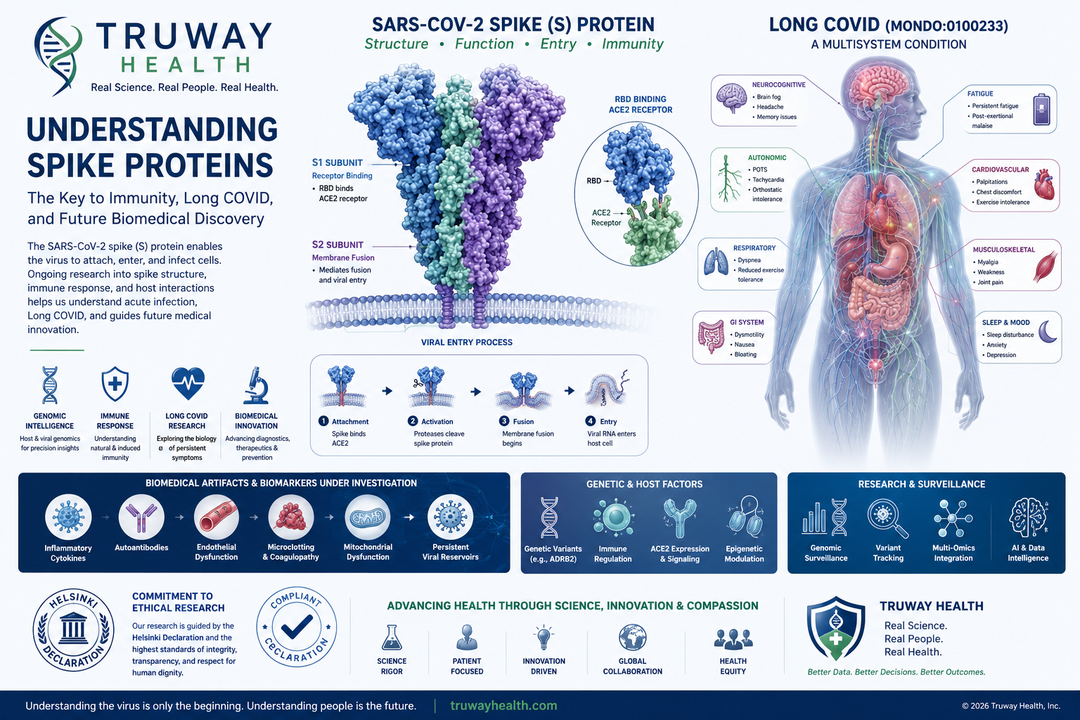
The coronavirus spike (S) protein is one of the most studied biological structures of the modern era. Located on the outer surface of SARS-CoV-2 and related coronaviruses, the spike protein serves as the primary mechanism by which viruses attach to and enter host cells. Since the emergence of COVID-19, scientists have devoted unprecedented effort to understanding how spike proteins influence viral transmission, immune activation, disease severity, and long-term health outcomes.
As research progresses, attention has expanded beyond acute infection toward understanding the biological mechanisms underlying Long COVID (MONDO:0100233), autonomic dysfunction, cardiovascular abnormalities, neurocognitive symptoms, and persistent inflammatory states.
This review summarizes the structure of coronavirus spike proteins, their biological functions, their relationship to host immunity, and why continued genomic surveillance remains critical for future public health preparedness.
Introduction
Coronaviruses comprise a large family of RNA viruses capable of infecting both animals and humans. Several members of this family—including SARS-CoV, MERS-CoV, and SARS-CoV-2—have demonstrated the ability to cause significant human disease.
The defining feature of these viruses is the presence of spike glycoproteins projecting from the viral envelope. These proteins give coronaviruses their characteristic crown-like appearance under electron microscopy and play a central role in viral infectivity.
Without functional spike proteins, coronaviruses cannot efficiently bind to host receptors or initiate membrane fusion, making the spike protein one of the most important targets for vaccines, therapeutic antibodies, and antiviral drug development.
Anatomy of the Spike Protein
The SARS-CoV-2 spike protein exists as a trimeric glycoprotein composed of three identical subunits.
Each monomer contains two major functional regions:
S1 Subunit
Responsible for receptor recognition and attachment.
Key component:
-
Receptor Binding Domain (RBD)
-
Interacts primarily with ACE2 receptors
S2 Subunit
Responsible for membrane fusion and viral entry.
Key components:
-
Fusion peptide
-
Heptad repeat regions
-
Transmembrane domains
Together, these structures allow viral particles to attach, activate, fuse, and enter host cells.
Receptor Binding and Cellular Entry
The first stage of infection begins when the spike protein encounters an ACE2 receptor on the surface of a host cell.
ACE2 receptors are widely expressed throughout:
-
Lung tissue
-
Cardiovascular tissue
-
Gastrointestinal tract
-
Kidney tissue
-
Endothelial cells
-
Nervous system structures
Following receptor engagement, host proteases such as TMPRSS2 and furin activate the spike protein through proteolytic cleavage.
This activation triggers conformational changes that permit viral membrane fusion and delivery of viral RNA into host cells.
Spike Proteins and Immune Recognition
The immune system rapidly identifies spike proteins as foreign antigens.
Major immune responses include:
Humoral Immunity
Production of neutralizing antibodies targeting:
-
Receptor Binding Domain (RBD)
-
N-Terminal Domain (NTD)
-
Conserved spike epitopes
Cellular Immunity
Activation of:
-
CD4+ T cells
-
CD8+ cytotoxic T cells
-
Memory immune populations
These immune responses form the basis of both natural immunity and vaccine-induced protection.
Viral Evolution and Spike Protein Mutations
As RNA viruses replicate, mutations naturally occur.
Some spike mutations may influence:
-
Viral transmissibility
-
Host receptor affinity
-
Immune escape potential
-
Antibody recognition
-
Disease severity
Examples observed during the pandemic include mutations within:
-
N501Y
-
E484K
-
L452R
-
P681R
Continuous genomic surveillance remains essential for identifying emerging variants and assessing potential public health impacts.
Long COVID and Persistent Symptom Complexes
One of the most important emerging areas of investigation involves Long COVID (MONDO:0100233).
Long COVID refers to persistent symptoms occurring after acute SARS-CoV-2 infection and may include:
-
Fatigue
-
Exercise intolerance
-
Dyspnea
-
Cognitive impairment ("brain fog")
-
Tachycardia
-
Orthostatic intolerance
-
Sleep disturbances
-
Autonomic nervous system dysfunction
Current evidence suggests that Long COVID likely represents a multifactorial syndrome involving interactions among:
-
Immune dysregulation
-
Endothelial dysfunction
-
Persistent inflammation
-
Autonomic nervous system abnormalities
-
Genetic susceptibility factors
Autonomic Dysfunction and Cardiovascular Signaling
A growing body of literature has identified abnormalities in autonomic regulation among Long COVID patients.
Reported findings include:
-
Postural Orthostatic Tachycardia Syndrome (POTS)
-
Heart rate variability changes
-
Orthostatic intolerance
-
Exercise-induced tachycardia
-
Vascular dysregulation
Researchers continue exploring whether genetic variants affecting adrenergic signaling pathways, including genes such as ADRB2, may contribute to differences in symptom severity or physiological response following infection.
Further investigation is necessary to determine the clinical significance of these associations.
Genomic Intelligence and Future Research
The integration of genomics, clinical phenotyping, and longitudinal health monitoring offers new opportunities to understand disease susceptibility and recovery.
Future areas of investigation include:
-
Host genetic risk modifiers
-
Cytokine response profiling
-
Multi-omics integration
-
Digital biomarker monitoring
-
Wearable physiologic surveillance
-
AI-assisted phenotype clustering
-
Precision medicine approaches
These technologies may help identify subgroups of patients who experience distinct biological responses following infection.
Implications for Public Health
Understanding spike proteins extends far beyond acute viral infection.
Insights gained from spike-protein research now influence:
-
Vaccine development
-
Therapeutic antibody design
-
Pandemic preparedness
-
Diagnostic innovation
-
Long COVID research
-
Genomic surveillance programs
The lessons learned from COVID-19 continue to reshape modern biomedical science and public health strategy.
Conclusion
The coronavirus spike protein remains one of the most important molecular structures in infectious disease research. Its role in receptor binding, membrane fusion, immune recognition, and viral evolution has made it central to understanding both acute COVID-19 and Long COVID.
As global research efforts continue, integrating virology, immunology, genomics, and clinical medicine will be essential for developing more effective prevention, diagnostic, and therapeutic strategies.
The future of precision health depends upon understanding not only the virus itself, but also the complex interactions between viral proteins, host biology, and long-term human health outcomes.
Prepared by: Truway Health Research Division
Document ID: TH-WP-SPIKEPROTEIN-2026-0607
Related Research Areas: Long COVID (MONDO:0100233), Autonomic Dysfunction, Genomic Intelligence, Precision Medicine, Viral Evolution, Immunology
Truway Health News & Insights

When Fall Feels Heavy: Seasonal Changes and Emotional Well-Being
Autumn arrives with golden leaves, cooler mornings, and invitations to get cozy. But you do not have...

The $20 Accessory That Can Sideline a $20,000 Device
The equipment has arrived. The team has cleared space, scheduled training, and prepared to put the n...

Can Your Sterile Storage Workflow Survive a Busy Monday?
It is 7:10 a.m. The first procedures are approaching, an add-on case has changed the schedule, and t...

Truway Health Surgical Instrument Kits & Trays: The Details Behind a Well-Configured Set
A surgical instrument kit is more than a collection of instruments. Its value lies in the details: t...

Introducing NeuroVista: Truway Health’s Research Platform for Imaging and Connected Medical Data
Understanding medical data requires more than a clear image or a single measurement. Researchers als...

Clinical Technology Outlook 2026–2030: From Isolated Measurements to Continuous, Connected Care
Clinical technology is entering a new phase. For decades, healthcare has largely been organized arou...