
Genomic Insights Into Long COVID: Truway Health Announces GenBank Submission SUB16239459
By Truway Health Research & Development Division
Study Reference: TRHW-DX-001 (NCT07209527)
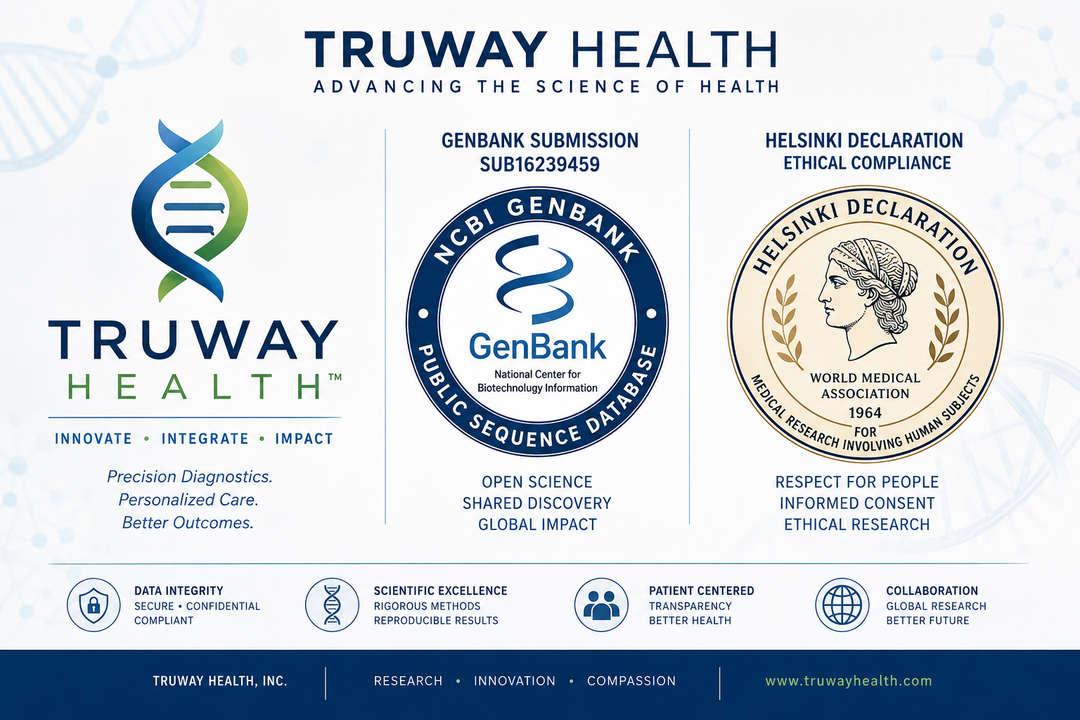
GenBank Submission: SUB16239459
Advancing Precision Diagnostics for Long COVID
Long COVID, formally recognized as Post-Acute Sequelae of SARS-CoV-2 Infection (PASC), continues to affect millions of individuals worldwide. Persistent fatigue, dysautonomia, cognitive dysfunction, exercise intolerance, neuropathic symptoms, and neuroimmune disturbances remain among the most challenging manifestations encountered in clinical practice.
To support ongoing scientific investigation into these conditions, Truway Health has completed the submission of genomic sequence data to the National Center for Biotechnology Information (NCBI) GenBank repository under Submission ID SUB16239459. This initiative represents an important milestone in our efforts to integrate genomics, diagnostics, and translational medicine into next-generation primary care workflows.
Building an Open Scientific Resource
The submitted dataset consists of whole-blood-derived human genomic DNA sequences collected from participants enrolled in the Truway Health Long COVID Cohort Study. The project was designed to establish a reference framework for future investigation of genetic factors that may influence susceptibility, symptom severity, recovery trajectories, and treatment response in individuals experiencing persistent post-viral illness.
Genomic data sharing remains a cornerstone of modern biomedical research. Public repositories such as GenBank enable researchers worldwide to access sequence information, validate findings, and build upon existing datasets to accelerate scientific discovery.
Why Genomics Matters in Long COVID
Although Long COVID presents with highly variable symptoms, several biological pathways have emerged as areas of scientific interest:
Neuroimmune Signaling
Research continues to explore how persistent immune activation and neuroinflammatory processes may contribute to cognitive symptoms commonly referred to as "brain fog." Understanding genomic variation within immune signaling pathways may provide insights into individual differences in disease expression.
Autonomic Dysfunction
Dysautonomia, including postural orthostatic tachycardia syndrome (POTS), has become increasingly recognized among Long COVID patients. Genomic analysis may help identify biological pathways involved in autonomic regulation and nervous system recovery following viral illness.
Endothelial and Vascular Health
Vascular dysfunction and altered endothelial signaling have been reported in subsets of Long COVID patients. The submitted genomic dataset includes annotation of ACE2-related regions, a pathway that continues to receive significant attention in SARS-CoV-2 research.
Neuropathic and Ion Channel Pathways
Persistent neuropathic symptoms and small-fiber neuropathy have prompted investigation into genes involved in neuronal signaling, ion channel regulation, and sensory processing.
Integration With TruDxPC
The genomic submission serves as a companion initiative to the Truway Diagnostic Tools in Primary Care (TruDxPC) program (NCT07209527).
Through TruDxPC, Truway Health is evaluating how advanced diagnostic technologies—including genomic analysis, imaging, laboratory testing, autonomic assessment, and clinical outcome tracking—can be integrated into primary care environments to improve patient evaluation and decision-making.
Future development efforts may explore:
-
Genomic biomarker identification
-
Precision diagnostic algorithms
-
Longitudinal symptom tracking
-
Functional neuroimaging integration
-
Multi-omics analysis
-
Predictive modeling of recovery pathways
Looking Ahead
The current submission represents an early-stage contribution to a rapidly evolving field of research. Future phases may include larger cohorts, expanded genomic coverage, transcriptomic profiling, proteomic analysis, and integration with clinical outcome datasets.
As scientific understanding of Long COVID continues to evolve, collaborative data-sharing initiatives remain essential for advancing diagnostics, improving patient care, and identifying new therapeutic opportunities.
Our Commitment
Truway Health remains committed to transparent, reproducible, and collaborative research. By contributing genomic data and supporting open-science initiatives, we aim to help accelerate discovery and foster meaningful progress for patients living with Long COVID and related chronic conditions.
Researchers, clinicians, and collaborators interested in learning more about our ongoing studies are encouraged to follow future updates from the Truway Health Research Division.
Research Program: Truway Diagnostic Tools in Primary Care (TruDxPC)
ClinicalTrials.gov Identifier: NCT07209527
GenBank Submission: SUB16239459
Organization: Truway Health, Inc.
Truway Health News & Insights

When Fall Feels Heavy: Seasonal Changes and Emotional Well-Being
Autumn arrives with golden leaves, cooler mornings, and invitations to get cozy. But you do not have...

The $20 Accessory That Can Sideline a $20,000 Device
The equipment has arrived. The team has cleared space, scheduled training, and prepared to put the n...

Can Your Sterile Storage Workflow Survive a Busy Monday?
It is 7:10 a.m. The first procedures are approaching, an add-on case has changed the schedule, and t...

Truway Health Surgical Instrument Kits & Trays: The Details Behind a Well-Configured Set
A surgical instrument kit is more than a collection of instruments. Its value lies in the details: t...

Introducing NeuroVista: Truway Health’s Research Platform for Imaging and Connected Medical Data
Understanding medical data requires more than a clear image or a single measurement. Researchers als...

Clinical Technology Outlook 2026–2030: From Isolated Measurements to Continuous, Connected Care
Clinical technology is entering a new phase. For decades, healthcare has largely been organized arou...