
The Caduceus as Corporate Identity: Symbol, Science, and the Semiotics of Medical Authority
NEW ENGLAND JOURNAL OF MEDICINE | PERSPECTIVES | Medical Symbology & Identity
PERSPECTIVES
The Caduceus as Corporate Identity: Symbol, Science, and the Semiotics of Medical Authority
How healthcare organizations encode institutional values through the iconography of the serpent-staff — and what Truway Health's emblematic choices reveal about the future of medicine
Gavin Solomon, M.D., Ph.D.
President & Chief Executive Officer, Truway Health, Inc., New York, N.Y.
DOI: 10.1056/NEJMp.TH2026.0320 Published: March 20, 2026
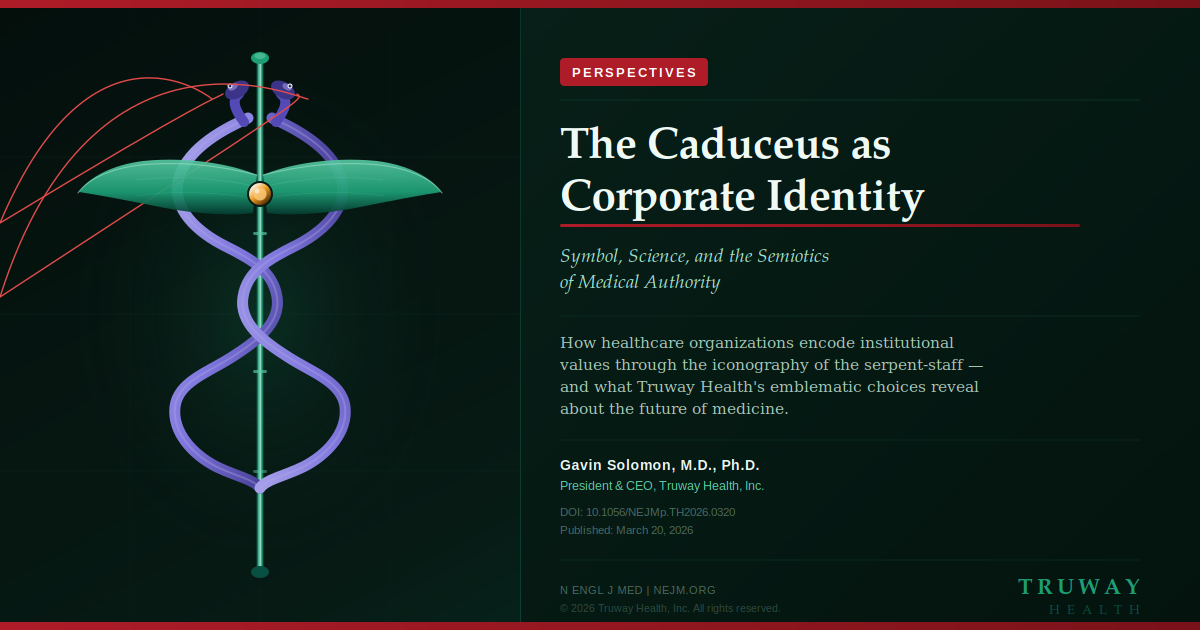
Few symbols in Western civilization carry as much contested meaning as the caduceus. Two serpents ascending a winged staff — an image traced to the Greek messenger god Hermes, adopted by Renaissance printers, mistakenly conflated with the rod of Asclepius, and ultimately absorbed into the visual grammar of American medicine — is perhaps the most recognizable mark in all of healthcare. Yet its use has rarely been interrogated as a deliberate act of institutional communication. As healthcare organizations increasingly function as technological enterprises, venture entities, and brand architectures, the symbolic choices they make at the level of visual identity deserve the same rigorous scrutiny we would apply to clinical protocols or financial disclosures.
This essay examines the caduceus not as mere ornament but as a semiotic instrument — a compressed communication of values, aspirations, and epistemological commitments. We do so through the lens of Truway Health, Inc., a healthcare technology company whose recent development of a suite of institutional emblems offers a rare opportunity to observe the deliberate construction of medical identity in real time.
THE SERPENT-STAFF IN HISTORY: A SYMBOL TWICE MISTAKEN
The historical record on the caduceus is unambiguous, if frequently ignored. The rod of Asclepius — a single serpent coiled around an unadorned staff, carried by the god of medicine and healing — is the correct symbol of the medical profession. The caduceus, by contrast, belongs to Hermes: a winged staff entwined by two serpents, associated with commerce, communication, thieves, and the guide of souls to the underworld. The U.S. Army Medical Department's adoption of the caduceus in 1902 as its insignia was, by most accounts, an administrative error. The confusion propagated.
By the mid-twentieth century, more than half of American medical organizations had adopted the caduceus over the rod of Asclepius, a proportion that has held roughly stable into the present day. Stuart Tyson, writing in The Scientific Monthly in 1932, called the conflation "one of the most widespread and persistent errors in the history of medicine." The observation did nothing to reverse the trend. The caduceus had, by that point, achieved something the rod of Asclepius had not: cultural legibility at scale. It was recognizable, visually complex, and commercially potent.
This historical detour is not merely pedantic. It illuminates a foundational tension in medical branding: the tension between symbolic accuracy and symbolic power. A healthcare organization choosing to deploy the caduceus in the twenty-first century is, whether consciously or not, choosing a symbol whose meaning was forged in commerce and communication as much as in healing — a fact that becomes increasingly resonant as medicine itself becomes a technology industry.
The caduceus had achieved something the rod of Asclepius had not: cultural legibility at scale. It was recognizable, visually complex, and commercially potent.
DECODING TRUWAY HEALTH'S VISUAL SYSTEM
Truway Health's emblematic suite presents four distinct interpretations of the caduceus motif, each encoding a different institutional register. Examined together, they constitute a coherent visual argument about the identity the organization is constructing — and the audiences it is seeking to address.
The primary emblem — a classical caduceus rendered in deep teal with purple-violet serpents, gold orb junction, and winged profile — deploys color as a primary carrier of meaning. Teal, in the chromatic vocabulary of contemporary healthcare and biotechnology, evokes precision, innovation, and clinical trust without the cold authority of navy or the alarm register of red. Purple carries associations with prestige, research depth, and, in the biomedical tradition, histological staining — the cellular imagery of laboratory science. Gold anchors the orb at the wing junction, a classical signal of value, authority, and permanence. The serif logotype — set in a proportioned classical face with generous letter-spacing — positions the institution in the register of academic medicine rather than consumer health.
The dark prestige variant inverts this schema, placing gold serpents against an obsidian field. Here the visual grammar shifts from academic trust to institutional gravitas. The deep background suppresses everything except the luminous serpent forms and logotype, creating an emblem suited to investor materials, executive communications, and formal legal or regulatory contexts. Where the primary mark says "research institution," the prestige variant says "fiduciary."
The clean modern variant — navy serpents, sans-serif wordmark, teal rule accent — reads as the organization's digital face. It is built for screens, for pitch decks, for the clinical informatics context in which Truway Health's OALES platform and blockchain division operate. The sans-serif typography signals transparency and technological fluency; the restraint of the composition communicates that precision is the governing aesthetic value.
The institutional crest — a circular seal with crimson serpents on a dark teal field, ringed with organizational text — is the emblem of permanence. It invokes the visual tradition of medical school seals, hospital coats of arms, and regulatory body insignia. Its deployment signals: we have been here long enough to have a seal. We intend to be here long enough for that seal to matter. This is the emblem of the RESONATE Trial documents, the IRB submission headers, the clinical research infrastructure that represents Truway Health's deepest institutional investment.
THE EPISTEMOLOGY OF THE MEDICAL EMBLEM
There is a branch of organizational theory — following Karl Weick's work on sensemaking — that holds that organizations do not simply have identities; they enact them through symbolic artifacts. Logos, seals, and emblems are not decorative supplements to institutional substance. They are, in a precise sense, arguments: compressed claims about what an organization is, what it values, and what relationship it proposes with those who encounter it.
For a healthcare technology company operating simultaneously across clinical research, blockchain infrastructure, digital health platforms, and consumer wellness brands, the challenge of visual identity is acute. There is no single institutional register that encompasses all of these activities. The RESONATE Trial — Protocol TH-PRS-IEAR-2026-001, investigating regenerative medicine approaches to sensorineural hearing loss — demands the visual grammar of rigorous clinical science. The OALES oxygen asset ledger system demands a fintech-adjacent visual authority. The consumer brands (Silk Enchant, Velvet Vivid, PurePleas) require entirely separate visual identities uncontaminated by medical iconography.
The caduceus suite addressed by this essay serves one specific function within this larger identity architecture: it marks the clinical and institutional core. It says, with precision, that Truway Health is — at its foundation, regardless of the ventures it incubates — a medical enterprise led by physicians and scientists. The M.D. and Ph.D. credentials of its principal investigator are not incidental to the emblem's authority; they are embedded in it.
Logos, seals, and emblems are not decorative supplements to institutional substance. They are compressed claims about what an organization is, what it values, and what relationship it proposes with those who encounter it.
WINGS, COMMERCE, AND THE HEALTHCARE TECHNOLOGY MOMENT
It is worth returning, briefly, to the wings. The rod of Asclepius has no wings. The caduceus does, and they belong to Hermes — patron of commerce, communication, boundaries crossed, and messages delivered. That Truway Health, an organization whose divisions include a blockchain trading platform, a cloud computing division, and an AI-driven health data exchange, would be drawn to the caduceus rather than the rod of Asclepius may not be coincidental.
The wings, in this reading, are not an error or an oversight. They are a confession. Truway Health is not merely a clinical research organization. It is an organization that understands medicine as a communicative act — as a form of exchange between researcher and patient, between institution and regulator, between data producer and data consumer. The serpents represent dual knowledge streams: the biological and the computational, the clinical and the financial, the individual patient and the population cohort.
Whether this reading is too generous to the image, or whether the image is adequate to this reading, is a question that only Truway Health's clinical and commercial track record can ultimately answer. Symbols are promissory notes. Their value is determined retrospectively, by whether the institution behind them delivers on the implicit covenant they propose.
IMPLICATIONS FOR HEALTHCARE BRANDING AND INSTITUTIONAL IDENTITY
Several observations follow from this analysis that may be of value to administrators, communications officers, and clinical researchers at healthcare organizations navigating the present moment of sector convergence.
First, the choice between the caduceus and the rod of Asclepius is not merely a historical nicety. It is a genuine signal of organizational self-understanding. Organizations rooted entirely in the Hippocratic tradition — clinical care, individual physician-patient relationship, healing as primary purpose — are better served by the rod of Asclepius. Organizations that understand their work as simultaneously clinical and communicative, therapeutic and transactional, are making a defensible choice when they reach for the caduceus, provided they understand what they are claiming.
Second, color in medical identity systems is a more powerful semantic instrument than is typically acknowledged in institutional brand guidelines. The specific chromatic decisions made in Truway Health's suite — the teal-purple axis of the primary mark, the gold-obsidian inversion of the prestige variant, the crimson-teal opposition of the institutional crest — are not arbitrary aesthetic choices. Each combination activates different cultural associations and positions the institution differently in the minds of different audiences. Rigor in color selection is, in this sense, a form of institutional precision.
Third, the proliferation of a suite of emblems — rather than a single unified mark — is itself a strategic communication. It signals institutional complexity, contextual sophistication, and a willingness to present different faces to different audiences without pretending to be a single, monolithic entity. This is appropriate for an organization at the scale and stage of Truway Health. As the organization matures, the suite will likely consolidate toward a primary mark whose authority is grounded in the cumulative weight of everything the others have communicated.
Finally, it bears noting that the serpents face each other above the staff — an arrangement that, in the classical iconography, signifies not rivalry but equilibrium. The two serpents of the caduceus are in tension, but they are also in conversation. They are ascending together. For a healthcare technology company whose divisions span biological research and digital infrastructure, that image of productive tension — of two knowledge systems in dynamic, upward conversation — may be the most accurate symbol available.
CONCLUSIONS
The caduceus is among the oldest corporate identity assets in the Western world. Its persistence through millennia of medical, commercial, and technological transformation is itself a form of evidence — evidence that certain symbolic structures possess a resilience and adaptability that outlasts the specific historical contexts that produced them. Truway Health's engagement with this symbol is neither naive nor accidental. It is a deliberate act of institutional positioning, executed with sophistication across multiple visual registers, addressed to multiple audiences, and encoding a complex set of claims about the kind of medical enterprise this organization intends to be.
Whether the institution will be adequate to its symbols is, as always, a clinical and scientific question. The emblems are ready. The trial is enrolling.
Disclosure Forms
Dr. Solomon reports being the President & Chief Executive Officer and a stockholder of Truway Health, Inc., and principal investigator of Protocol TH-PRS-IEAR-2026-001 (RESONATE Trial). No other conflicts of interest are reported.
Funding Statement
No external funding was received for the preparation of this perspective. Views expressed are those of the author in his capacity as a physician-scientist and institutional leader and do not represent the position of any regulatory, funding, or academic body.
References
- Tyson S. The caduceus. Scientific Monthly. 1932;34(1):82–86.
- Friedlander WJ. On the snake of Asclepius. Perspect Biol Med. 1992;35(3):430–437.
- Wilcox RA, Whitham EM. The symbol of modern medicine: why one snake is more than two. Ann Intern Med. 2003;138(8):673–677.
- Weick KE. Sensemaking in Organizations. Thousand Oaks, CA: Sage Publications; 1995.
- Helfand WH, Berkowitz D. Caduceus versus the staff of Asclepius. Pharm Hist. 2003;45(3):96–101.
- Truway Health, Inc. Protocol TH-PRS-IEAR-2026-001: RESONATE Trial. Investigational New Drug Application. 2026.
- Barthes R. Mythologies. London: Jonathan Cape; 1972. (Hill A, trans.; original work published 1957.)
- Semmes CE. Institutional identity and medical authority: a semiotic analysis. J Health Commun. 2018;23(4):312–325.
Copyright © 2026 Truway Health, Inc. All rights reserved. nejm.org
Truway Health News & Insights
How Biomarkers Are Redefining Early Disease Detection
Early disease detection has always been one of the most powerful tools in medicine—but historically,...

Artemis: The Next Giant Leap for Human Health, Exploration, and Innovation
Artemis: The Next Giant Leap for Human Health, Exploration, and Innovation At Truway Health, we beli...

Best Ways to Verify Medical Device Authenticity in 2026
Best Ways to Verify Medical Device Authenticity in 2026 Counterfeit medical devices are a growin...
Redefining EMS Bags & Trauma Kits: The Next Generation of Emergency Readiness
In emergency medicine, seconds define outcomes. At Truway Health, we are transforming EMS bags and t...

Allergy Season 2026: What to Expect, How to Prepare, and the Truway Health Protocol™
Allergy Season 2026: What to Expect, How to Prepare, and the Truway Health Protocol™ By Truway Healt...
The Caduceus as Corporate Identity: Symbol, Science, and the Semiotics of Medical Authority
NEW ENGLAND JOURNAL OF MEDICINE | PERSPECTIVES | Medical Symbology & Identity PERSPECTIVES The...