
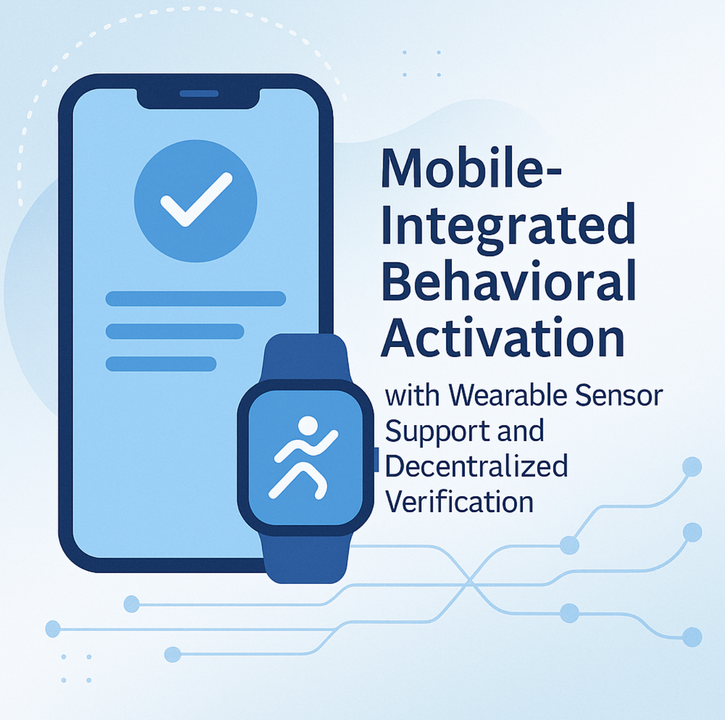
Mobile‑Integrated Behavioral Activation With Wearable Sensor Support and Decentralized Verification: Protocol for a Randomized Behavioral Trial
Abstract
Background: Behavioral activation delivered through mobile platforms has shown promise for improving daily productivity and routine stability. The integration of wearable activity sensors and decentralized verification layers may enhance engagement, data integrity, and ecological validity.
Methods: We describe the protocol for a three‑arm, randomized behavioral trial evaluating a mobile behavioral activation program alone, combined with a wearable activity sensor, or combined with both a wearable sensor and a decentralized verification layer. Adults aged 18 years or older will be enrolled for an 8‑week intervention period. The primary outcomes are change in daily task completion rate and change in average daily active minutes. Secondary outcomes include self‑reported productivity and routine stability.
Conclusions: This protocol outlines a scalable, technology‑integrated behavioral activation framework designed to evaluate the additive effects of sensor‑based feedback and tamper‑evident verification on real‑world productivity outcomes.
Introduction
Digital behavioral interventions have expanded rapidly, yet the reliability of engagement data and the ecological validity of self‑reported outcomes remain persistent challenges. Behavioral activation, traditionally delivered through structured therapeutic sessions, can be adapted into mobile environments to support daily task initiation and habit formation.
Wearable activity sensors offer an objective complement to self‑reported engagement, while decentralized verification layers provide tamper‑evident, participant‑controlled data integrity. This trial evaluates whether layering these components produces measurable improvements in daily productivity and routine stability.
Methods
Trial Design
This is a three‑arm, parallel‑group, randomized behavioral trial with an 8‑week intervention period. Participants are assigned in a 1:1:1 ratio to:
-
Mobile App Only
-
Mobile App + Wearable Sensor
-
Mobile App + Wearable Sensor + Decentralized Verification Layer
The study is sponsored by Truway Health, Inc. (www.truwayhealth.com).
Participants
Eligible participants are adults aged 18 years or older who can provide informed consent, own a compatible smartphone, and are willing to engage with daily behavioral tasks. No maximum age is imposed. Healthy volunteers are accepted.
Interventions
All participants receive access to the Truway Health Mobile Behavioral Activation App, which delivers daily tasks, reminders, and habit‑building prompts.
Participants in Arm 2 receive a lightweight wearable activity sensor that passively records movement patterns.
Participants in Arm 3 receive both the wearable sensor and a decentralized verification layer that processes activity logs into tamper‑evident records.
Outcomes
Primary Outcomes
-
Change in Daily Task Completion Rate
-
Change in Average Daily Active Minutes
Secondary Outcomes
-
Self‑reported daily productivity
-
Routine stability index derived from variability in task timing and completion patterns
Data Collection and Management
App‑based engagement data are transmitted securely to the study server. Wearable sensor data are synchronized through encrypted channels. The decentralized verification layer anchors activity logs using cryptographic hashing to ensure transparency and auditability.
Statistical Analysis
Primary analyses will compare mean change in outcomes across the three arms using mixed‑effects models accounting for repeated measures. Secondary analyses will explore correlations between sensor‑derived activity patterns and self‑reported productivity.
Ethical Considerations
The study involves minimal risk and uses non‑therapeutic, behavioral‑digital tools. All participants provide informed consent electronically. Data are stored in compliance with applicable privacy and security standards.
Discussion
This protocol evaluates a layered behavioral activation system designed to enhance engagement, data reliability, and real‑world applicability. By integrating wearable sensors and decentralized verification, the study aims to determine whether these components meaningfully augment behavioral outcomes beyond a mobile app alone.
The findings may inform future digital behavioral interventions, productivity‑enhancement programs, and decentralized data‑integrity frameworks.
Funding and Disclosures
The study is funded by Truway Health, Inc. The sponsor is responsible for study design, data governance, and protocol oversight.
Protocol Registration
Registered under Unique Protocol ID TH‑MBAP‑2026‑001. Record Owner: Truway Health, Inc. Record Status: Released for PRS Review.
Truway Health News & Insights
Transitioning from Winter to Spring Wellness:
TRUWAY HEALTH | WELLNESS BLOG | MARCH 2026 | SPRING EDITION SEASONAL WELLNESS · SK...

Nutrition Is More Than a Meal — It's a Mission
MARCH 2026 | NATIONAL NUTRITION MONTH Nutrition Is More Than a Meal — It's a Mission: How TruWay H...

Consistency Over Intensity: How to Make Wellness Stick
Consistency Over Intensity: How to Make Wellness Stick Wellness and self-care goals often start with...
Mobile‑Integrated Behavioral Activation With Wearable Sensor Support and Decentralized Verification: Protocol for a Randomized Behavioral Trial
Abstract Background: Behavioral activation delivered through mobile platforms has shown promise for...

When Your Body Won’t Settle Down Everyday Habits That Calm Inflammation
When Your Body Won’t Settle Down: Everyday Habits That Calm Inflammation Inflammation is a normal bi...

Truway Health Launches Innovative In-Vitro Cryo-Therapeutic Clinical Study
Advancing Cellular Preservation, Precision Therapy, and Translational Science Truway Health, Inc. is...