
Creating Your Personalized Health Roadmap: Break Bad Habits and Build Long-Term Well-Being
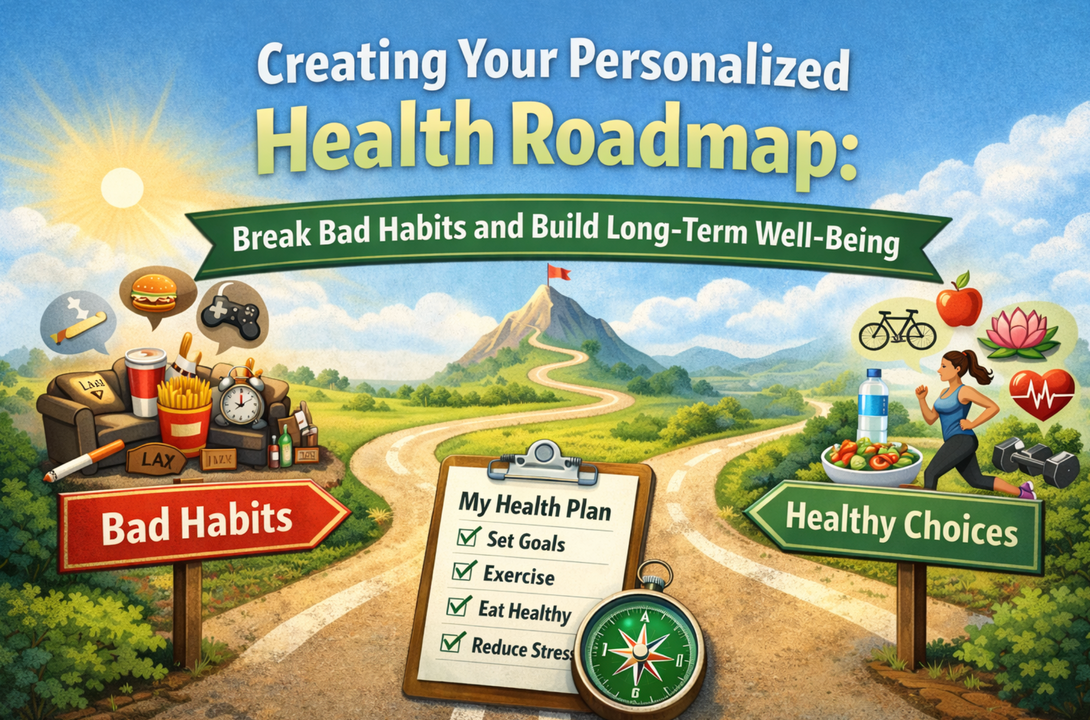
Creating Your Personalized Health Roadmap: Break Bad Habits and Build Long-Term Well-Being
Improving your health isn’t about quick fixes or extreme overhauls—it’s about designing a roadmap that reflects your reality, your habits, and your goals.
A personalized health roadmap helps you make lasting changes by aligning your daily actions with your deeper motivations.
Quick Takeaways for a Healthier Path Forward
- Define why health matters to you—purpose drives consistency.
- Focus on small, measurable actions instead of vague resolutions.
- Break one habit at a time to avoid overwhelm.
- Use digital tools to track progress and stay accountable.
- Plan for setbacks—they’re part of the process, not a failure.
Building the Foundation: Self-Awareness and Motivation
Before setting goals, clarify your why. Are you trying to manage stress, prevent disease, or boost energy for family and work? When motivation is intrinsic, your plan becomes more resilient. Write down how better health will change your daily life, not just your waistline.
Then, assess your current habits honestly. List the daily behaviors that support your health (like walking or meal prepping) and those that undermine it (like late-night snacking or skipping workouts). Awareness always precedes change.
How to Shape Your New Health Habits
Start by focusing on a single area that has the biggest ripple effect—sleep, nutrition, movement, or stress. Trying to fix everything at once creates decision fatigue.
Steps to Break an Unhealthy Habit:
- Identify triggers (stress, boredom, certain times or places).
- Replace (not erase) the behavior (swap scrolling for a short walk).
- Use “if-then” cues: If I feel tired mid-afternoon, then I’ll do five minutes of stretching instead of grabbing caffeine.
- Celebrate progress instead of perfection.
The Habit Transition Table
Here’s how to transform small actions into sustainable wellness gains.
|
Habit Type |
Common Example |
Healthier Swap |
Long-Term Payoff |
|
Physical |
Skipping breakfast |
High-protein smoothie |
Steady energy and fewer cravings |
|
Emotional |
Journaling or breathing app |
Better sleep and lower stress |
|
|
Nutritional |
Sugary drinks |
Infused water or herbal tea |
Improved hydration and metabolism |
|
Social |
Weekly walk with a friend |
Accountability and mental health |
Even one change in each category creates momentum across your entire lifestyle.
Using Digital Tools to Strengthen Accountability
Designing your roadmap digitally makes it dynamic and adaptive. Tools that allow you to log, visualize, and adjust your habits bring clarity and motivation. You can use browser-based PDF tools to create, edit, and update your personalized health roadmap. Converting your handwritten goals or trackers into PDFs makes them portable and editable anywhere—perfect for reviewing progress each month. You can annotate milestones, compress updates, and add new reflections without starting from scratch.
Digital planning also keeps your goals visible, syncing across devices and ensuring your wellness roadmap evolves as you do.
A Simple Checklist for Long-Term Success
Keep this list visible as a self-check every few weeks.
Your Personal Health Roadmap Checklist:
- I’ve written down a clear, specific health goal.
- I know the key habits I’m replacing or building.
- I track progress weekly using an app or digital planner.
- I’ve identified one supportive friend or accountability partner.
- I review and adjust my plan monthly to stay aligned with my lifestyle.
This checklist helps you measure progress without judgment—only direction.
Real-World Barriers and How to Overcome Them
Breaking bad habits can trigger resistance, both mental and emotional. Expect friction—then plan for it.
- When motivation dips: Revisit your “why” or set a short-term reward.
- When time feels tight: Attach new habits to existing routines (walk during calls, stretch while the coffee brews).
- When perfectionism strikes: Focus on consistency, not streaks—missing one day isn’t failure.
Resilience grows from forgiving yourself faster and restarting sooner.
Beyond the Plateau FAQ — Common Roadmap Questions
Even with a plan, doubts creep in. These answers keep you moving forward.
- What’s the best first step if I feel stuck?
Start with one daily action that feels easy. Momentum beats intensity. Each win reprograms your brain for consistency. - How long does it take to break a habit?
Research suggests around two months of repetition. But the real milestone is when the new behavior feels like part of your identity—not an effort. - How can I tell if my plan is realistic?
If it fits your schedule and doesn’t rely on constant willpower, it’s realistic. The best plan is the one you’ll actually follow. - What if I backslide into old habits?
That’s data, not defeat. Identify what triggered the lapse, adjust your strategy, and restart the next day. Progress isn’t linear. - Should I track everything digitally?
Track the metrics that motivate you—steps, meals, sleep—but skip over-detailing. Simplicity keeps you consistent. - When do I update my roadmap?
Revisit monthly or after major life changes. Evolving goals mean your roadmap should evolve, too.
The Takeaway
Your health roadmap isn’t a one-time project—it’s a living system that adapts as you grow. Each choice, each tracked habit, and each reflection brings you closer to your ideal state of well-being. Progress doesn’t require perfection—just persistence.
Design it, track it, and live it—one intentional habit at a time.
Truway Health News & Insights

How to Improve Your Home’s Air for Healthier Lungs and Happier Kids
How to Improve Your Home’s Air for Healthier Lungs and Happier Kids For healthcare professionals, me...

Regenerative Neuro-Auditory Therapeutics for Sensorineural Hearing Loss
Regenerative Neuro-Auditory Therapeutics for Sensorineural Hearing Loss Early Clinical Evaluation in...
Transitioning from Winter to Spring Wellness:
TRUWAY HEALTH | WELLNESS BLOG | MARCH 2026 | SPRING EDITION SEASONAL WELLNESS · SK...

Nutrition Is More Than a Meal — It's a Mission
MARCH 2026 | NATIONAL NUTRITION MONTH Nutrition Is More Than a Meal — It's a Mission: How TruWay H...

Consistency Over Intensity: How to Make Wellness Stick
Consistency Over Intensity: How to Make Wellness Stick Wellness and self-care goals often start with...
Mobile‑Integrated Behavioral Activation With Wearable Sensor Support and Decentralized Verification: Protocol for a Randomized Behavioral Trial
Abstract Background: Behavioral activation delivered through mobile platforms has shown promise for...